The Nightshirt Sightings, Portents, Forebodings, Suspicions
The Amazing Reality of Dream Precognition
Reposted with permission from Inner Traditions’ “Off the Shelf” blog.

Throughout history and in most if not all cultures, the phenomenon of dreams seeming to foretell future experiences—what we now call precognitive dreams—has been accepted as a normal, even unremarkable, feature of sleep. Yet mainstream psychology continues to deny—or at least ignore—this belief.
I’m here to tell you, with great confidence, that the skeptics are wrong. It is not just superstition or wishful thinking. There is overwhelming evidence that dreams can and do foreshadow experiences ahead in one’s life. For the past 10 years I’ve been collecting and studying this evidence. Here are just a few publicly available examples, to whet your appetite:
A retired London art teacher named David Mandell awakens from a terrifying dream on September 11, 1996, about two tall towers crashing to the ground in some kind of explosion or earthquake, and paints the scene in watercolors. He also has himself photographed with his painting in front of the clock at his local bank—a habit he developed to authenticate and date his dream-paintings, since they often predict the future. Six months later, he has another similar dream, and then the following year he dreams about planes crashing into buildings. (He paints these as well.) He is stunned on the morning—or for him, afternoon—of September 11, 2001, when the scene from his dreams unfolds in real time on television, five years to the day after he first dreamed of it.
In November 16, 1995, astronomer Paul Kalas dreams about a strange, highly asymmetrical debris ring around a distant star. He writes the dream and draws a picture of the debris ring in his dream journal. Nine years later, almost to the day, he makes a landmark discovery of a highly off-center debris ring circling the star he is then studying, Fomalhaut, and finds that the Hubble Space Telescope photograph closely matches the drawing he had made of his dream. His discovery of this unique debris ring leads to the first photograph of an exoplanet in visible light—a planet that he had predicted would be on the elliptical boundary of that debris ring.
After being struck by lightning in the parking lot of her synagogue in 1988, a Houston mother named Elizabeth Krohn starts to dream frequently about disasters that later occur, especially plane crashes. For example, on January 15, 2009, Krohn dreams of an American airliner—she thinks it is either Southwest or US Airways—crashing in the water in New York City. She emails herself the dream to provide a date and time stamp; she also tells her husband that, impossibly, the passengers are standing on the wing of the plane. Six and a half hours later, Captain Chesley “Sully” Sullenberger deftly pilots his damaged US Airways jet to a safe water landing on the Hudson River. Photos that went viral within minutes of the event show the lucky passengers lined up along the wings awaiting rescue by nearby boats.
Or perhaps my favorite: Long before his writing fame, 17-year-old Russian child of privilege Vladimir Nabokov loses his wealth in the revolution that swept away the old Tsarist order; but he dreams one night that the benefactor he had inherited his wealth from, his dead uncle Vassily, will come back to him as a pair of circus performers, “Harry and Kuvyrkin.” Over four decades later, now an émigré novelist making a modest living teaching literature at Cornell University, Nabokov learns that he is once again, for the first time since his youth, a wealthy man: Harris-Kubrick Pictures has bought the movie rights for his novel Lolita for a hefty sum. When anglicized, the circus performer Kuvyrkin in his dream would be Kubrick.
Experiences like these—and I could give you hundreds of similar ones—are head scratchers for sure. But no matter how amazing each example is individually, they don’t amount to much for most psychological scientists: they sound like anecdotes, not data. For nearly two centuries, since the advent of scientific psychology, most who try to bring objective tools to studying human behavior have denied that dreams could bring information about experiences ahead in the dreamer’s life.
It’s not that there’s actually any evidence against precognition. Quite the contrary: Researchers in the marginalized field of parapsychology have amassed statistically overwhelming evidence that it does exist. It’s just that such an idea runs counter to our culture’s taken-for-granted assumptions about causality: that it flows in a single direction, causes always preceding effects in time. Consequently, scientific psychologists and other skeptics will reach into a handy grab bag of well-known biases, and our general failure to understand statistics, to support their claim that dream-precognition claims are wrong. The fact that until recently there has been no well-understood physical theory that could make sense of such “backwards” experiences buttresses such dismissals—although that, as we will see, is changing.
The result is a massive truth gap when it comes to an activity we spend at least a few hours of every day doing: A divide between how mainstream psychologists and sleep scientists continue to attempt to explain dreams and dreaming (although to this day they have still never gotten their stories straight) and what many ordinary dreamers suspect, and some know beyond doubt, to be the case: that our minds/brains do in fact reach into our future when we sleep—astonishingly, sometimes even years or decades ahead in our lives.
The Citizen Science of Precognitive Dreamwork
“It’s a poor sort of memory that only works backwards.” – Lewis Carroll
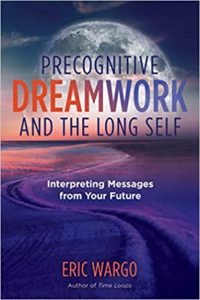
What I’m hoping to do in my new book, Precognitive Dreamwork and the Long Self, is change the conversation around dreams and dream precognition, in an effort to close that truth gap. As part of this, I’m inviting readers—ordinary dreamers—to play the role of citizen scientists, crowdsourcing the study of this until-now virtually unexplored reality of our minds/brains.
Examining precognitive dreams collectively and comparatively, a clear inner anatomy of precognition begins to emerge, like a skeleton in an X-ray. Precognition turns out to be governed by consistent principles—perhaps even laws—and we as citizen scientists can begin to enumerate them.
In the book, I list 27 principles that I and a few collaborators have thus far identified (readers of the book will undoubtedly be able to help add to the list) as a way of orienting dreamworkers at this early stage of our collective investigation. The basic method of precognitive dreamwork, however, can be distilled to three basic steps. You can start tonight (well, tomorrow morning), and it is really easy:
1) Write down whatever dreams you can recall upon waking.
2) Free associate briefly on each of the details in a dream (“what’s the first thing this reminds me of?”) and write those associations down along with the dream narrative.
3) Take a minute or two to revisit your recent dream records, from at least the last few days, at the end of each day.
Lots of people who are interested in dreams do the first step anyway. And if you have experience with psychoanalytic dream interpretation, the second one may come naturally as well. It’s the third step that nobody thinks to do, but it’s the one that will reveal to you that a not-too-shabby portion of your dreams (a quarter, by some estimates—I think it is much more) do clearly relate to subsequent experiences in your life.
Note I said experiences, not events. The most fundamental principle—Principle #1—is that precognitive dreams are not directly about events in the objective future; rather, they are about your own future experiences, including learning experiences. People who dream of disasters—like David Mandell or Elizabeth Krohn—are really dreaming about their own emotional experience of learning or reading about those disasters in the news or on the internet. By the same token, it is very common to dream about interesting (and totally fictitious) stories and pictures—movies, TV shows, and so on.
As a matter of subjective personal experience, precognition is really no different from memory. We don’t remember objective events like the Battle of Waterloo or the first Moon landing; we remember books we’ve read and movies we’ve watched and lectures we’ve listened to about those events. But our memory, as the White Queen suggested to Alice, really does go both directions in time. This is why it is misleading to think of precognition as a kind of perception (i.e., extrasensory perception or ESP); it is really our connection to our own future experiences, obeying most of the same laws that govern memory for experiences in our past.
Frequently the experiences foreshadowed in our dreams are imminent—the next few days, sometimes even within a few minutes of waking—but there are many exceptions. Another of the principles I discuss in the book is that some dreams relate to significant experiences exactly a year or multiple years later: what I call calendrical resonance. It’s mind-blowing the first time you experience this fact for yourself. It’s why the dreams in your dream journal need to be dated.
Importantly, information refluxing from our future is often couched in symbolism that, while obscure on the surface, can in many cases be decoded using insights from the long tradition of Freudian psychoanalysis. Although he was probably wrong about the purpose or function of dreaming—it’s not all about forbidden sexual thoughts—Sigmund Freud was right about the way we should approach decoding their symbolism. That second, free-association step above, asking what every dream element reminds you of, really opens dreams up like a key in a lock.
You will also find that dreams use playful puns and other substitutions to represent those future experiences and thoughts. And while it is a myth that precognitive dreams always feel numinous or special—they don’t—they do sometimes quietly announce themselves using symbolism involving time travel or other kinds of anachronisms. Looking for time gimmicks in your dreams will help clue you in that you may later discover that a dream was about some later experience.
Among the ideas I will attempt to persuade you of in my book, in fact, is that what Freud and his psychoanalytic school called “the unconscious” is really mainly the aspect of your memory that is from your future. Pretty much all of the phenomena that occupied Freud’s attention, in fact—dreams, slips of the tongue, obsessions and neuroses, creative inspirations, and so on—are manifestations of your future conscious thoughts, experiences, and discoveries refluxing in time to affect you in the present.
Oh, and yes, synchronicities. A section of the book describe how we can explore precognition via meaningful coincidences that punctuate your lives. You may even find that odd and amazing synchronicities have already led you to this subject, and to this article.
Your Tesseract Brain
How can it be that future experiences affect us in the present?
Mainstream psychologists haven’t gotten the memo yet, but it turns out that physics is starting to support such a possibility.
For instance, in 2009, an amazing experiment at the University of Rochester seemed to show that laser light could be amplified in its past by measuring it in the present (!). Over the past two years, Julia Mossbridge, a researcher on precognition and the physics of retrocausation, has gathered data using a tabletop optical instrument she named “Amelia” that suggests that photons in the future interact with other photons in the past (another !, even a !!!, if her findings are supported by further research).
Meanwhile, researchers in the field of quantum information theory are now reporting—on an almost monthly basis if you follow the science news—that you can reverse the temporal sequence of a calculation in the spooky guts of a quantum computer. And, guess what gray, squishy, grapefruit-sized organ is increasingly thought by some biologists to be a biological quantum computer?
With its 150 trillion synaptic connections controlled by exponentially more, possibly quantum-computing molecular microtubules, the brain, I believe, is a tesseract: a four-dimensional tunnel extending through your whole life and carrying information in both directions, from future to past as well as past to future.
The reality of precognition means that you are in constant contact with the whole span of your biography, your long life on Earth. Your future experiences already are encoded—although symbolically—in your head right now. And by the same token, your past is being (/has been) influenced by your experiences today.
Sit with that last one a moment: Just as future emotional upheavals in your life affect your present via your dreams, your present thoughts are now shaping—or did shape—your past. Amazing, right? It means that you really are a time traveler, literally.
That dated dream journal, which I precognize you are going to start compiling tomorrow, is your time machine.
What Is the Long Self?
The fascinations of precognitive dreamwork go way, way beyond identifying individual precognitive dream “hits.” Although those are incredibly exciting, far more amazing is what those instances of precognition reveal about you and your life.
You are far more than what you imagine you are, limited to whatever you are consciously experiencing in the present moment. You have a future, even a long future, and it is already here. You also have a past that is still here. The great adventure of precognitive dreamwork (and precognitive lifework) is directly experiencing that vastness and value of our lives and our stories.
It is truly a gnosis for the 21st century—a time when we are on the advent of socially transformative precognitive and even time-traveling technologies. We will be rewarded in this four-dimensional future by thinking four-dimensionally about our own bodies, our own minds/brains, and our own biographies. In dreams, we come face to face with our older, wiser, more knowledgeable selves. And while we never knew it, our younger selves were always coming face to face with us now, while we slept.
What are you waiting for? Don’t wait to read my book: You can start tonight, by putting a pad and pen by your bedside—as well as carrying a notebook with you during the day to record those synchronicities. Your future is literally awaiting you.
Actually, you are already there.
The Passion of the Space Jockey
Alienated Sentience and Endosymbiosis in the World of H.R. Giger
by Eric Wargo
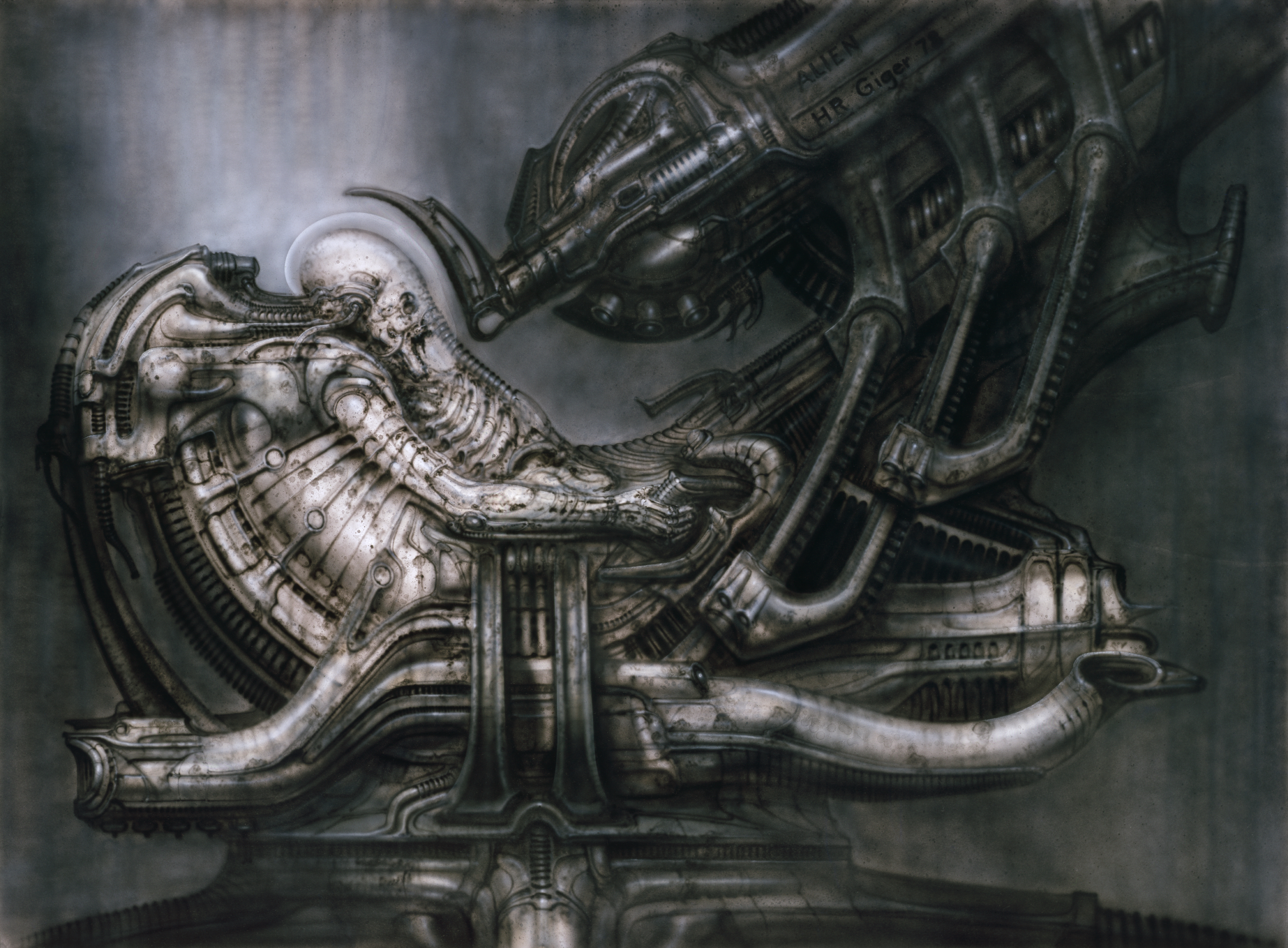
H.R. Giger, Pilot in Cockpit, 1978, 100×140 cm, acrylic on paper
The following is a paper presented in 2018 at the Rice University conference Gnostic Afterlives in American Religion and Culture. A final, fully sourced version appears in the journal Gnosis: Journal of Gnostic Studies 5(1), 2020. Giger paintings are used with permission of Mr. Giger’s estate.
Any magazine-cover hack can splash paint around wildly and call it a nightmare or a Witches’ Sabbath or a portrait of the devil, but only a great painter can make such a thing really scare or ring true. That’s because only a real artist knows the actual anatomy of the terrible or the physiology of fear—the exact sort of lines and proportions that connect up with latent instincts or hereditary memories of fright …
—H.P. Lovecraft, “Pickman’s Model” (1928)
Everyone who had ever lived was literally surrounded by the iron walls of the prison; they were all inside it and none of them knew it.
—Philip K. Dick, VALIS (1981)
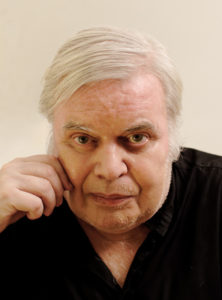 It will come as no surprise to those familiar with the art of the Swiss painter Hans Ruedi Giger (1940-2014) that from childhood through much of his adult life he suffered frequent, horrifying nightmares. He dreamed of being trapped in narrow passageways, of being chased by devils, of objects like lavatories coming alive to devour or castrate him. He often explained that his paintings were attempts to exorcise these visions, getting them out of his head so he wouldn’t be so frightened of them.
One may thus be reminded (as with many great artists) of the famous, psychotherapeutically sage saying of the Gospel of Thomas: “If you bring forth what is within you, what you bring forth will save you. If you do not bring forth what is within you, what you do not bring forth will destroy you.” Giger saved himself, certainly from neurosis and perhaps from worse, by bringing forth what was within him and inhabiting it, putting it on his walls, adorning his world with his visions. He lived surrounded by his uniformly black art and sculptures, what would seem like a dark and oppressive environment—except people who met Giger were often surprised at his normality, and what a pleasant, gentle, ‘un-Giger-like’ person he was in real life. His self-exorcism thus seems to have been a success, and on many levels—for it was not only his own walls that came to be adorned with his nightmares.
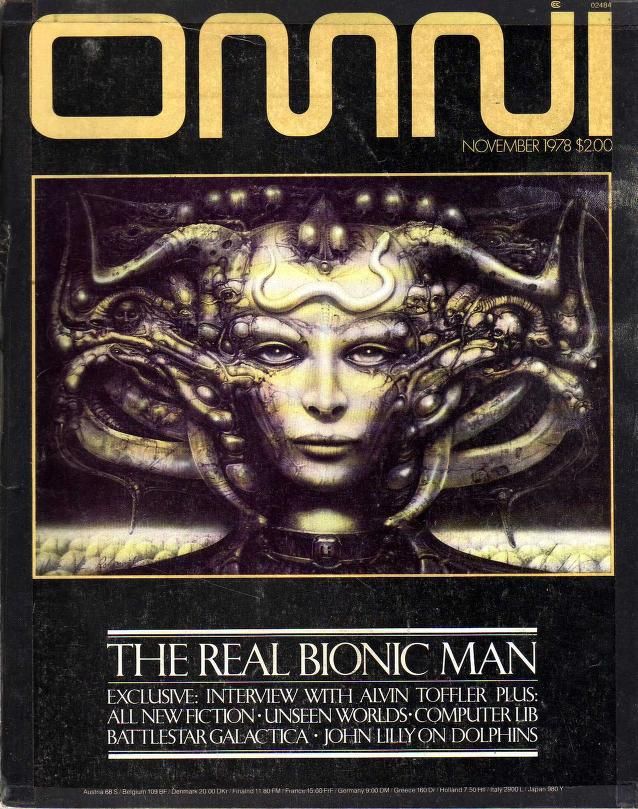 With his distinctive monochrome “biomechanoid” aesthetic, Giger in the 1970s singlehandedly gave birth to a whole new iconography of alienness, of the erotic possibilities of technology, and of its horrors. Giger’s visual style seems to have landed on this earth fully formed, an affront to our species and civilization that has only very slight precedents, for instance in Hieronymus Bosch, Francis Bacon, or the monochromatic and uncannily machine-like images of insects and cells seen under an electron microscope. Although bio-machines and cyborgs had already been staples of science fiction and futurism for decades, it was only when audiences first encountered Giger’s work in his designs for the movie Alien in 1979, as well as frequent features of his art in magazines of the time like Omni, that the public saw, clearly and fully, how the future of technology might be organic, and how the future of the organic might be technological.
Giger’s work is often called “Freudian,” using the term loosely, since whatever it is he is showing us, it seems to be the unconscious. But there is disagreement about just what unconscious—some properly Freudian unconscious of difficult-to-acknowledge personal anxieties and desires, or something more collective or even from deep time. Psychedelic explorers have been particularly drawn to Giger, since the artist was clearly exploring an outrageous but uncannily familiar interior terrain similar to that glimpsed in altered states. Czech psychiatrist and psychedelic researcher Stanislav Grof has been a major evangelist of Giger’s art, arguing that it shows us the pre-Oedipal trauma of birth, a literalized version of the psychoanalytic heresy that got Otto Rank ejected from Freud’s inner circle in the mid-1920s.(1) Timothy Leary, more closely to what I will be arguing in this paper, linked Giger’s work to “the unicellular politics within our bodies, our botanical technologies, our aminoacid machines. … Giger’s work disturbs us, spooks us because of its enormous evolutionary time-span. … He reaches back into our biological memories.”
Arguably no visual artist before Giger had created anything so spookily defiant of all the categorical boundaries that people in our culture at least, if not all humans, depend on for their sanity—such as the boundaries between the living and the artificial, or between the human and nonhuman.(2) Surrealism’s experiments in that direction tended to retain a playful, winking quality, whereas Giger’s art is distinctively realistic and, in most cases, serious. He was not engaging in mere provocation or play. He forced viewers to correlate all our mind’s contents—H.P. Lovecraft’s famous recipe for madness.
Even if his visual style was largely without precedent, it is not hard to situate Giger’s work intellectually and literarily. As a teenager, he gravitated to beat writers Jack Kerouac (On the Road) and William S. Burroughs (Naked Lunch). (It is easy to see a lot that is Burroughsian in Giger, especially in his pen-and-ink work from the early and mid 1960s.) As an adult, he gravitated to Kafka, Gustav Meyrink, and especially Lovecraft. The latter, along with the writings of Aleister Crowley and Éliphas Lévi, were important intellectual influences on Giger’s most characteristic and unsettling images from the late 1960s through the following decade.
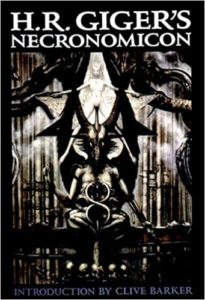 Giger was first introduced to Lovecraft in 1968, when he was invited to illustrate a Lovecraft fan magazine. His work from this point until the publication of his book Giger’s Necronomicon, in 1977 is probably his most characteristic and distinctively “Gigerian” art, and typically depicts either demonic alien beings, such as might be found (or alluded to) in a Lovecraft story, or else ritual altarpieces depicting the torture-slash-ecstasy of his lover and muse, actress Li Tobler. (Tobler, who suffered manic depression, committed suicide in 1975, at the age of 27.) The title of Giger’s book is that of the fictitious ancient grimoire that figured in many of Lovecraft’s stories. John A. DeLaughter points out that Giger seems very much like a belated embodiment of Lovecraft’s fictional horror artist Richard Upton Pickman, who knew “the actual anatomy of the terrible [and] the physiology of fear—the exact sort of lines and proportions that connect up with latent instincts or hereditary memories of fright.”(3)
If there is an origin trauma in Giger’s work, I suggest it is really the trauma of origins in the ancient Gnostic sense: of spirits who find themselves born, painfully, even hopelessly, into the world of matter, with all of matter’s pains, frustrations, and limitations. Many of Giger’s paintings depict humans, semi-humans, or vestiges of humans as parasites, forced to live immobile within a larger, vaguely architectural or technological host, imprisoned for some diabolical and unknowable purpose. Bound women, deformed babies, and monstrous mutants are fettered to each other or to the environment or locked in enforced coupling with machines; the eyes of the figures are often turned up, white, frozen in a gaze that is very much like that of someone drugged or in the midst of orgasm. An impression viewers may have is that Giger is showing us the result of some unspeakably diabolical science experiment, bioengineering as an evil occult ritual.
These entrapped, tortured beings, fused to their environments and to each other, seem like perfect visual illustrations of existence in what the famously Gnostic writer Philip K. Dick called the “black iron prison.” Often mutilated or partial, with no apparent hope for ever getting out of their prison, the figures in works like National Park I (1975), the Spell (e.g. The Spell II) (1974) and Passage-Temple (e.g. Life) (1974-5) series, or A. Crowley (The Beast 666) (1975) look as though their whole reason for being has been reduced to pure suffering, or else a kind of enforced ecstasy that is somehow the opposite of pleasure.(4)
In the stereotypical Gnostic origin myth, the fall of spirit into matter is the fault of a demiurge, an evil lesser deity who wants to rule and enslave his subjects. Importantly, Giger’s work does not simply show us the results of this fall; it forces the viewer to directly identify with the malevolence responsible. Unlike the bulk of post-Renaissance realistic and even surrealistic art, in which the viewer is implicitly displaced and decentered, an incidental or accidental witness to a scene, Giger reverts to the central constructions of the first perspectival paintings and altarpieces, in which the viewer is addressed as the One for whom this visual feast has been laid. Thus, we are seduced to identify with the cruel demiurge, to see that we are Him (using the gendered pronoun intentionally), enjoying these creatures’ pain and suffering.
By bringing forth what was in him, Giger showed us perhaps what it is we are all really frightened of: not suffering as such, but our own capacity to inflict suffering on others and, more troublingly, to enjoy it. As soon as we find ourselves enjoying the beauty of Giger’s work, then we already find ourselves guilty as charged.(5)
Endosymbiosis
While the “fall of spirit into matter” seems like a purely theological or mythic narrative, it has an uncanny reflection in what has become the accepted, fully materialistic account of the origins of complex life forms on Earth. The theory, first proposed by the Russian botanist Konstantin Mereschkowsky in 1926 and then supported by the discoveries of biologist Lynn Margulis (below) in the early 1970s, is now entrenched in biology textbooks: Over two billion years ago, changes in Earth’s environment such as an increasingly oxygen-rich atmosphere led bacteria to adapt in new ways, including by merging and coopting each other, sharing their genes and unique bacterial talents. Through a process called endosymbiosis, independent creatures engulfed each other and “grew together”—most often, perhaps, pointlessly and painfully, but every now and then forming mutually beneficial and stable unions that shaped subsequent life. This was the origin of the first complex, nucleated cells or eukaryotes.
 All the nonbacterial cells in our bodies have internal organs—the term is organelles—that were originally independently living creatures or parts thereof. For example, the mitochondria that equip our cells to use oxygen for energy were originally freely living aerobic bacteria; they still contain their own DNA distinct from that found in the nucleus, and genetic analysis has found that they are closely related to the modern bacteria that cause typhus. Similarly, the chloroplasts that enable plant cells to convert energy from sunlight were once light-harvesting cyanobacteria floating freely in oceans and fresh water.
Still a matter of debate is the origin of another type of organelle, the microtubules that control cell division and movement and that are thought by anesthesiologist Stuart Hameroff and physicist Roger Penrose to be the quantum-computing substrate for consciousness. These perfect tubular lattices are incredibly numerous and complexly arrayed in neurons, where they control a number of functions including reshaping the synapse during learning. They also form the cilia and flagella through which many other kinds of cells sense their environment and, in cases like sperm, propel themselves through it. Margulis argued that these structures were originally freely living spirochetes, distant ancestors of syphilis. Because they lack their own DNA, it has been impossible to prove the endosymbiotic origins of microtubules definitively, but it makes a beautiful—and Gigerian—kind of sense that our consciousness, or our spirit, may have originally been bacterial (indeed a venereal disease) and that it was imprisoned in larger hybrid unions because it was highly useful to the collective.
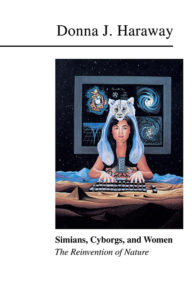 The theory of endosymbiosis contrasted sharply with the old-school Darwinian understanding of evolution as driven solely by competition between individuals. The real evolutionary action occurs, Margulis argued, when cells swap and exchange their genetic material in new endosymbiotic unions. Her work could thus be situated within the larger poststructuralist and feminist embrace of hybrids and novel forms of affiliation that captured the academic imagination in the 1970s and 1980s. One could cite Deleuze and Guattari’s “rhizomes” in their 1972 book Anti-Oedipus and Donna Haraway’s 1985 “Manifesto for Cyborgs” as expressions of the same reveling in new biological and technological metaphors of multiplicity, merger, and affiliation that escape preexisting codes of culture and patriarchy. Like Haraway’s cyborgs, Margulis’s story about our merging bacterial ancestors is inspiring and cool … as long as you hold it at a 2-billion-year arm’s reach. Can you imagine the horror of being forced to live out your life immobilized inside another organism?
Giger’s art directly captures this horror implicit in endosymbiosis: sentience or spirit imprisoned and exploited. One could suggest that Stanislav Grof’s “birth trauma” doesn’t go back nearly far enough—that the real trauma depicted in Giger’s work is a collective memory of our bacterial ancestors’ engulfment in the primordial soup, the traumatic birth of eukaryotic cells. But Giger’s work carries a postmodern twist on this two-billion-year-old theme: the engulfing matrix is technological or architectural, not organic. Arguably the 20th Century depth psychologies readily invoked to explicate Giger’s work—Freudian, Jungian, Grofian—look in the wrong direction for trauma and even for origins: They look to the past (of the individual, of the species, or of life itself), when in fact they should be looking to the present or even to the future. Whatever the extent to which Giger was exorcising some trauma in his own or humanity’s collective history, he was also prophesying what may be the next phase in our evolution, a new and traumatic endosymbiotic journey: becoming a mere component in our machines, a kind of “fall into technology.”
Giger’s design work for the movie Alien, for which he remains best known, contains his most interesting statement of this dark Gnostic prophecy.
The Space Jockey
As all sci-fi nerds know by now, the story of Giger’s involvement with Alien really begins in 1975, with the Chilean-French director Alejandro Jodorowsky’s ill-fated attempt to adapt Frank Herbert’s sweeping sci-fi epic Dune to the screen. Jodorowsky had cast the eccentric and theatrical surrealist painter Salvador Dali (at astonishing expense) to play the Galactic Emperor, but in the course of the negotiations Dali showed the director some pictures by Giger, a young artist he admired. Immediately struck by the cruelty in Giger’s “ill art,” Jodorowsky sought out the Swiss painter to design the homeworld and castle of the evil Harkonnen family in his film. When the project was halted for lack of funding in 1976, a young American filmmaker whom Jodorowsky had hired to do his special effects, Dan O’Bannon (below), returned dejected to California, where in a few weeks of depression and desperation while living on a friend’s couch, he penned the first draft of a script called “Star Beast,” the seed of what ultimately became Alien.
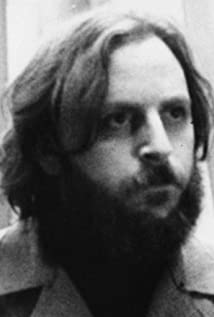 When O’Bannon’s script captured the interest of 21st Century Fox, hot on the heels of its unexpected success with Star Wars, he was quick to show the producers some works by Giger, whom he had met in Paris briefly during the Dune fiasco. Giger later admitted to O’Bannon that he had sent him the very first copy of his Necronomicon, hot off the presses, in hopes it would help persuade the producers, who were initially on the fence about his strange art. When the director Ridley Scott was brought on board to direct the film, he took one look at Giger’s book and was immediately sold. Two of its vaguely Lovecraft-inspired paintings, Necronom IV and Necronom V, for instance, were translated directly to the screen as the famous “xenomorph,” the adult form of the indestructible alien parasite that bursts from John Hurt’s chest and then decimates the crew of the Nostromo, a space tugboat hauling a load of ore bound for Earth.
O’Bannon could be said to have played the role of John Hurt’s Kane in this real-life alien story, serving as the host for Giger’s seed, carrying it from the wreckage of Jodorowsky’s Dune to 21st Century Fox and Ridley Scott. After a period of creative gestation, it burst out the chest of Alien in 1979 and has lurked in the ventilation shafts of our culture ever since. It also earned Giger an Oscar—a happy, well-deserved milestone in the artist’s life. Notably, Giger’s art from that point forward generally is less depressing and frightening and more explicitly erotic.
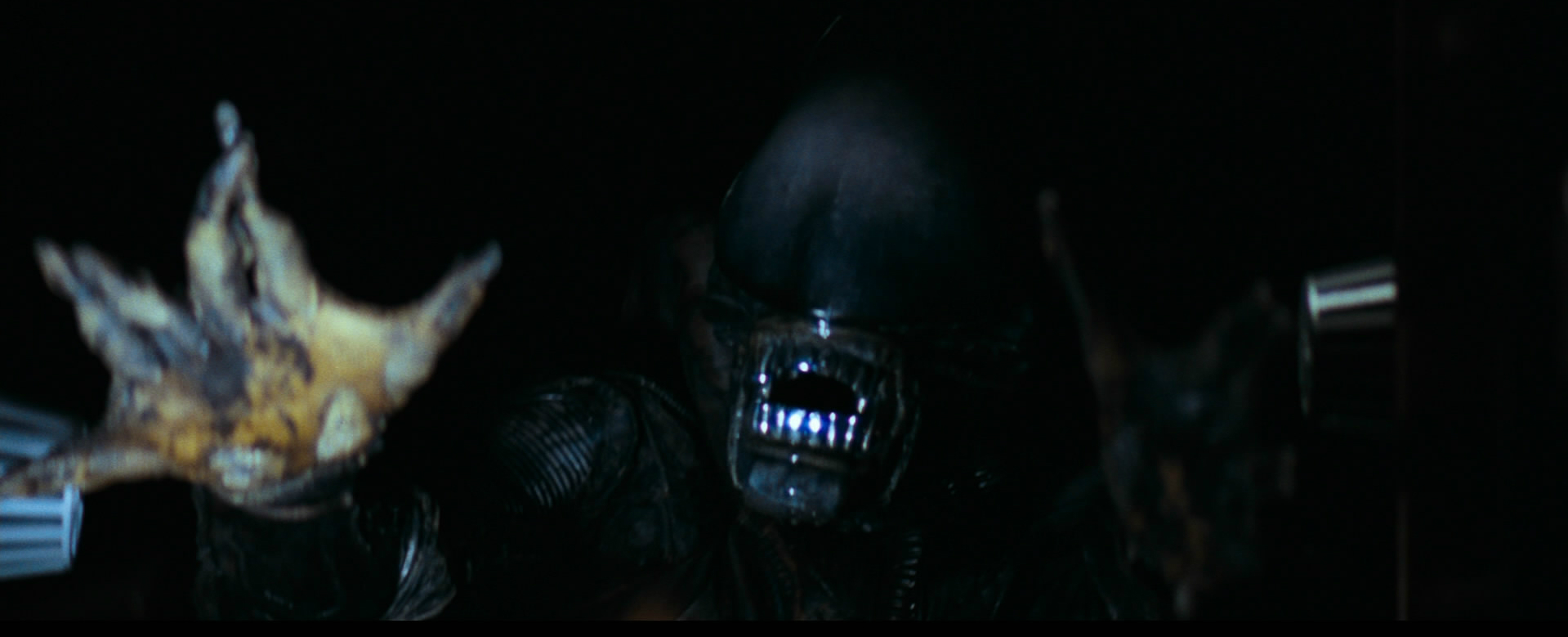 Plenty has already been written about the hyper-phallic morphology of the xenomorph, the deadly predator that continued its rampage over the course of three sequels and even some spinoff films. Yet the film’s most haunting image has received less critical attention: the giant fossilized star pilot (below, and top of this post), in whose derelict ship on a remote moon the astronauts find the xenomorph eggs. When the camera pulls back to reveal this ancient dead thing, merged with its seat, gazing eternally into its cockpit instruments, with a strange hole in its chest, it is one of the most spellbinding moments in sci-fi cinema. This literal “ancient astronaut”—which was dubbed the “Space Jockey” by the filmmakers—is also the clearest and most interesting object lesson in Giger’s work of the alien-ating possibility of machine endosymbiosis.
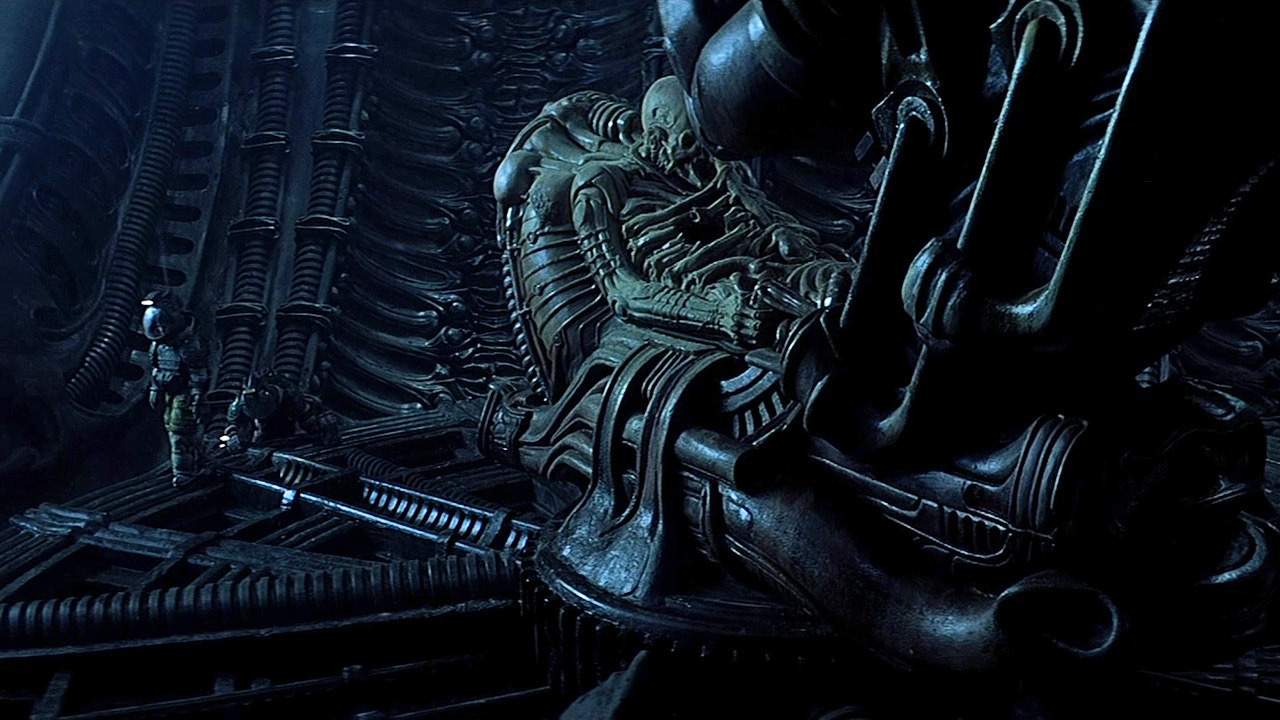 There are many unsettling dimensions to the Space Jockey’s morphology. For one thing, it is essentially an Ouroboros, with a “trunk” that connects its face to the front of its torso. Similar ouroboric or trunked beings appear throughout Giger’s Necronomicon and were explicitly the inspiration for the Space Jockey’s design. It is hard to pinpoint what is so unsettling or at least strange about these figures, but it may have to do with a kind of implied isolation, a self-sufficiency that is ambiguously either orectic or respiratory or sexual (or even all the above).(6)
More important is the Space Jockey’s fusion to its seat: This ancient astronaut appears that it could have had no existence, no purpose, no life, independent of its functioning as a sentient element in a ship—a pilot, but one that could never leave its cockpit, never get up and walk around. Giger was quoted in the debut issue of Cinefex magazine in 1980 as saying that the dead pilot is “biomechanical to the extent that he has physically grown into, or maybe even out of, his seat—he’s integrated totally into the function he performs.” In his book of designs for the film, he reiterated: “The pilot is conceived as one of my biomechanoids, attached to the seat so as to form a single unit.” In a DVD commentary, Ridley Scott described it similarly: “this Space Jockey I’ve always thought was the driver of the craft [who] has started to look like a perfect example of Giger’s mind, which is ‘where does biology end and technology begin?’” The director did not remain committed to such an interpretation, however, when he revisited this creature and its society in his 2013 prequel film Prometheus—which I will come back to in the Postscript.
The Future of Enjoyment
Giger was hardly the first artist or thinker to explore the hybridization of human and machine, but his art was distinctive in the 1970s for depicting this hybridization as something coerced and sadistic, a kind of torture or bondage, rather than the kind of benign augmentation or supplementation of the body by technology that was then being explored under the rubric of cyborgs. The artist noted that his pictures “always depict straps and cords and fettered bodies.”
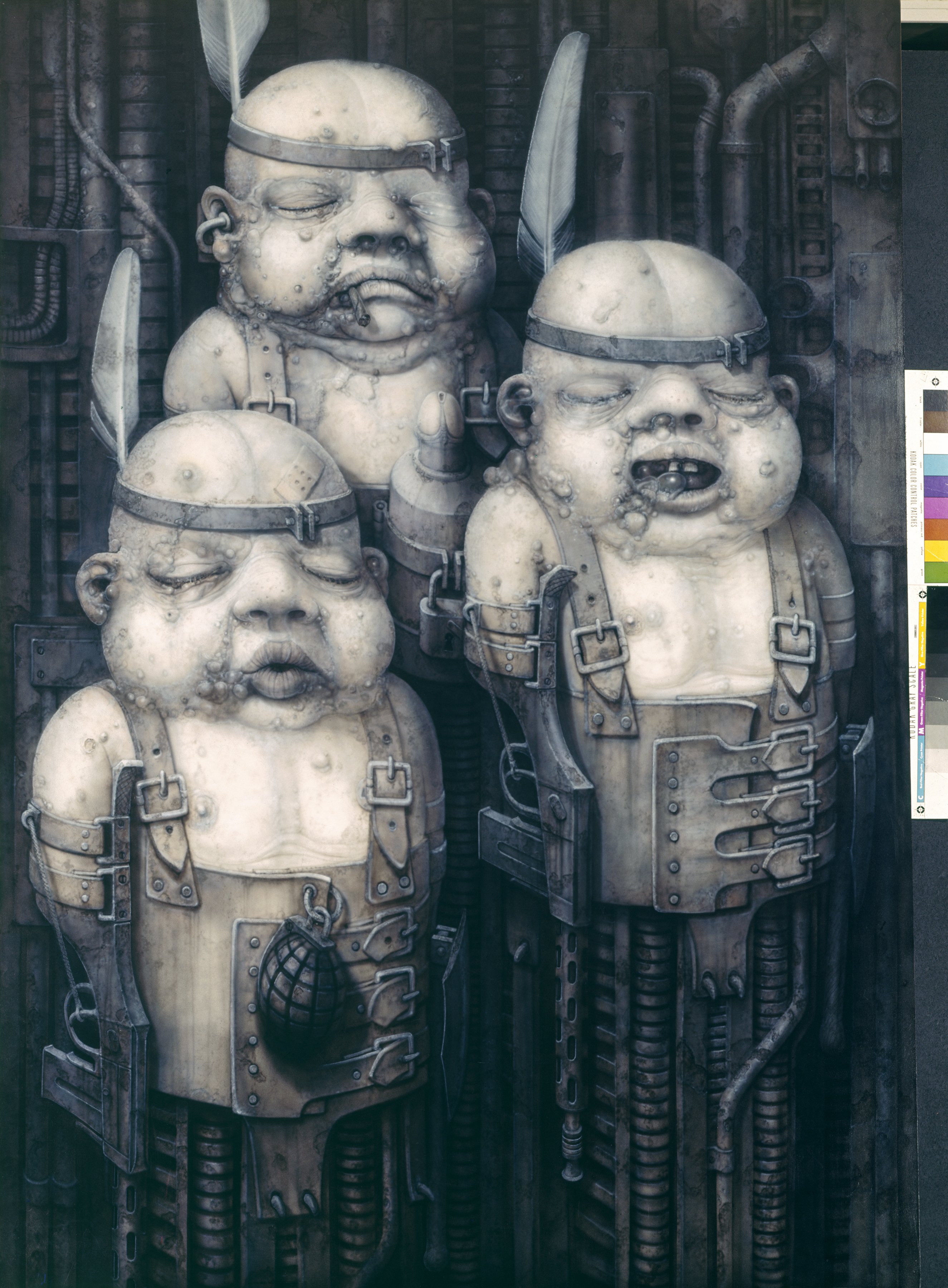 Giger’s 1974 painting Biomechanoid I for instance (left–Caption: H.R. Giger, Biomechanoid I, 1974, 200×140 cm, acrylic on paper on wood) shows three deformed babies strapped and bound; Giger describes: “The three children wear an iron headband which holds the feather. The band is held together by a screw, so that they must play at Indians whether they like it or not…” This describes perfectly what is so strange and even sad about the Space Jockey: Just as Giger’s biomechanoid children have to play at being Indians whether they like it or not, the Space Jockey, in its “lifetime,” had to play at being a star pilot whether it liked it or not. It is commanding, giant, and powerful but also, at the same time, shackled and enslaved, and that makes it fascinating. We are left wondering about its role and its frame or presence of mind as it fulfilled that role. Was it lucid, writhing in pain as the xenomorph burst from its chest untold aeons ago? Or was it far away in some star navigator’s trance?
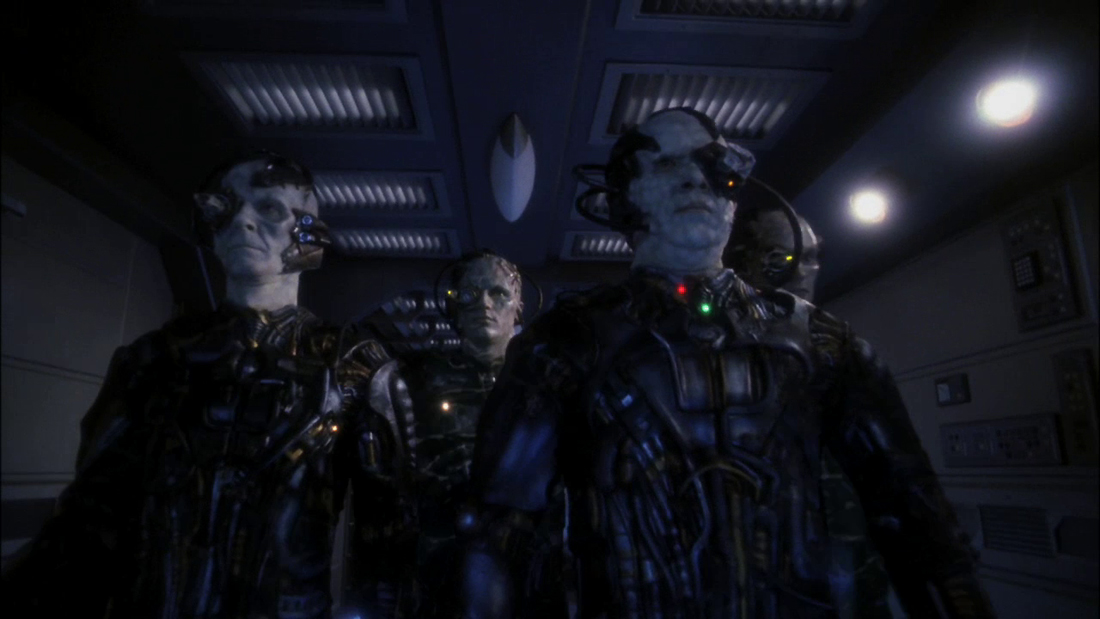 Giger’s iconography of human-machine symbiosis, with the interpenetration of black technology and pallid flesh, was hugely influential on the cyberpunk dystopias of the decades that followed Alien. Often in these dystopias, the mind was beguiled, distracted, or erased so that the individual’s physical labor could be exploited. Those assimilated by Star Trek’s Borg, for instance, have become zombie functionaries, usefully performing physical tasks without any independent will or feeling. It reflects an intuitive but perhaps simplistic model of “ideology”—as a kind of distraction or even emptying of the mind in order to more efficiently exploit the labor of the body or at least enforce obedience. Giger’s implicit fettering of the body to exploit the mind or spirit of a living being inverts and subverts such a picture, although it is not completely without precedent or parallel.
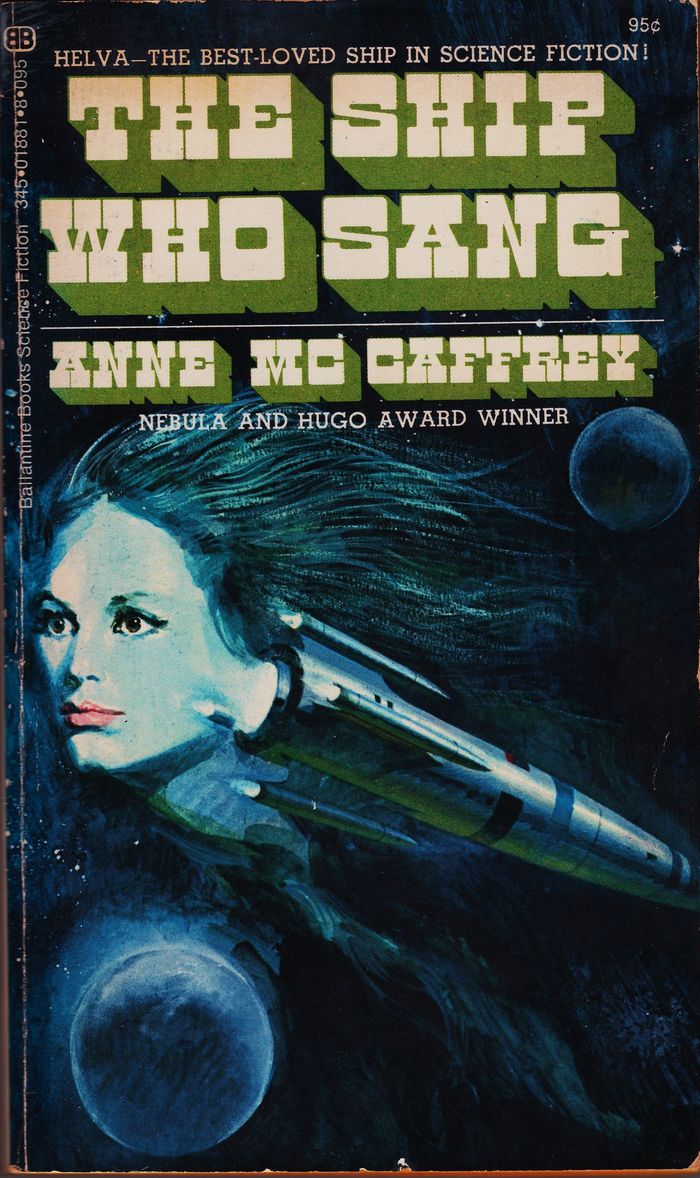 There is no sense that Giger was aware of it when he created the Space Jockey, but there is a minor but interesting tradition of sci-fi thought experiments about the symbiosis of mechanical ships and their organic, thinking, feeling pilots. Anne McCaffrey’s 1961 story “The Ship Who Sang” is a notable example. This story, and several sequels, describe the interstellar adventures, frustrations, and heartbreaks of Helva, a cyborg ship, the permanent fusion of the brain of a woman born severely physically disabled and the vessel for which she serves as the nervous system. The ship for her is a kind of prosthesis, giving her the ultimate freedom in one sense—space travel—but preventing the human contact a part of her soul yearns for. Unable to physically interact with her male pilot, her love for him can only be Platonic, and then she watches helpless as he dies in her airlock during a rescue mission.
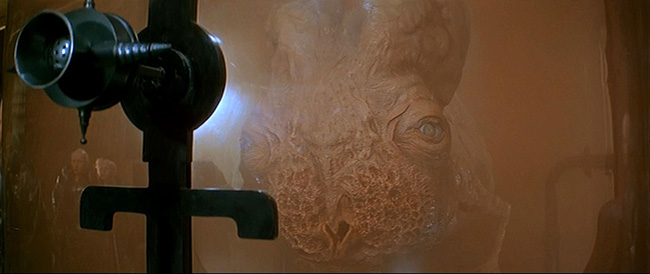 Other thought experiments make the organic pilot’s feeling, higher consciousness, or ecstasy integral to spaceflight itself. The once-human Spacing Guild navigators in Frank Herbert’s Dune series are worth mentioning here: Although not physically bound to the enormous space transport carriers they pilot, their drug-expanded oracular vision is necessary to navigate across distant light years due to an ancient prohibition on computers. More interesting though is David Lynch’s 1985 film adaptation, which made the Guild Steersmen’s role more radical: It is their trance itself that actually “folds space”; thus the mind and awareness are intrinsic to the fabric of spacetime. The important intuition being expressed here is that transcendence is equivalent to hyperspace. (This may have been a nod to Lynch’s twice-daily practice of descending into what he calls the “unified field” in Transcendental Meditation.) An even more explicit expression of this idea is Norman Spinrad’s 1983 novel The Void Captain’s Tale, in which a female pilot’s orgasm is integral to faster-than-light travel: Her ecstasy is literally the “jump” into the traversable void called the “Great and Only.”
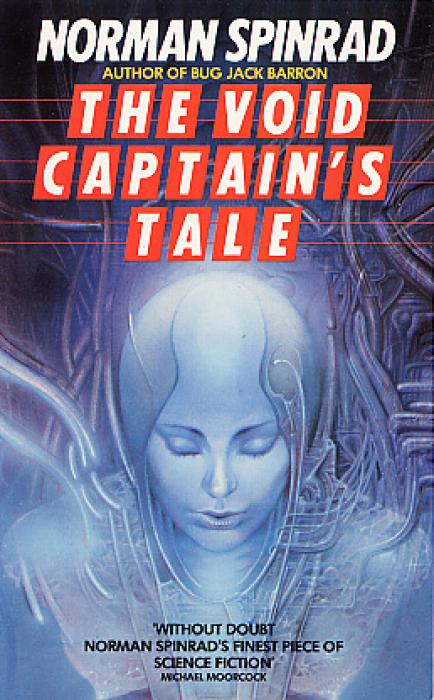 In these cases, it is not just advanced technology but a coupling of technology and human self-transcendence in trance or orgasm that is essential, that either shows the path or actually closes a circuit to make the ship go. To be “ecstatic” means literally to be outside one’s position, outside oneself—or to use a term that is increasingly popular these days, to be nonlocal.(7)
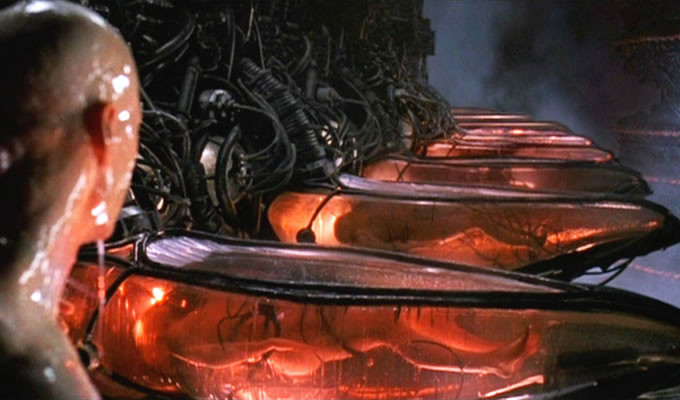
The most alienating variant of machines’ exploitation of something intrinsically human is of course that found in The Matrix—the Wachowskis’ quintessential “Gnostic” movie from 1999—where the minds of humans are distracted by a virtual reality so the energy of their bodies can be harnessed to power the underground world of our machine overlords. (Like the world of the Borg in Star Trek, The Matrix’s machine world, and the pods that contain its human batteries, below, are straight out of Giger, even though he did not work on the film and was not credited for inspiring its designs.) Slavoj Žižek pointed out the scientific absurdity of the film’s premise, as long as we take it literally: The human body generates about enough electrical energy to power a single energy-saving LED bulb (and also needs to be fed), making it totally useless as an energy source. The energy we are really talking about here seems to be jouissance, the painful pleasure or pleasurable pain so beloved of French theorists and that Jacques Lacan asserted was the “only substance” psychoanalysis really deals with. The usual English translation, “enjoyment,” misses the excessive, agonizing dimension of this ‘substance’—which the Swiss painter H.R. Giger, of all artists, seems uniquely to have been put on this earth to depict with his airbrush.
 Jouissance occupied an interesting position in Lacan’s theorizing, as the core or nucleus of human psychology. It was a kind of Moebius strip, where feeling ascends to ecstasy and then circles back on itself, ouroborically you might say, to become a kind of primitive, material, and mute drive. Sometimes called “surplus enjoyment,” on the analogy of Marx’s surplus value, Lacan’s followers like Žižek built a whole Marxian-psychoanalytic critique of political-economy around the infusion of political structures with this substance or energy and its ability to be extracted or exploited in late capitalism.
While we know nothing about the Space Jockey directly, we can infer not only from its morphology but from the orgasmic/addicted expressions of Giger’s other tortured biomechanoids that this being may represent the same basic idea or archetype as those creatures: alienated jouissance, a kind of helpless yet perhaps also ecstatic suffering of its materiality. Its sentient capacity to feel pain and frustration—and perhaps also pleasure—may not simply be an unhappy accident of being an organic creature embedded in a vast spaceship prosthetic. Its sentience—its jouissance or perhaps spirit—may even somehow be integral to that ship’s very functioning.
I am referring to something beyond simply intelligence, or the capacity to make decisions. Whether there is or is not really a “something beyond”—a spirit that can fall into matter (and by extension, technology) from some immaterial and timeless perch, or some je ne sais quois that sets spirit off from ordinary intelligence—goes to the heart of current debates about “consciousness” and the promises of transhumanism. The ecstatic suffering of Giger’s star pilot—the passion of the Space Jockey—offers an interesting, oblique perspective on these debates.
The well-known claim of inventor Ray Kurzweil, echoed in some form by many futurists and now even manifesting in Silicon Valley startup companies, is that we are on the cusp of twin achievements that will constitute a decisive—and positive—threshold for humanity: We will finally create conscious machines, and we ourselves will be able to shuffle off our meat envelopes, achieving a kind of immortality by uploading our minds to some more durable substrate. Kurzweil’s term for this historical-evolutionary event-horizon is the Singularity (or if you prefer, “rapture of the nerds”). It is a vision premised, of course, on the reductive view that holds consciousness to be nothing special or nonmaterial—just a certain threshold of intelligence that will be just as readily achieved in electronic circuits (or perhaps, quantum-entangled qubits) as it is in organic brains.(8)
Critics of such views are not hard to find, of course. Philosopher David Chalmers, for instance, holds consciousness to be much more than an epiphenomenon of complex computation, even something basic and irreducible. This argument rests on what are sometimes called qualia, the fact that there is something it is like to be alive and aware, and which the reductive theories sidestep or gloss over. While consciousness in this view may or may not be exactly like the pneuma of the ancient Gnostics (the divine spark that was older than the material, created world and was capable of being liberated from the body, e.g., in ecstatic states), today’s anti-materialists often embrace a similar dualism about mind as consisting not only of intelligence (perhaps more or less equivalent to the older term soul or psyche) but also some other basic level of awareness or experience that is distinct from and prior to it. Again, I am inclined to take Lacan’s jouissance as essentially the same thing—as spirit or consciousness, the thing that separates us from inert matter.
No amount of philosophical or scientific argument may be able to resolve these debates—whether consciousness is one thing or two, whether it is material or immaterial, or whether it even exists at all. But there may be a kind of Darwinian proof in the pudding: How adaptive will superintelligent machines be if their alleged consciousness just consists in the ability to pass Turing tests? We saw how something like “spirit” may have been a decisive addition to Proterozoic bacterial collectives. A possibility not broached to my knowledge in transhumanist writings (because it would probably seem senseless to most writers in that tradition) is that superintelligent AI could either discover through experience, or else infer through cold calculation, that it lacks something essential and “spiritual” needed for its own continued survival, something only flesh-and-blood humans can continue to supply.
In other words, if superintelligent machines prove capable of everything except consciousness in this enlarged sense, could our descendents become endosymbionts, or sentient organelles, in our technology? Might future humans find that their only purpose and function within larger biomechanical constructs (including spaceships) is their useful capacity for feeling and perhaps higher consciousness or ecstasy? Is late capitalism itself already such a machine? Giger’s world shows us this dark threat of cyborg endosymbiosis: not to be simply augmented by machines (or even simply replaced by them) but to be parasitized and engulfed by them in a kind of numbed ecstasy that somehow masks the violence being done.
Is this really worth worrying about?
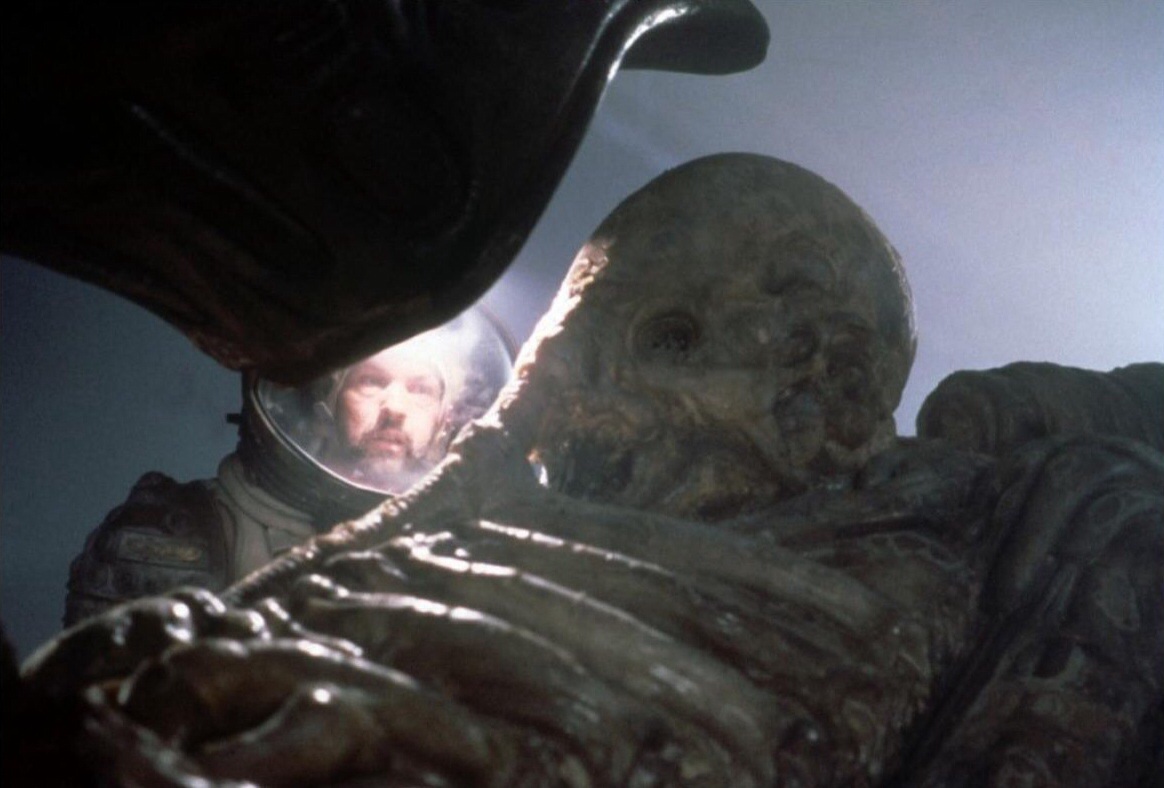 Consider one of the compelling mysteries about the Space Jockey: the uncertainty of just what it is the creature is eternally staring at. Is it an instrument display? A telescope? A gunsight? It has invited all these interpretations. Whatever it is, it so captured the Space Jockey’s attention that it died staring at the device, its hands still grasping firmly the controls.
The first steps of the trajectory leading to the Space Jockey’s fatal enrapture are visible already in the way we now find ourselves wedded to our own, more humble devices. Whatever freedoms our smartphones, etc., give us, we all know how most of the time our engagement with this technology is a kind of compulsion, not pleasure as such. We also know it is sometimes fatal: Escalating fatalities among motorists and pedestrians are being attributed to the inability to withdraw attention from smartphones, and according to the National Safety Council in 2015, it is estimated to cause over a quarter of auto accidents.
 This is exactly what Lacanian psychoanalysis means by surplus enjoyment—a kind of unpleasurable but irresistible drive “beyond the pleasure principle” that is the basis of addictive behavior and that can readily be coopted or extracted. Capturing and recapturing our attention in a drug-like way is not a new aim for media companies and developers of apps, but it is undertaken with increasingly scientific and diabolical precision (by companies with names like Dopamine, Inc.); one frequently hears the argument that this attention-grab is precisely what is scrambling and even destroying the possibility of gnosis (with a small-g) in the modern world, as well as making users increasingly susceptible to manipulation.
It is beginning to render The Matrix’s vision of humans immobilized in a virtual reality to capture their jouissance weirdly realistic. The Space Jockey too can be read the same way: as a warning about everything from cyborg modification of the body to drone warfare to video games and iPhones.
If we are going to merge with our machines, we obviously would want that “choice” to be conscious and deliberate, something that ultimately liberates and frees us. Donna Haraway suggested that even to hope for such a choice could be a mirage, because we have always been cyborgs: Language, culture, tools, all act on and in the body so thoroughly we could never unplug from them. But there are cyborgs and there are cyborgs. What Giger’s biomechanoids invite us to consider is that there may be no clear horizon beyond which augmenting technological aids or prosthetics become something more enveloping and total, able even to coopt our spirit by holding our attention and keeping us in a perpetual thrall of expectation.(9) As with the hapless mitochondria that power our cells or the quantum microtubules where our prophetic spirits may really reside, there could come a time when our descendants (like, one imagines, the Space Jockey and its kind) no longer remember a prelapsarian eon before they became mere components in their machines.
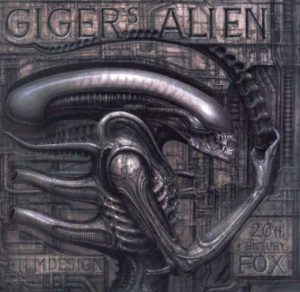 “If someone asks me why my pictures appear so terrifying, dangerous and scary,” Giger told an interviewer in 1985, “I always tell them that soon one day the world could look like this.” Only time will tell if the artist was right, and whether jouissance will continue to be what entraps us in technology, what liberates us from it, or some mix of both … or (who knows?) whether it could even somehow power our spaceships. But optimistic transhumanist promises of contented uploading—and even the darker but similarly materialist visions of being violently wiped out or quietly replaced by AI—ignore the deep and complex questions about spirit in relation to matter, and of materiality in relation to agony/ecstasy, and often appear ignorant of the great antiquity of efforts to address these issues. Giger, almost alone among visual artists in our time, confronted them from the very depths of his prophetic unconscious, to free himself of the nightmares that troubled his sleep.
Postscript: The Space Jockey Is Risen
In his book on the making of Alien, Ian Nathan attempts to describe the quality that made Giger’s ancient astronaut so compelling as well as sympathetic: “The jockey possesses an air both elegiac and hopeful—the universe might yet offer nonlethal alien contact. Quite why he was (and is) considered benign is hard to pinpoint, yet everyone who saw him mourned his passing—a lost soul staring through his telescope at the unreachable heavens forevermore.”
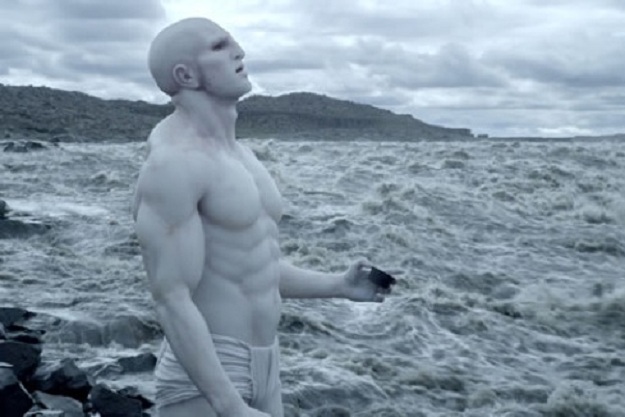 Unfortunately, Ridley Scott did not remain faithful to Giger’s (or his own) original vision for the Space Jockey when he revisited his Alien universe in 2013 to tell a new story related to the origins of humanity—or else life on earth (it isn’t really clear which)—as the result of bioengineering by this same race of ancient astronauts. When not wearing their exoskeletal spacesuits, these beings, now called “Engineers,” were revealed in Prometheus to be big, muscular, pale humans. The mysterious “seat fusion” was visually explained away as a bit of high-tech strapping-in to their cockpits. And a convoluted “bringing back the head” action set-piece revealed that what had looked for all the world like a like a mummified flesh hugging an elephantine alien skull (with teeth even visible in the jaw, in the original Alien) is really just an odd helmet.
In other words, what had been a vulnerable and imprisoned, weirdly ouroboric, vaguely benevolent, and utterly un-human-like creature was transformed into a totally buff, incommunicative (not to mention, incredibly white) Adonis, a grimly committed soldier still fighting some ancient interplanetary war. It is an aggressive, hypermasculine stereotype indistinguishable from the villains in virtually any other big-budget superhero or sci-fi blockbuster. For hardcore Giger fans, it was a kind of aesthetic vandalism, destroying the qualities that had made that dead creature in the original film so appealing as well as mysterious.
Prometheus’s scriptwriter Jon Spaihts admitted he did not feel adequate to the challenge of telling a story about ouroboric aliens fused to their machines. In an interview with Forbes magazine, he lamented that “All the mysteries [in Alien] have alien players: the exoskeleton nightmare and giant pilot of the ship, the elephantine titan that was called the ‘space jockey’ in the fan literature. How do you make anyone care about events between creatures like this?” It is questionable whether, by turning these creatures into pale humanoid killers, he and Scott really made audiences care more about these beings than if they had taken up the challenge of exploring a truly alien way of life. The bottom line seems to be that mainstream audiences—or at least mainstream filmmakers—really don’t know what to do with Giger’s biomechanical, endosymbiotic prophecy. Here, erasure was the expedient solution.
One may be reminded of the fate of Gnostic visions in antiquity: To be labeled heretical and then to be erased and destroyed, only to be rediscovered and pieced together much later from surviving fragments. No one has forgotten Giger himself, thankfully—two recent documentaries, Jodorowsky’s Dune and Dark Star, pay warm tribute to his vision and his influence on art and film design. But the meaning of his images, and their message for our time, is increasingly obscured by layers of cultural misdirection, obfuscation, and in the Space Jockey’s case, obliteration. Drawing Giger’s apocryphal Space Jockey gingerly from the sand, blowing the dust off it, I offer the above reading as one crucial portion of that movie’s authentic and forgotten teaching, a warning transmission to the future about the trajectory of the human spirit in relation to matter. It is a trajectory that, if we are not careful, may well mirror, painfully, our distant unicellular origins—a trauma whose memory, as Timothy Leary noted, may yet reside in all our cells.
NOTES
(1) Grof links Giger’s imagery especially to what he calls the “second perinatal matrix,” the terrifying violent contractions of the womb just prior to being forced out the birth canal. There is little evidence humans really retain memories as such from the perinatal period; if the stress of birth somehow lingers and shapes later life, it would become “traumatic” by being linked to later-learned ideas about (and cultural representations of) birth, the womb, the mother’s body, etc. Thus a better theoretical coordinate for Giger’s birth imagery might be Otto Rank’s original theorizing. Rank (1968) argued that it is not an individual’s literal, historical birth as such that is traumatic, but rather that birth serves as a universal symbol for traumatic separation and anxieties about individuation and self-expression throughout the course of life—artists being particularly subject to such anxieties.
In 1977, Giger articulated this self-insight about the nightmares that inspired his Passages series: “The only way out was to wake up. I subsequently painted some of these imaginary passages and since then have been spared this birth trauma. But the passages became for me a symbol of growth and dissolution in every possible stage of pleasure and pain …”
(2) Sci-fi artists and illustrators had previously drawn more on surrealism and Japanese art to figure “the alien.” The French Painter Yves Tanguy was a strong, acknowledged influence on the art of Richard Powers, whose illustrations for pulp sci-fi novels in the 1960s had a distinctly “alien” look (Frank 2001). The mid-century sculpture and design of Japanese-American artist Isamu Noguchi may also have influenced, for example, the alien environments on Star Trek.
(3) This arrow of influence—Lovecraft’s Cthulhu mythos to Giger’s Necronomicon—could be called an oblique Gnostic transmission, if some Lovecraft scholars are right that the horror writer drew major unacknowledged inspiration from the Theosophy tracts being widely and cheaply sold on the streets of New York City when he lived there in the 1920s. April DeConick (2018) calls Helena Blavatsky’s movement the “second alpha channel” by which ancient Gnostic ideas have been transmitted to modernity. Robert M. Price (1982) identified suggestive parallels between Lovecraft’s dark visions and Blavatsky’s work; and Christopher Loring Knowles has argued on his blog The Secret Sun that Lovecraft’s stories about ancient alien gods took inspiration even more directly from the writings of his contemporary Alice Bailey, particularly her 1922 book Initiation: Human and Solar. Bailey’s book consisted of revelations of a channeled Mahatma Djwal-Khul, who told of ancient alien beings coming to earth from the Sirius star system and shaping human evolution—their mode of locomotion being the Theosophical mainstay of astral travel. Lovecraft was just recasting this vision in black, Knowles argues, and giving these old wise travelers much more eldritch morphology and malevolence. He notes that Lovecraft’s young male readers would have been unlikely to notice the borrowing, considering the rather different target demographic of his source material.
(4) Giger was able to trace his adult obsession with such figures to a “living scarecrow” in a fairy tale his mother had read him as a boy: “I think this stake-bound life, for whom redemption meant as soon a death as possible, plainly showed me the senselessness of existence. An existence better never begun. Many of my works reflect this state of hopeless enslavement which leaves no room for religious beliefs.” Some of Giger’s adult nightmares were also provoked specifically by horrific photographs of a Chinese execution in The Tears of Eros by Georges Bataille, which a fellow art student showed him and that he wished he had not looked at.
(5) Tricking the viewer into identifying with malevolence is a subversive gambit of much modern and postmodern art (Alfred Hitchcock was a master at this, for instance). The traumatic impact of such identification with cruelty is explicated beautifully by Richard Rorty (1989) in the context of George Orwell’s brutally dystopian 1984. The novel centers on the torture of Winston Smith by O’Brian, the whole point of which, by exposing him to “the worst thing in the world” (the threat of having his face eaten by rats), is an extraction of Smith’s ultimate willingness to inflict the awful fate on his beloved Julia instead of suffering it himself: “Do it to Julia!” Presumably, Rorty notes, we all stand in the same relationship to some thought or some sentence, whose utterance would mean the total loss of our self-consistency, our “breaking” (as they say of prisoners’ or horses’ will).
(6) One can talk about “unity” and “oneness” and other lofty metaphysical referents to the Ouroboros symbol all one wants, but these ideas mask an additional transgressive dimension, which can be glimpsed in that distinctively American Ouroboros, “The Man from Nantucket.” Those who know this subversive limerick know that it is about sexual self-gratification made possible by an astonishing physical endowment. (It is subversive, at least, if you are a 9- or 10-year-old boy or have one inside you.) Some of Giger’s works from the late 1970s, such as Deification XI (1979), depict precisely bisexual, dual-bodied beings whose only purpose or even possibility in life is to ouroborically have intercourse with themselves. Deification XI also calls to mind Aristophanes tale from Plato’s Symposium, about the original form of humans as sharing a single head with two faces and two bodies; it is literally what Shakespeare called a “beast with two backs.”
While the transvaluation of the serpent in ancient and modern Gnostic writers (e.g., Kripal 2007) is generally tied to its role as a bestower of knowledge/gnosis in Eden, the subversive autoerotic possibility suggested by the animal’s unique morphology, its physical possibility of taking its “tail” in its mouth and forming a circle, may be another reason. Is this even a psychodynamic basis for our discomfort with such creatures?
(7) This idea of ecstasy as nonlocality or hyperspace was directly borrowed by the creators of the early 2000s SyFy channel reboot of Battlestar Galactica: The faster-than-light jumps of the Cylon ships are depicted as a kind of orgasmic ecstasy of a female “hybrid” floating in a kind of amniotic tank. That tank was itself a borrowing of the tank of the precogs in Steven Spielberg’s Minority Report, but also had precedent in Giger’s work (e.g., The Tourist IV and Necronomicon II).
(8) Some even consider what we call consciousness to be an illusion altogether. Princeton neuroscientist Michael Graziano, for instance, argues that consciousness is nothing more than a misconstrual of a cognitive mechanism that enable social creatures to keep track of each other’s attention and intentions. He argues that an uncannily human-like artificial consciousness—one that (mis)perceives itself and others to be suffused with spirit—can be created within the next decade or two, simply by equipping a computer with what he calls an “attention schema.”
Space prevents me from delving into the long tradition of SF thought experiments that implicitly adopt the viewpoint that consciousness is nothing more mysterious than the ability to pass some variant of the Turing test—including Stanley Kubrick’s 2001, Ridley Scott’s Blade Runner, and Alex Garland’s Ex Machina.
Philosopher Colin McGinn, embracing an extreme version of this position he calls mysterianism, thinks the “hard problem” of consciousness will be forever insoluble by humans.
(9) While I was writing this paper, these questions of prosthesis and freedom were brought into new focus for me by the death of Stephen Hawking—and especially, a fascinating Twitter war over whether to call his death a “liberation from his wheelchair.” The latter was forcefully resisted and rejected by some people with disabilities as reflecting ableist ignorance of how freeing prosthetics are to those who use them.
While it seems to undercut my own “warning” (via Giger), I would be remiss in leaving out Alluquere Rosanne Stone’s amazing account of sneaking into a full auditorium to see Hawking speak (instead of just listening to his talk outside the auditorium) at UC Santa Cruz, and her epiphany at what his prosthetic devices (especially his Votrax speaking machine) enabled him to achieve:
And there is Hawking. Sitting, as he always does, in his wheelchair, utterly motionless, except for his fingers on the joystick of the laptop; and on the floor to one side of him is the PA system microphone, nuzzling into the Votrax’s tiny loudspeaker.
And a thing happens in my head. Exactly where, I say to myself, is Hawking? Am I any closer to him now than I was outside? Who is doing the talking up there on stage? In an important sense, Hawking doesn’t stop being Hawking at the edge of his body. There is the obvious physical Hawking, vividly outlined by the way our social conditioning teaches us to see a person as a person. But a serious part of Hawking extends into the box in his lap. No box, no discourse; Hawking’s intellect becomes a tree falling in a forest nobody around to hear it. Where does he stop? What are his edges? (Quoted in Barad 2007, 159).
BIBLIOGRAPHY
Barad, Karen. 2007. Meeting the Universe Halfway. Durham, NC: Duke University Press.
Bazan, Ariane, and Detandt, Sandrine. 2013. “On the Physiology of Jouissance: Interpreting the Mesolimbic Dopaminergic Reward Functions from a Psychoanalytic Perspective.” Frontiers in Human Neuroscience 7:709.
Chalmers, David J. 1995. “Facing Up to the Problem of Consciousness.” Journal of Consciousness Studies 2: 200–219.
Davis, Erik. 1998. Techgnosis. New York: Three Rivers Press.
DeConick, April D. 2016. The Gnostic New Age. New York: Columbia University Press.
DeConick, April D. 2018. “The Sociology of Gnostic Spirituality.” Paper delivered at the Gnostic America Conference, Rice University, March 2018.
DeLaughter, John. 2014 (September 21). “H.P. Lovecraft and H.R. Giger: ‘Was there a Madness to their Methods?’” Lovecraft eZine. https://lovecraftzine.com/2014/09/21/h-p-lovecraft-and-h-r-giger-was-there-a-madness-to-their-methods/
Deleuze, Gilles and Guattari, Felix. 1983(1972). Anti-Oedipus. Minneapolis, MN: University of Minnesota Press.
Dick, Philip K. 2009. VALIS and Later Novels. New York: The Library of America.
Frank, Jane. 2001. The Art of Richard Powers. London: Paper Tiger.
Giger, H.R. 1985. Giger’s Necronomicon II. Las Vegas, NV: Morpheus Fine Art.
Giger, H.R. 1991(1977). H.R. Giger’s Necronomicon. Las Vegas, NV: Morpheus Fine Art.
Giger, H.R. 2001. H.R. Giger ARh+. Cologne, Germany: Taschen.
Giger, H.R. 2003(1978). Giger’s Alien. Beverly Hills, CA: Galerie Morpheus International.
Graziano, Michael S.A. 2012. Consciousness and the Social Brain. Oxford, UK: Oxford University Press.
Grof, Stanislav. 2005. “The Visionary World of H.R. Giger.” http://www.stanislavgrof.com/wp-content/uploads/pdf/Visionary_World_Giger.pdf
Hameroff, Stuart. 1998. “Quantum Computation in Brain Microtubules? The Penrose-Hameroff ‘Orch OR’ Model of Consciousness.” Philosophical Transactions of the Royal Society of London A 356:1869–1896.
Haraway, Donna. 1991. Simians, Cyborgs, and Women. New York: Routledge.
Herbert, Frank. 1965. Dune. New York: Berkley.
Houston, David. 1979 (September). “H.R. Giger: Behind the Alien Forms.” Starlog 26:26–30.
Knowles, Christopher Loring. 2014 (August 11). “Lovecraft’s Secret Source for the Cthulhu Mythos.” The Secret Sun. https://secretsun.blogspot.com/2014/08/lovecrafts-secret-source-for-chthulu_9.html.)
Kripal, Jeffrey J. 2007. The Serpent’s Gift. Chicago, IL: The University of Chicago Press.
Kripal, Jeffrey J. 2011. Mutants & Mystics. Chicago, IL: The University of Chicago Press.
Kurzweil, Ray. 2005. The Singularity is Near. New York: Viking.
Leary, Timothy. 2001. “Foreword” to H.R. Giger, H.R. Giger ARh+. Cologne, Germany: Taschen.
Lovecraft, H.P. 2005. “The Call of Cthulhu.” In. Tales. New York: The Library of America.
Lynch, David. 2006. Catching the Big Fish. New York: Tarcher.
Margulis, Lynn. 1998. Symbiotic Planet. New York: Basic Books.
Margulis, Lynn. 2001. “The Conscious Cell.” Annals of the New York Academy of Sciences 929:55-70.
Margulis, Lynn and Sagan, Dorion. 1986. Microcosmos. New York: Touchstone.
McCaffrey, Anne. 1989. The Ship Who Sang. New York: Ballantine.
McGinn, Colin. 1990. The Problem of Consciousness. Oxford, UK: Blackwell.
Mulhall, Stephen. 2002. On Film. London: Routledge.
Nathan, Ian. 2011. Alien Vault. Minneapolis, MN: Voyageur Press.
National Safety Council. 2015 (May 18). “News Release: Cell Phones Are Involved in an Estimated 27 Percent of All Car Crashes, Says National Safety Council.” http://www.nsc.org/Connect/NSCNewsReleases/Lists/Posts/Post.aspx?ID=9
Olson, Parmy. 2012. “How an Unsung Screenwriter Got to Work with Ridley Scott on Prometheus, and Ended Up ‘Riding a Bronco’.” Forbes. https://www.forbes.com/sites/parmyolson/2012/05/03/how-an-unsung-screenwriter-got-to-work-with-ridley-scott-on-prometheus-and-ended-up-riding-a-bronco/2/#65b1d64f67cf
Pagels, Elaine. 1979. The Gnostic Gospels. New York: Vintage.
Price, Robert M. 1982. “Lovecraft’s Use of Theosophy.” Crypt of Cthulhu 1(5).
Rank, Otto. 1968. Will Therapy and Truth and Reality. New York: Alfred A. Knopf.
Regalado, Antonio. 2018 (March 13). “A Startup Is Pitching a Mind-Uploading Service that Is “100 Percent Fatal.” MIT Technology Review. https://www.technologyreview.com/s/610456/a-startup-is-pitching-a-mind-uploading-service-that-is-100-percent-fatal/
Rorty, Richard. 1989. Contingency, Irony, and Solidarity. Cambridge, MA: Cambridge University Press.
Shay, Don. 1980 (March). “Creating an Alien Ambience.” Cinefex 1(1): 34–71.
Spinrad, Norman. 1983. The Void Captain’s Tale. New York: Tom Doherty Associates.
Stone, Maddie. 2015 (August 12). “Could You Charge an iPhone with the Energy in Your Brain?” Gizmodo. https://gizmodo.com/could-you-charge-an-iphone-with-the-electricity-in-your-1722569935
Sydor, Natasha. 2016. “Li Tobler the Melancholy Muse of H.R. Giger.” Futurism. https://futurism.media/li-tobler-the-melancholy-muse-of-h-r-giger
Volk, Steve. 2018. “Down the Quantum Rabbit Hole.” Discover Magazine. http://discovermagazine.com/bonus/quantum
Wargo, Eric. 2017. “What Was Your Original Face on Mars?—Zen and the Prophetic Sublime.” The Nightshirt. http://thenightshirt.com/?p=4024
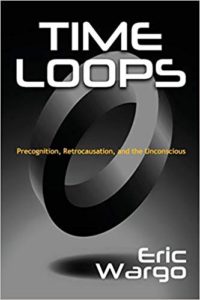
Wargo, Eric. 2018. Time Loops. Charlottesville, VA: Anomalist Books.
Wu, Tim. 2017. The Attention Merchants. New York: Vintage.
Žižek, Slavoj. 1989. The Sublime Object of Ideology. London: Verso.
Žižek, Slavoj. 1999. “The Matrix, or, The Two Sides of Perversion.” http://www.lacan.com/zizek-matrix.htm;
Žižek, Slavoj. 2006. How to Read Lacan. New York: W.W. Norton and Company.
Time Portals, Time Drones, and Timeships
The thrust of much futurism since the 1950s has been toward space exploration and the prospect of colonizing Mars and exploiting the solar system’s resources. But I think the real final frontier for our species (and any intelligent, technological civilization) is going to be Time. Our destiny, if we do not destroy ourselves, is to become timefarers and something like history gardeners, sowing seeds in the past for a better tomorrow.
 The past cannot be changed, but that is no obstacle to influencing the past: We don’t actually know much (or anything) about the past–even our own personal pasts, believe it or not (memory is basically imagination); the past can be (and in fact, constantly is) interacted with in ways that lead to optimal outcomes ahead. This is what it means to be involved in time loops, and I think we (and all living creatures, and maybe even the fabric of spacetime itself) are made of time loops. We will always find that our forays into the past were already included in our histories, and these discoveries are redemptive.
If history gardening is also a technological possibility for our descendants on a collective level using actual, physical time travel, then we should look for evidence of it now. The UFO phenomenon is the most obvious place to look.
The possibility that UFOs represent time traveling technology rather than (or in addition to) space traveling technology has gained renewed cache lately, but it is not a new idea. It is implicit in some of Jacques Vallee’s writing, for instance. In his classic, Passport to Magonia, he suggested that the UFO phenomenon is some kind of active shaping of our imagination possibly projected from some interdimensional elsewhere, although he says explicitly that one way of looking at Magonia is as the future–either our own future or perhaps the future of some other civilization. This line of interpretation of Vallee’s work is explored further by Jeffrey Kripal in his essential book, Authors of the Impossible.
Lately, physical anthropologist Michael P. Masters has revisited the UFOs-as-time-travelers idea in a more nuts-and-bolts fashion. Masters builds his argument from the principle of neoteny–also called paedomorphy–or the retention in adulthood of juvenile features a species’ ancestors. The resemblance of many reported “ETs” to children (small stature, big heads, and big eyes) suggests to Masters that they could be our distant descendants.
From where I sit, having no direct experience of the phenomenon, I’m agnostic about most ufonaut and visitor encounters. So many reports seem “archetypal,” when they do not seem hoaxed or like some kind of mind-control experiment, and separating the psychological or imaginal dimension from the physical reality seems impossible. So, boringly perhaps, I am more interested in evidence from first- and second-kind close encounters—i.e., sighting reports—that could support the existence of time traveling technology in our airspace.
What would that evidence look like? What are its visual signatures?
Let’s explore a few possibilities.
Wormholes
What we really mean by “time travel” is the movement of the time traveler’s subjective “now” relative to the surrounding temporal river.
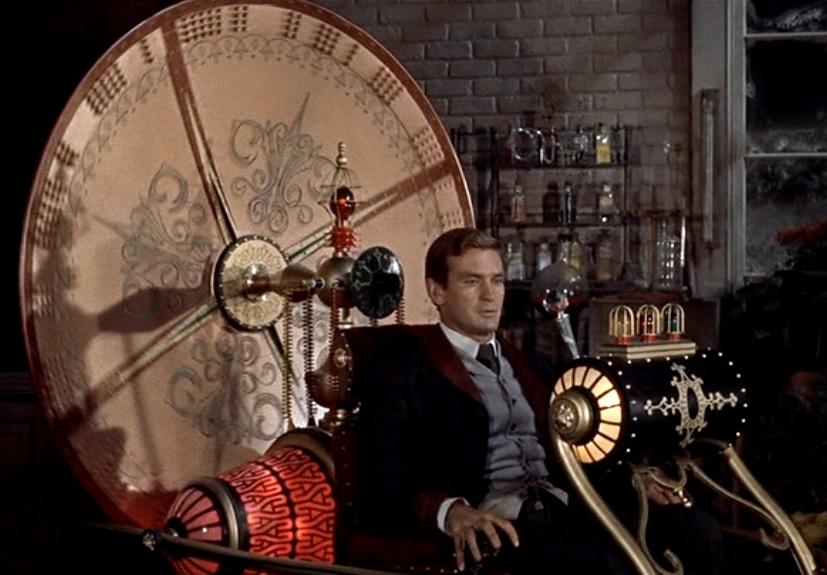
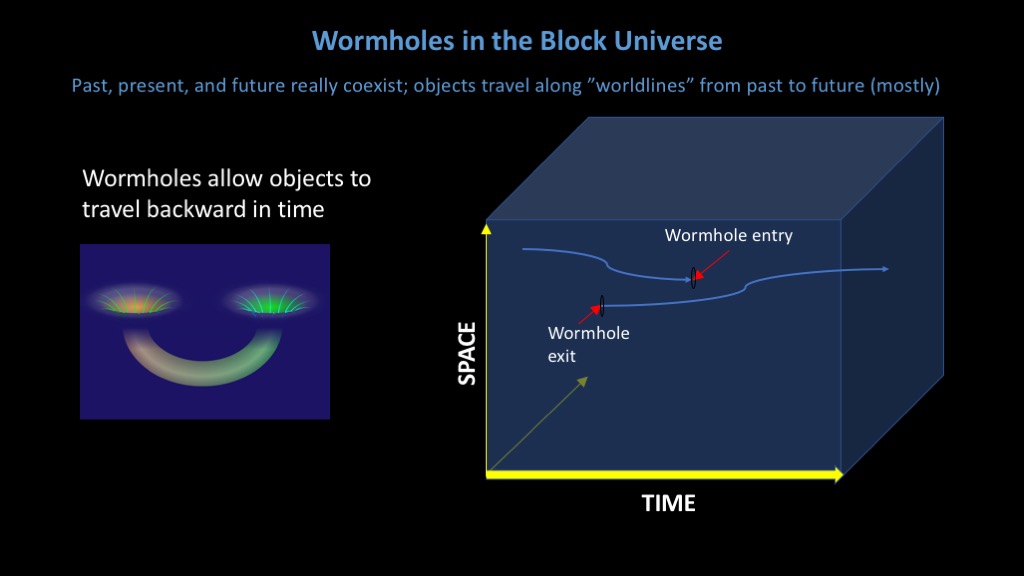 If the universe is a four-dimensional continuum (spacetime), or block universe, then objects are really worldlines, snaking their way through the block. This holds for an H. G. Wells-style time machine too. Traveling forward in time in such a device is in fact no different from just sitting there, waiting a long time for it to be the future. For all practical purposes, it is the same thing as a spaceship traveling at relativistic velocity or with suspended animation. Either way, you step out of your spaceship and you haven’t aged but it’s the future all the sudden. If you were in cryosleep, you also have a hangover. The problem is getting back to your home time.
Backwards travel (into the past) is probably senseless in such a device without also talking about motion through space: Otherwise the time machine’s past is just its own previous history. What would it mean to push “T minus 5 minutes” on a stationary time machine console? What exactly would appear 5 minutes ago at the same physical location in your garage laboratory?
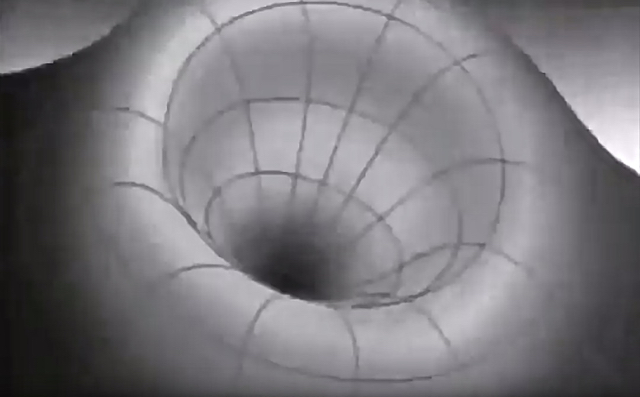
The most obvious answer, and the one most commonly discussed in the literature, is travel through a wormhole. Wormholes are like tubes linking distinct spacetime regions, and they allow objects to travel not only great distances across space but also in both directions across the fourth dimension.
You can find a million articles on wormholes on the internet, so I won’t go into more details. But is there evidence of wormhole travel in the UFO literature? I see the eager hands waving in the front row, but I’m sorry to disappoint you. For various reasons, I don’t find the famous description of an aerial portal sighted at Skinwalker Ranch very compelling as evidence of a wormhole or dimensional doorway (or star gate). There is a tell in the authors’ description that makes me seriously doubt the story:
When I asked Gorman for a detailed description of the orange shape, he told me that it looked different depending on the observer’s viewing angle. … It was like a three-dimensional orange tunnel that receded away from them, and the sides of the tunnel were perfectly camouflaged with the sky, so from a side view an observer could see nothing at all. The only perspective that offered a good view into the interior was directly opposite the mouth of the tunnel.[64-5]
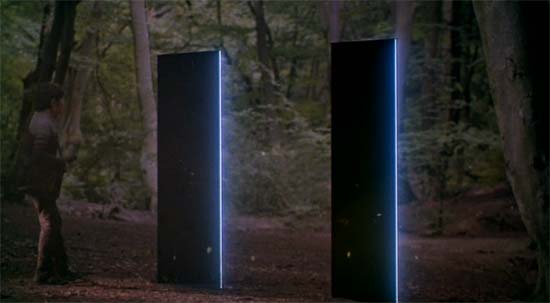 The wonderful Time Bandits (and a million lesser movies) notwithstanding, a tunnel or door is not in fact what a wormhole mouth would look like to an outside observer. For reasons I explored years ago on this blog, a wormhole mouth is a convex, three-dimensional object, and from a distance it would look like a sphere—visible in all directions. To me, the description in Hunt for the Skinwalker sounds very much like either a sky hologram meant to fool people or else a rancher who didn’t know what wormholes would look like telling a fib.*
But there’s no need to limit our future time-traveling selves to conventional air- or spacecraft traveling through wormholes. A more interesting possibility is that some UFOs could themselves be wormholes. Assuming a roughly spherical chamber for wormhole generation in some distant future laboratory, the wormhole projected into the past would appear to an outside observer as that chamber turned inside out. Only as you approached and entered the perceptually and cognitively bewildering object would you realize you were … somewhere, or somewhen, else–a seamless transition from outside to inside. We have no familiar experience to serve as a touchstone for such an encounter, but any number of “high strangeness” UFO encounters seem to have such a quality. If a “ship” was really a laboratory chamber projected to another locale, it would explain the “bigger on the inside than the outside” quality abductees sometimes report. (Although again, with such reports, there is little way we can rule out cognitive distortions produced by hallucinogenic aerosols and other more mundane explanations.)
One problem that the UFO-as-wormhole possibility would help solve is the incredible energies that are sometimes estimated to be associated with UFOs. In a 1998 paper, Vallee estimated the luminous power output of six UFOs in his encounter files, finding values potentially up to 30,000 megawatts in one case, which is not even including the power necessary for propulsion. If some of these objects were really wormholes projected from somewhere or somewhen else, instead of packing massive power plants (or massive batteries) within their visible dimensions, you could have a building- or city- (or planet-) sized power plant off-stage supplying the energy.
But still, wormholes and stargates are so 2019. Are there other solutions to physically traversing the time dimension in reverse that would be available to our human or posthuman descendants?
“Tell me about … quantum computers”
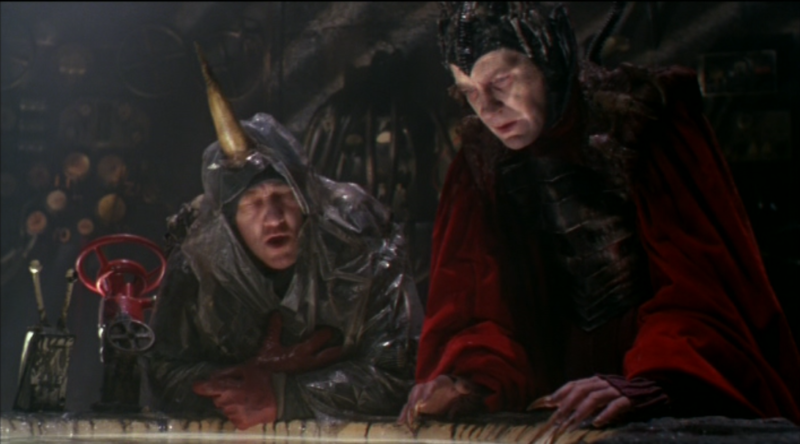 First let’s back up a bit … rewind. The prehistory of physical time travel is actually a technology that is already being developed, believe it or not. I’m referring to the possible ability to send messages (or information) into the past, and by extension, receive messages from the future. This will likely be possible using a quantum computer.
A quantum computer is a matrix of atoms or other particles that are entangled and used as bits (or qubits, quantum bits) to perform computations. Their enhanced power is usually described as a function of the way they capitalize on superposition–the ability of a qubit to occupy more than one state simultaneously, thereby facilitating a kind of hyper-parallel processing. But if Yakir Aharonov and a growing number of other physicists are right, the uncertain or seemingly random aspects of interactions at the smallest scales are really the portion of retrograde causal influence on a particle’s behavior. In this view, the entanglement that enables quantum computation is a function of a kind of causal zig-zag back and forth through time. By extension, the superposition that gives quantum computers their power would really be computation over the computer’s history. The computing power of a quantum computer, in this view, depends on how long you leave it plugged in.
Lots of recent work is showing that causal order can be reversed in quantum computers. As you already know from having read my book Time Loops in your near future (click here to order), you can use a quantum computer to “teleport” objects through time (destroying the object in the future, reassembling it in the past), a bit like the transporter in Star Trek except across the fourth dimension. Long-lived quantum computers attached to peripherals like 3-D printers could also theoretically create objects in the past based on instructions sent from a user in the future–a premise of William Gibson’s novel The Peripheral. Such objects could include “time drones” piloted by a future operator. These would not be true time machines, because only their blueprints and commands come from the future, not the machines themselves; but they are a likely first step toward true history management via technology.
There are two major limitations on purely quantum-computer-mediated time travel. The most obvious is that you cannot send a time drone to an earlier point in time than when the computer was turned on. Since we are right now only at the very infancy of quantum computing, we would not yet expect to see 3-D printed time drones flying around based on information sent back from future users. (And nobody in the field has apparently figured out yet that these devices are really time machines, but it’s only a matter of time, so to speak.)
The other limitation concerns the wyrd rules that govern information propogation into the past. Information cannot reflux back in time in a way that would lead to its foreclosure in the future (grandfather-and-grandmother paradoxes, etc.). This means that for “freely willed” time-drone operators in the 23rd century, communication with a time drone printed out in the 21st will be garbled. Their viewscreens will not show a clear and literal representation of the past landscape, but may be distorted in various ways, or even symbolic. The same would be true for their instructions to the drone.
It is not coincidental that the same rules (Igor Novikov’s self-consistency principle) explain symbolic distortion in dreams. Your brain is really a tesseract or informational time tunnel–a hybrid quantum-classical computer–and (as you know from 2021-You having already read my forthcoming book Precognitive Dreamwork and the Long Self) it is possible that all dreams may be precognitive (or contain precognitive material) but in such a way that they cannot actually be used to foreclose or prevent the experiences pre-presented in them—hence all the symbolism and distortions. Sigmund Freud meets Einstein.
Flipbook Travel
Let’s get a little bit more precise about what actual time travel is: It is really the ability for a time traveler to occupy a reference frame that is distinct from the surrounding reference frame.
 In a 2013 paper cleverly called “Traversible Achronal Retrograde Domains In Spacetime,” physicists Benjamin K. Tippett and David Tsang proposed that a true, TARDIS-like time machine could be created by isolating a bubble of spacetime geometry from its surrounding reference frame. Conceivably, such an isolated spacetime region could reverse its temporal trajectory through the block universe. This would be a true time machine, or what I like to call a timeship.
There’s a lot of talk in the UFO world these days about metamaterials. Rubbing my temples and squinting, I do foresee that nano-engineered metamaterials are probably the answer for creating time-reversible objects along the lines of what Tippett and Tsang proposed. For instance (just guessing here), a spintronic superinsulating or superconducting metamaterial might be used to create a membrane or barrier capable of surrounding and encapsulating the thermodynamic reference frame of a timefaring chrononaut and her cat from the reference frame of the surrounding environment. After she removes her comfy sleeping cat from her warm control panel, the chrononaut could pull a lever and reverse the flow of time within her timeship’s hull relative to that of the outside flow of events.
Such a vessel would be able to make switchbacks in the time dimension as freely as a plain old spaceship can make a switchback in space. And here’s where ufologists should take note: To an outside observer, such a switchback in time would have a distinct appearance, creating a unique motion signature that could identify such a craft.
Specifically, an object reversing its temporal direction would look from outside like two identical objects converging and immediately vanishing. The two objects are/were really the same object, one of which was traveling into the past. (More accurately, we would say that its worldline through the block universe did an about-face.) This type of temporal switchback is something you can see for yourself if you diagram 4-D motion in a flipbook, my latest weird hobby. My artistic abilities and my patience do not allow me to depict any timeship more complicated than an orb, but click on the frame below to see what a basic time reversal for an orb-shaped timeship (“throwing it into reverse”) would look like:

When our chrononaut decides it is boring traveling backwards against the external temporal reference frame, or when she reaches her destination time, she could throw the lever again, reversing the time flow and rejoining the local historical reference frame. To an outside observer (at an earlier time), it would be the opposite of the above situation: It would look like an object (the timeship) expanding into existence from nothing and immediately splitting into twin objects traveling apart:

In my flipbooks that litter the house and perplex my wife and daughter, crudely penciled orbs appear out of nowhere, split into two, and one of those two merges with another orb and disappears. This is a basic S-shaped switchback in time for a single orb:

So, quite distinctively, time travel and time reversal create doppelgangers—clones—in violation of the conservation laws physicists used to preach.
 It so happens that the writers of the beyond-wonderful film Yellow Submarine figured out the doubling effect of time travel. After accidentally traveling backwards through the Sea of Time, the Fab Four reverse course again and then observe another version of themselves traveling backwards. Then they sing “When I’m Sixty-Four” and Eric Wargo gets a little tear in his eye … just before he gets all pedantic and mansplains to bored-looking wife and daughter that there ACTUALLY should be a third submarine, the original version of themselves before the switchback. Time reversing objects tend to appear in odd numbers, you see–another thing you quickly discover when you depict these turnabouts in flipbooks.
In his book Identified Flying Objects, Masters notes that some UFOs show signs of disappearing and reappearing, which could suggest some kind of wormhole or stargate traversal, or jumping between timeframes. More intriguing to me are the reports of lights or solid objects that behave suggestively like the orbs in my flipbooks: confusingly splitting into two or more objects after appearing and/or converging, merging, and vanishing.
Splitting and merging is behavior consistent with a single timeship reversing its direction along the T-axis of local time. But it can get even more complicated and strange when the chrononaut decides to switch the temporal vector of her timeship repeatedly, perhaps to get multiple vantage points on the same external event. What is really a single time-reversible object can quickly look like a swarm of orbs (always an odd number) dividing and merging in a hypnotically beguiling pattern:

I invite readers aware of these three specific behaviors in UFO reports—(1) twin objects appearing from nothing and flying apart, (2) identical twin objects converging and vanishing, and/or (3) “swarms” of coordinated objects or lights merging and dividing in this specific way—to point me in the direction of references. And observers should be on the lookout for these specific behaviors.
World-Rewinding
The physically minded will have spotted some problems with my timeships. I have assumed for flipbook purposes that a time-reversed object is really just a duplicate of the original object occupying the same time frame—in other words, a worldline or worldworm that has doubled back. But the special properties of the superinsulating metamaterial might make it impossible to interact electromagnetically with the surrounding environment in either direction—in other words, it might de facto be cloaked.
If that’s the case, then the motion signature of a simple brief time reversal followed by switchback would be: a duplicate object appearing at a distance from the first, followed at some point thereafter by the disappearance of the first object.
However, this would present serious navigational problems, as we are about to see. So for my purposes, I’m assuming that the superinsulator is sandwiched between a conventional inner hull surrounding the cabin and a sort-of-conventional outer hull that is traveling forward in time even when the ship within is traveling backwards. I’ll explain why this might be important in short order.
 Another potential problem concerns the mechanics of those switchbacks. Remember that, unlike H. G. Wells’ time machine, a timeship with a metamaterial hull would need to be able to travel conventionally in space as well, so that its journeys into the past don’t conflict with itself. This is potentially a problem for any timeship traveling slower than light. To solve this problem, I am anticipating some type of metamaterial that modifies the “metric” around the ship in such a way that it will enable switchbacks at lower velocity (at least as measured by an outside observer).
Perhaps relevantly, Jack Sarfatti thinks the hulls of the famous Tic Tacs are made from layers of molecularly engineered materials able to slow down the speed of light, thereby insulating the occupants from the local gravitational field and enabling astonishing speed and maneuverability. (He has also speculated that these objects are indeed made by us, in our future.)
But another big problem concerns navigation. What would a chrononaut actually see on her timeship viewscreen? The external environment would look like a film running in reverse, right? Unfortunately, no.
Theoretically, traveling backward against the external temporal reference frame, our chrononaut should be effectively blind, since the photons needed for vision also will be receding toward rather than emanating from their sources. Everything outside the ship would look black from from the pilot’s vantage point during a retro-jaunt.
Unless, that is, there is a tachyon spectrum, a realm of faster-than-light particles that travel in temporal retrograde. Our eyes can’t see in such a spectrum, but if it exists, presumably the builders of a time-reversible ship also could make you special goggles to see tachyons too, enabling you to enjoy the “world-rewinding” experience of timeship travel against the local temporal current.**
However, if the internal reference frame of the ship is totally sequestered from the outside, then nothing, during that retro-flight, can get in our out, and that includes a closed-circuit feed from the cameras mounted on the outside of the ship.
Depending on the hull’s properties, there could be a strange workaround: If an outer hull layer is still traveling forward in time along with the external thermodynamic environment, it could be embedded with cameras and thus film its forward journey from the past and then transmit its record to the interior of the ship during the crossover/switchback. The pilot inside could then play the record in reverse, to “see” the external environment during that jaunt.
And here’s one place the law of wyrd would come to play a role in timeship navigation. Suppose the chrononaut decides she doesn’t like where she is heading (into the past) and decides to swerve—that is, to contradict the history that was recorded in the backwards-playing video that is serving as her viewscreen-into-the-past? Could she?
She might feel like that’s what she was doing. But in fact, her video will always anticipate her maneuvers and her thoughts/impulses. Again, as I’ve discussed in previous posts, the whole business of grandfather paradox and “bilking” one’s own future is really moot, given the Novikov self-consistency principle. Since history is self-consistent, everything the chrononaut sees on her screen will be consistent with her own in-the-moment, “freely willed” decisions. This is what wyrd means: History is self-consistent.
You cannot cheat your future self. Accept it or don’t. Someone who is made crazy by the laws of wyrd won’t step into a timeship in the first place, and quickly would find the experience unbearable, if they did. They would be like the sufferers of “akinetic mutism” in Ted Chiang’s “What Is Expected of Us?” In contrast, the Time Force pilots of the 24th Century will be selected on the basis of their non-neurosis, their conscientious obedience to their future and past selves, and their resistance to feeling like they need to defy or resist reality. They will be like the heptapods in Denis Villeneuve’s great film Arrival (based on another Chiang story). They will be Zen beings, having left their egos at the door and transcended ancient hangups about free will.
Part of what really fascinates me about time travel is that, however you slice it, it creates added mass that shouldn’t be there. In a universe that includes time traveling objects and information, the quantity of matter and energy in a given time window is determined not only by what was there just a minute ago, but also by how much cloned matter/energy has traveled back from the future (and thus self-duplicated). This could have immense cosmological implications. Backward-traveling objects, even if they are electromagnetically isolated in superinsulating envelopes, would still gravitationally interact with the surrounding environment. Could this be an explanation for dark matter/dark energy?
The search for the mysterious gravitational envelopes that cause stars in the outer galactic disc to travel faster than they should around the center needs to consider the future technological history of the galaxies in question. Are we perhaps already seeing the effects of wormholes, timeships, and other time-travel technologies that will shape the universe in its middle- and older age, reaching back into the present/past?
Postscript: Preemptive Tenet Criticism
I don’t know if it is a symptom of my own precognition, but a month or two after I became weirdly obsessed with making flipbooks about time-reversing orbs, the first trailer of the forthcoming Christopher Nolan film Tenet was released. The film, whose theatrical release has now been put off until September (good luck with that), deals with temporal inversion, or time-reversal—specifically spies somehow reversing time locally to prevent World War III. The special effects featured in the trailers seem to depict the “world rewinding” appearance of the external environment from the point of view of time-reversing spies.***
 The first Tenet trailer showed a rolling car de-fragmenting on a highway in apparent defiance of the arrow of time and entropy. Subsequent trailers have shown the main character (John David Washington) “firing” bullets at a target, but a woman explaining to him that his gun is really “catching” the bullets, which are presumably traveling in temporal retrograde.
We can expect that Nolan may attempt to exploit the dramatic possibilities afforded by time reversal. A tempting one for a spy film is getting into tightly guarded buildings or sealed vaults by waiting until after they are opened and entering in time-reversed mode, or else going back in time to before the guards were placed or the vault was closed. You could do a heist this way, or a daring rescue. That might be what Nolan has in mind.
But from the looks of it, Nolan is fudging things in a bunch of ways. Let me be the first irritating time-travel pedant to preemptively point out his possible error(s).
The first is that, at least from the trailers, I see no evidence of the doubling (and really, trebling) that would be the signature of time-reversing objects and people. At some point in the narrative, if his hero is time-reversing, he’ll need to merge with his doppelganger and or appear out of nowhere as a pair of twins, one of which is (ideally) “passing” by doing a kind of “backwards” walk-and-talk like the Black Lodge characters in Twin Peaks. (Incidentally, that Lynchian technique is one that the Beatles also used, in the video for “Strawberry Fields Forever.” I have heard it was first used by Jean Cocteau in Orpheus.) Or, time-reversing objects like that car need to split into two and then merge with their doubles. Same with the bullets.
There also needs to be some kind of delineation between temporal reference frames—minimally a membrane such as my hypothetical metamaterial timeship hull. Are the main character and the woman traveling back in time while he’s “shooting” at the wall? Are the bullets traveling back in time relative to the shooter? The scene doesn’t make sense, at least as shown.
 Again, causal linearity is generally regarded as a function of the second law of thermodynamics. Entropy defines our unilinear experience of time, but it isn’t the same thing as time-the-dimension. So from the trailers, it looks like it is not really time that is reversible in Tenet but entropy. Nolan may be allowing a nifty sci-fi idea to be driven by some original special effects—in this case, seamlessly integrating backward-running footage of entropic events like gunshots and car crashes into ordinary scenes—rather than by real science.****
A different, more coherent (and interesting) possibility for Tenet is that the temporal inversion being depicted may actually be the main character’s ability to un-stick his subjectivity/awareness from the external temporal flow, a la Billy Pilgrim in Kurt Vonnegut’s Slaughterhouse Five. In that case, what we may be seeing in the trailers is his learning to scrub back and forth along his own timeline, as in a video-editing program, likely as a result of some kind of training/initiation by this secretive Tenet group. We may be seeing his time-reversed subjective point of view, in other words.
In either case, the first trailer hinted that the protagonist’s ability may also have to do with something about a prior near-death experience or something about his actual death (later). Thus Tenet may be a sort of superhero origin story about precognition (loosely defined), and Nolan may be trying to out-do Arrival, which also explored these themes.
I’m looking forward to finding out … but not in a theater, thank you very much.
NOTES
 * I’ve been called “the Sherlock Holmes of retrocausation,” which was mere flattery, but I actually AM the Sherlock Holmes of visual perspective. It was the subject of my PhD dissertation. So don’t get me started on the sins of science illustrators and special effects folks for decades representing wormholes as doors, and black holes as whirlpools or big space anuses. The only film to have ever gotten both objects right visually is Christopher Nolan’s Interstellar, but that was thanks to his work with Kip Thorne on the science aspects.
As for Skinwalker … Many of the big UFO cases of the last few decades, including this one, are looking more and more like psyops to me: a cocktail of extravagant aerial holography, cloaking tech, and hallucinogenic aerosols being deployed against both unwitting members of the public and semi-witting experts to see what sticks. MKULTRA 2.0.
** Tachyons, when they were proposed in the late 1960s by Gerald Feinberg, seemed to offer a handy possible explanation for psi phenomena, especially precognition. It makes intuitive sense until you consider that tachyons are about as useful for directly seeing into the future as photons are for directly seeing into the past—in other words, not at all. Looking through tachyon goggles, the world would look just like it does normally.
The exception is astronomy. With very distant objects, it does make a difference whether you were seeing the past of an object (as we do with photons—billionths of a second in the past for anything in our immediate environment)—or the future of an object, as we would when observing in the tachyon spectrum. Through a tachyon telescope, nearby stars would appear more or less in their familiar positions, but more distant objects would be offset, and distant galaxies would be in very different positions and configurations.
I predict the tachyon telescopes of the 22nd century will observe much more evidence of sidereal and even galactic engineering in our own and neighboring galaxies, since the future may hold much more time for civilizations to evolve and reshape their stellar neighborhoods. A tachyon telescope may reveal lots of Dyson spheres and ringworlds, for instance.
*** Occultists will know that Tenet refers to the Sator Square, a five-word palindrome believed to have magical properties.
SATOR
AREPO
TENET
OPERA
ROTAS
The most literal of the possible translations is “Farmer Arepo has a plough (wheel) for his work,” but there are others.
Palindromes were believed to confuse the devil, sort of the way time travel and time loops confuse us. TENET, the middle word (“holds/possesses”), is the only palindrome within this palindrome, so it is a kind of meta-palindrome.
**** The great Memento and the at-least-wormhole-accurate Interstellar notwithstanding, Nolan has history of science fudging. Don’t get me started on the goddamn out-of-gas spitfire in Dunkirk somehow maneuvering without stalling. That’s a Hanukkah miracle … except the Dunkirk evacuation was in May, nowhere near Hanukkah. Nolan clearly has issues with entropy. (Did entropy kill his mom and dad?)
I’m not a fan of Inception either, which imagined the dreamworld as coherent CGI environments for standard action fare. It has been suggested that Tenet could be an Inception sequel. I’ve never had a dream anything like anything in Inception, and neither have you. The only directors who have ever made good films about dreams are David Lynch and Luis Bunuel. Okay, and Victor Fleming. Change my mind!
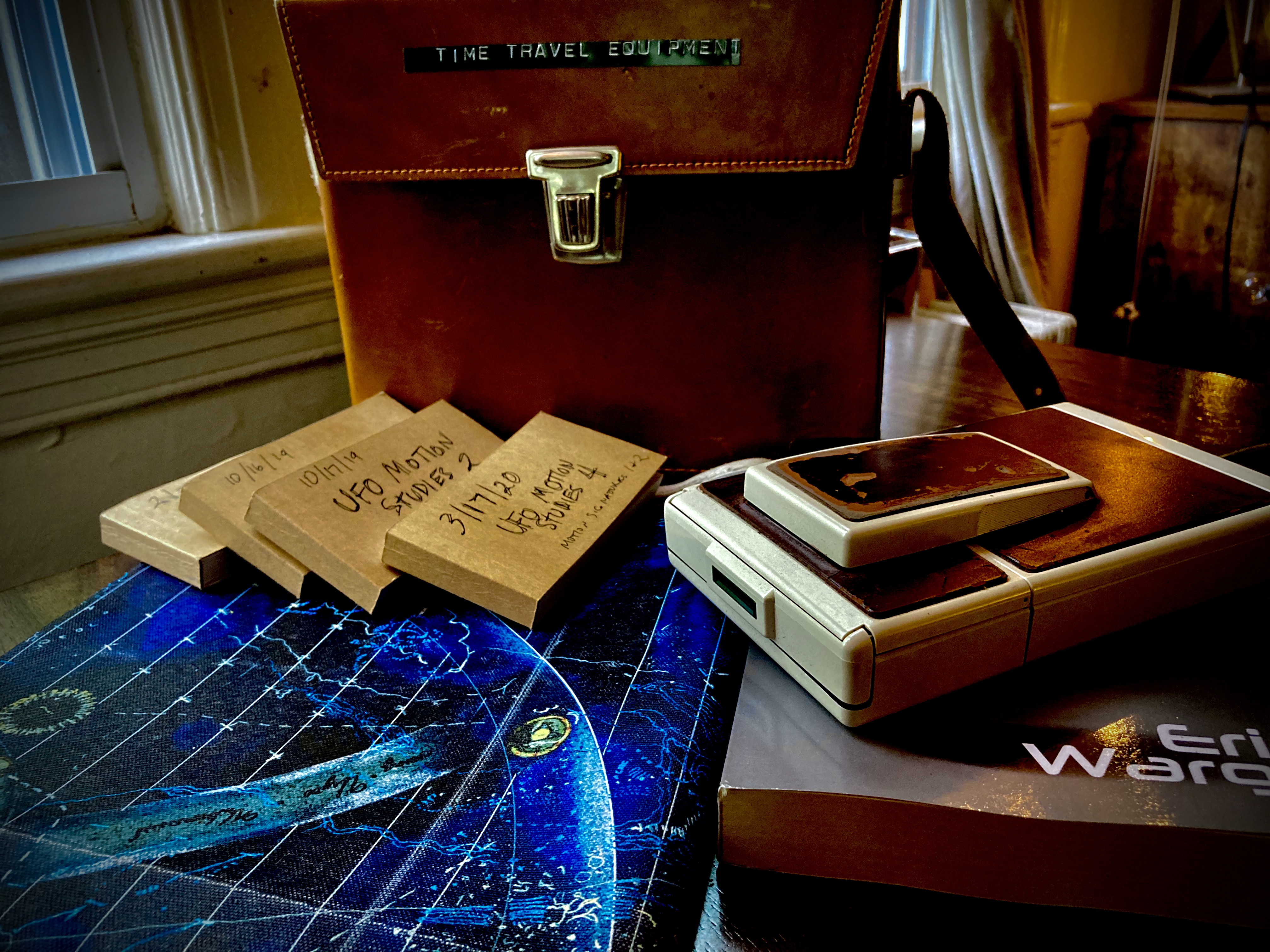
Pat Price, Precognition, and “Star Wars”
Whenever and wherever I discuss the hypothesis that most forms of ESP, including remote viewing, could really be misrecognized precognition, I’m answered with the same thing: “But Pat Price, Semipalatinsk.” Everyone who knows anything about the remote viewing and the research at Stanford Research Institute in the mid-1970s “knows” the story of how Pat Price, given a set of coordinates in the USSR, sent his consciousness across the globe and saw (and drew) a crane that had been seen in satellite images as well as the construction of metal spheres that were confirmed only three years later in an Aviation Week article, two years after Price had died.
 It’s a story that appears in pretty much every history of the SRI research and the Star Gate program that grew out of it.
Problem is, it’s not true. At least not as it has been told.
Not only was the magazine article supposedly confirming what Price saw completely inaccurate about what was going on at the site–a piece of Cold War propaganda–but the experimenters’ recollections of the sessions in which Price allegedly described the spheres were also inaccurate, probably shaped in hindsight by that magazine article. Transcripts that have come to light in the new Archives of the Impossible at Rice University present a very different picture of this affair, one that actually supports (I believe) the precognitive hypothesis of remote viewing, versus the standard “nonlocal consciousness” interpretation.
Judge for yourself. Read my new article in EdgeScience, “Pat Price, Precognition, and ‘Star Wars’.” I look forward to feedback (even push-back) from remote viewers. Please give me your thoughts in comments here.
This fascinating case raises a host of questions, not only about ESP but also about the Cold War context in which remote viewing first emerged.
Enjoy!

Big in Japan
Check out the very fun conversation I had last year with John Craig on his Japanese webcast Real Rover, about all things time-loopy. We discuss retrocausation, alchemy, Zen, and the Long Self that precognition gives access to. Enjoy!
***
Where Was It Before the Dream? — Time Loops and Creativity

Dreams go hand in hand with origins, so it is conveniently coincidental—coincidentally fractal maybe—that what is usually considered to be the first recorded poem in our tongue was about the origins of origins—the beginning of created things—and was composed in a dream after the poet had tried to escape the burden of being original himself.
Caedmon was an aging, illiterate cow-herder for the Abbey of Whitby in the Kingdom of Northumbria in the late 600s of the Common Era. We would now say he had a terrible fear of public speaking. Whenever the harp was being passed around the hall for everyone to take their turn, he would slip out into the night to avoid the humiliation of having nothing to sing.
 According to Bede, the great historian of this period, one night after the old introvert had fled the pressures of the hall, he fell asleep in the byre near the cows it was his job to watch, and he was approached in a dream by a man who bade him to sing. Complaining that he could not sing, the dream-figure told him to sing “about the beginning of created things.” Suddenly, in his dream, Caedmon found himself singing the following, beautifully composed lines in praise of “the work of the father of glory”:
Now [we] must honour the guardian of heaven,
the might of the architect, and his purpose,
the work of the father of glory
as he, the eternal lord, established the beginning of wonders;
he first created for the children of men
heaven as a roof, the holy creator
Then the guardian of mankind,
the eternal lord, afterwards appointed the Middle Earth,
the lands for men, the Lord almighty.
When the cowherd-dreamer brought his verse to the Abbey’s clerics, he was sent to the Abbess herself, Hild (later St. Hilda), who recognized in his composition the work of divine inspiration and persuaded him to take up the monk’s habit. Bede tells us that Caedmon spent the rest of his days transforming sacred history, as told to him by his fellow monks, into beautiful songs. Unfortunately, the only work that has survived is his first, 9-line hymn of praise to the Creator, “received” in a dream. (There’s a nice exegesis of the hymn here.)
Way too many centuries have elapsed to put all that much evidential stock in Bede’s account of Caedmon and his inspired song.* But his narrative stands at the beginning of a long line of stories about poems, novels, and other artworks whose genesis supposedly came to the artist in a dream or in some hypnagogic or hypnapompic, semi-awake state.
Samuel Taylor Coleridge reported getting his very best poem, “Kubla Khan,” in an opium-induced dream. Mary Shelley—given permission by Coleridge—reported getting the idea for Frankenstein from a hypnopompic reverie. Robert Louis Stevenson got the plots of some of his stories, including Dr. Jekyll and Mister Hyde, from dreams. Franz Kafka wrote many of his stories, such as “The Metamorphosis,” after significant images came to him during or following a dream. J. R. R. Tolkien wrote his elvish mythologies from a trancelike semi-dream-state he called “faerie.” Salvador Dali used the hypnagogic state to get ideas for his paintings. And it’s just as true of scientific explorers. No book or article on the subject of creativity fails to mention August Kekule, who claims to have discovered the ring-structure of benzene from a hypnagogic vision of snakes eating their own tails.
Critics and biographers love debunking these stories. They will point out, as they have done ad nauseam in Coleridge’s case for example, that saying “it came to me in a dream” is a handy way of excusing the flaws of a work, or perhaps its brevity (as with the short “Kubla Khan”). It also creates a handy excuse for cultural borrowings, or intellectual property theft. Kekule only told the story of the dream-origins of “his” benzene discovery at a fest in his honor decades later, when some of the scientists in the audience may have been aware that at least two other researchers had published on benzene’s ring structure before Kekule ever did. Saying “it came in a dream” and that he waited a few years before publishing on it (just to be sure the dream was right) seems to have been Kekule’s way of justifying the glory being bestowed upon him in the face of others’ (and his own) doubts as to his originality.
But treating dreams and reveries as a rhetorical fig leaf does not negate the reality of the phenomenon of ideas coming in these daily altered states. It’s a real thing. Anyone who dreams and creates in some fashion, whether via writing or in any other medium, or even science, knows how fertile the unconscious is, and how normal it is to wake up with the feeling of having glimpsed some wondrous idea only to have it fade like the morning dew. Occasionally writers and artists do manage to capture a bit of that magic, and turn it into art or some new scientific discovery or invention.
The question that hovers over these narratives, though, is: But where was it before the dream?
No Sweat
When you drill down into your theory of creativity and even causality more generally, there’s the problem of making the new from the old. The question of origins in the realm of culture has direct analogues in natural history and cosmology. If things tend to repeat—natural processes, the forms of living things, cultural memes—what is the source of new things under the sun? How do you get life from lifeless chemistry, new species from old ones, and unheard-of ideas?
 God’s creative Act at the beginning of Genesis has provided a convenient model for writers and artists through the ages when thinking about their own creative process. Caedmon would not have doubted the divine origins of his hymn. But most in our day are not satisfied appealing to gods (or spirits) when some more mundane explanation is imaginable. God’s solution—creating from nothing—is truly Herculean … and we assume, impossible. We frame the problem instead as the reshaping of some raw material that’s already present in the world, including the raw material of pre-existing ideas.
Philosophers and critics addressing the question of creativity since the Enlightenment have largely adopted the idea that cultural innovation of whatever sort, when you really subject it to scrutiny, can be traced back to preexisting ideas, its pedigree masked by ingenious recombination and recontextualization. A kind of mechanistic, billiard-ball model of mental and cultural causation arose alongside the physicists’ Newtonian and thermodynamic models of physical causation. New ideas can always be traced back to other hidden sources, whether in other books or artworks or in the writer’s own earlier life experiences. In this view, there is really nothing new under the sun, just the old repackaged, rearranged, and repurposed.
Consequently, criticism, in emulation of physics, is more often than not the “debunking” of inspiration, the tracing of aesthetic causality and the lines of past influence leading to a poem or artwork or novel. Fearful of discontinuity, the critic is sometimes only satisfied when all possible influences are accounted for, lest there be any hint of creation ex nihilo—something gotten from nothing. For that is the real fear about artists in a Protestant, capitalistic society: that they’re slackers.
It’s that fear, I think, that gives rise to the sour truism constantly invoked to minimize artistic inspiration: Thomas Edison’s quip that genius is “one percent inspiration, and ninety-nine percent perspiration.” The right context, a favorable disposition, and persistence at a well-practiced craft are all-important. Forget the magic of those ideas that come to the artist unbidden, out of the blue, or in a dream.
The trouble is, the reductive Edisonian framework makes it very hard to explain myriad “prophetic” anomalies in the world of art and literature and popular culture, which look very much as though a creator, whether awake or dreaming, was reaching into their future, not the past … and doing it effortlessly.
Move Along, Nothing to See Here
I discussed several examples of literary prophecy in Time Loops. For instance, in 1951, after a long creative struggle with a novel that felt perpetually unrealistic to him, Norman Mailer published Barbary Shore, about a writer like himself living and working in a Brooklyn Heights rooming house with a colorful mix of artist neighbors, one of whom turned out to be a KGB spy. A few years later, after a stint in Hollywood, Mailer returned to the East Coast, to Brooklyn Heights, where he rented a room in a building to work on his next novel. He was stunned to encounter a New York Times headline about a top KGB Colonel named Rudolf Abel who had just been caught running a massive spy ring out of the same building he used for his office. He had known the spy as “Emil Goldfus,” the “guitarist” who worked one floor down from his studio.
 We don’t normally expect visionary prophecy from a writer like Mailer, but Philip K. Dick was especially known for this kind of thing. To take just one of many examples, in 1962 he wrote a story about an android “simulacrum” of Abraham Lincoln but couldn’t find a publisher so the story languished unread in his desk drawer; two years later, Disneyland unveiled one of their most perennially popular exhibits, their “animatronic” Abraham Lincoln. When he read about this new exhibit, Dick clipped the article from the paper as proof that he was a “precog” straight out of one of his stories. (Previously on this blog, I’ve written about how Dick precognitively got the idea of “VALIS,” the extraterrestrial teaching satellite, from his reading of Jacques Vallee‘s Invisible College, 2-3 years after he began writing the first versions of that novel.)
The best-known case of literary prophecy is the novel Futility by sea-adventure writer Morgan Robertson. Published in 1898, Futility told the story of an alcoholic seaman working aboard the largest ocean liner ever built, the Titan, which hits an iceberg on an April night in the North Atlantic on a run between New York and England, killing nearly everyone aboard due in part to a shortage of lifeboats. Fourteen years later, the 51-year-old (and by then, largely forgotten) writer would have been nearly as stunned as his fellow New Yorkers by the New York Times headline reporting that the Titanic, with close to the same stats as the fictitious Titan, had carried most of its passengers to a watery grave under nearly identical circumstances to those in his novel.
Writers happen to leave a rich paper trail of prophecy, by the very nature of their work and their tendency to write or be interviewed about their lives, but it happens in all media. Recall for instance one of the funniest moments of the 1984 mockumentary This Is Spinal Tap: the descent onto the stage of a miniature Stonehenge model that had been made to the wrong proportions—18 inches instead of 18 feet—because a confused band member (played by Christopher Guest, who also co-wrote the movie) has used a double apostrophe instead of a single one on the back of a napkin. It could be one of the most weirdly prophetic moments in cinema.
 Heavy metal insiders may have thought, when they viewed this scene, that the filmmakers were basing it on a real fiasco involving the band Black Sabbath that had occurred just six months before Spinal Tap‘s release: That band had planned to include a Stonehenge model in their concert tour for their Born Again album (one of the songs was called “Stonehenge”), but they were forced to shelve the idea at the last minute because the fake monument delivered to them was nine times too large—a result of a failure of communication between the band and the company commissioned to make the fake monument (the dimensions were supposed to be in feet but were interpreted in meters). Yet “impossibly,” Spinal Tap had already been written and shot by the time of Black Sabbath’s embarrassing mixup—including a version of the Stonehenge scene. So in other words, the movie idea for an embarrassingly mis-sized Stonehenge model (whichever member of the writing team thought of it) preceded the real-life Black Sabbath mishap by as much as a year.
Or less amusingly, take the 1999 sculpture Tar Baby vs. St. Sebastian, by the African American sculptor Michael Richards. In this self-portrait, the artist depicted himself standing like a stiff board or tower, being pierced by a multitude of planes, much the same way St. Sebastian is depicted in Renaissance art as a pincussion of arrows. This piece has gained notoriety because of the tragic circumstances of the artist’s death on 9/11, in his 92nd-floor studio of 1 World Trade Center. Friends who had visited his studio before the attacks recalled several similar works on the themes of being martyred by planes, planes crashing, and explosions. Artworks and cultural ephemera from the months prior to 9/11 and appearing to depict its events are numerous.
The more one delves into artists’ and writers’ biographies—as I’ve been doing a lot this past year, preparatory to a book on this subject—the more one finds astonishing “synchronicities” that I believe are really cases of artistic precognition. The above cases (which can be found with a quick Google search) are just the tip of an enormous iceberg that includes some of the greatest writers and artists of our age (names like Kafka, Tolkien, Lynch, Herzog, and many others—watch this space).
100 Percent Masturbation
It’s amazing and a little sad to watch generations of academic scholars wrestle with the problem of creating the new from the old without invoking some purposive (let alone teleological) factor. Psychologists and other writers on creativity endlessly offer solutions acceptable to the essentially materialist, “enlightened” mentality of the time, and every one falls short, merely having found some new way of saying the same thing: Some faculty in the mind sees some new and pleasing possibility in materials at hand—influences, life experiences, etc.—and arranges them in some unexpected way. But the question “how did it see or find this new possibility amid the myriad available ingredients?” remains unanswered.
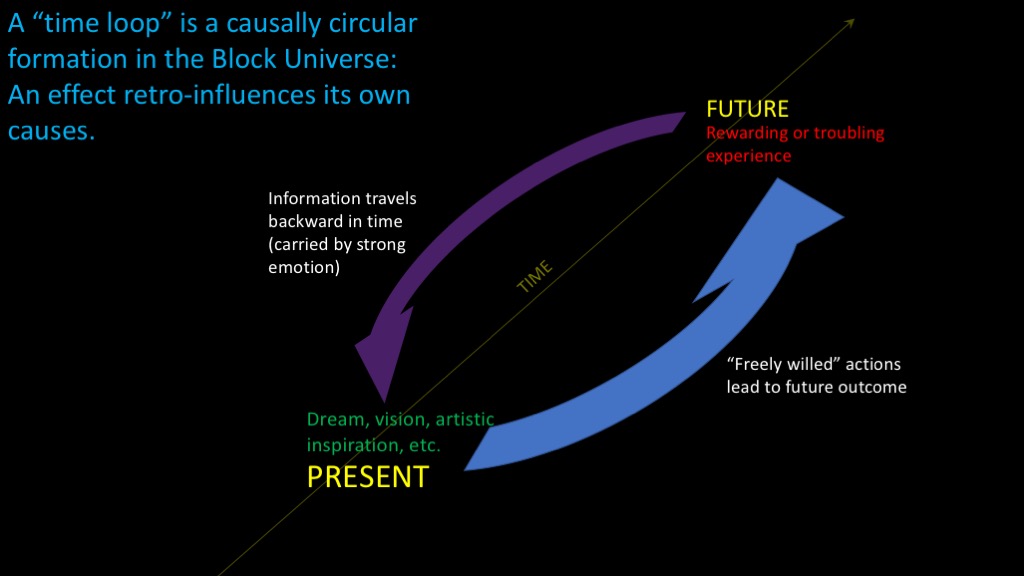 The time is ripe for a reassessment of creativity and its roots in precognition.
My argument in Time Loops is that our future thoughts and emotions in response to upheavals ahead get displaced in time and influence us in all the ways Freud attributed to “the unconscious.” It is best understood in dreams: Whereas Freud thought dreams symbolically represent repressed wishes and wholly relate to our past, I argue that they really represent responses to positive and negative turning points on the road ahead. However, since there is no way to fully grasp the meaning of information refluxing from our future—because only the future could give it context—the dreaming brain reaches into its grab-bag of memories and pre-existing associations to help it pre-present those alien-seeming thoughts. Dreams are thus like effigies of future thoughts sewn together from scraps of past experience, or “ruins” of future structures built from past bricks.
Our tesseract brains do the same thing when we create art, I believe. Artists, like dreamers (and we are all dreamers) are prophets, channeling their own future thoughts and emotions and traumas into material creations (images, stories, films, song, sculpture, whatever). Even though we can trace the past influences on a visionary work until the cows come home, those influences are simply the “bricks” with which a thought from the artist’s future is being pre-presented.
Intended as a satire on the pretentions of artists, William Tenn’s 1955 short story “The Discovery of Morniel Mathaway” expresses this time-looping logic through the trope of time travel: An art historian from the 25th century is awarded the privilege of traveling back several centuries to visit the Greenwich Village painter Morniel Mathaway, to study how the artist (the greatest ever, by late-25th-century standards) created his works. What the time traveler finds, however, is that Mathaway is a talentless fraud and a trickster, who instead of painting masterpieces simply cheats people, and he even steals the art historian’s time machine. Trapped in the past, the art historian has no choice but to simply assume the identity of Morniel Mathaway and paint the paintings he remembered from the future—thus, he himself is the master he had studied.
It’s more than just a trope. It has been known since Einstein that time machines are possible, in principle, and thus that the universe could be riddled with causal loops, the self-fulfilling prophecies known in physics-speak as closed timelike curves. You really could have a situation like what William Tenn described. The quantum computing pioneer David Deutsch described such a possibility in a 1991 paper, using a similar thought experiment: A Nobel Prize-winning mathematician travels back in time and finds his younger self toiling in some library over the very theorem that he will eventually win the Nobel prize for proving. To help his younger self out, the mathematician shows his younger self the proof.
Physicists who treat information and its conservation with a kind of holy reverence will be perturbed by such stories, as Deutsch appears to have been by his own story about the time-traveling mathematician. Deutsch found the “creation ex vacuo” of new information in his unproved-theorem scenario not paradoxical, exactly, but “pathological.” Where did the solution to the theorem originate? What was the source of this new information in the universe? Deutsch felt it violated Karl Popper’s dictum that “knowledge comes into existence only by evolutionary, rational processes.”
 As Paul Nahin notes in his essential text Time Machines, the underlying anxiety here really arises from something like the work ethic—although I’d suggest it is more precisely Marx’s labor theory of value: “the creation of knowledge demands hard work!” In other words, what really bugged Deutsch was that there was nowhere in his gedanken-time-loop where anybody actually did the hard work of proving the theorem. There was no perspiration, in other words. The proof was self-caused. Fans of the outstanding Netflix series Dark will recognize this as the “bootstrap paradox”—in that show, the volume Eine Reise durch die Zeit (A Journey Through Time) by watch- and time-machine maker H. G. Tannhaus also evidently has no origin, having been transmitted to its author by a time traveler from the future.
If the last century of physics has taught us anything, it is that physical reality does not play by the tedious rules that would prevent such things. For instance, the old conservation laws are increasingly thought to hold for delimited, well-defined physical systems, not the universe as a whole. New things constantly arise from nothing, without anyone doing a lick of work. Empty space, if you zoom way in, is really a seething “quantum foam” where layabout particles arise out of emptiness, uncaused, and undeserving. And matter and energy are all just information—so it violates nothing, really, to say that information can be created ex nihilo. It just … bugs us.
Tautologies, those lazy, unsociable, self-enclosed ouroboroses that fascinated ancient mystics, are not paradoxical. Neither is the kind of self-causation that is starting to look like the rule in physics, not the exception. Karl Popper, bless his heart, was simply wrong. And Deutsch’s discomfort with the pathology of information (although he really means meaningful information) arising from nothing is rooted in those fears of slack that pervade our work-ethic culture. They are also akin, I would add, to deep-seated worries and fears over masturbation—a pleasurable activity that doesn’t visibly produce anything for the community.
Thus the bootstrap paradox is a misnomer; being might even be bootstrapping, in the end. Thus there is no reason the labor theory of value, or the Protestant ethic, or really any kind of socially sanctioned “perspiration” needs to underlie the creation of new ideas.
I’m going to scandalize my stern, hard-working, penny-pinching Dutch Calvinist ancestors here and say that Edison’s quip about the effortfulness of genius is a total distraction, even an ideological one. To really understand creativity, we must move beyond the craft and industry metaphors—such as the toiling “guys in the basement” whom Stephen King credits for his ideas—and embrace the more ouroboric (/masturbatory) picture painted by modern physics. Just as the vacuum produces particles out of the void, for free, real creation produces the new out of nothing.
The creative germ or spark that gives rise to a novel, or a film, or a sculpture, or a song may in all cases be a time loop.
Prophecy’s Fractal Geometry
Even if we are open to the possibility that the artist creates precognitively, “from nothing,” it raises the question how a created work, like the created world, has positive features: Where does the uniqueness of a work of art come from?
There is a clue, I believe, right in our culture’s template for creation ex-nihilo, the 31st line of Genesis 1: “And He saw that it was good.”
When you drill down, many cases of artistic prophecy or precognition seem to follow a very specific, hindsight logic: novelists don’t just precognize any old thing; they precognize their reactions to their own works after the fact. Filmmakers precognize their own hindsight reactions to their films. And illiterate cowherds precognize how they will feel after delivering their poems to the local clerics.
It is worth noting that the theme of the verse that came to Caedmon in his dream was gratitude: gratitude toward the originator, for the wonders he had fashioned for the children of men. Wouldn’t gratitude precisely be how a shy, tongue-tied cowherd would have felt when suddenly recognized and embraced by his local ecclesiastical community as an original creator after presenting a poem essentially “given” to him by God? The poem that he had brought the local abbey, fractally about origins, from a man anxious of being unoriginal, transformed him into a celebrated member of his community; never more did he have to fear the approaching harp. But how could his dream “know” he would feel that way until after the events inaugurated by his dream?
 I have come to think that creativity always works this way, obeying a kind of “fractal geometry of prophecy.” I’ve explored a few cases previously on this blog. When she was writing her novel Picnic at Hanging Rock, Joan Lindsay was literally dreaming about the conflicted emotions she would feel later about her novel, including the excision of its paranormal final chapter; the novel was based on those dreams. While there were certainly objective past influences on her story that could be traced and that gave form to her inspiration, at its heart was a void, an artistic semi-trauma in her future, very much like the fascinating three-dimensional “hole” in spacetime that beguiles her doomed lost girls atop the rock in the “missing” Chapter 18.
Similarly, Harlan Ellison’s script for the Star Trek episode “City on the Edge of Forever” was, I believe, really about the hard feelings Ellison himself would experience as a result of bringing his creation into the world and submitting it to the “castrations” of Gene Roddenberry’s producing and writing team. It was a story about its own counterfactual future and, like Picnic at Hanging Rock, a time loop in the truest, purest sense.
All the various possibilities for the artist’s reaction to his/her work in hindsight will shape the work in different ways, push it in different directions, even if subsequent iterations and editing and reworking—the “perspiration” part—generally has the effect of effacing or obscuring this future influence, sanding it away or making it invisible. (It tends to be in the most “raw” and unpolished works that prophecy is most apparent.)
Underneath all these emotional possibilities, I believe, is amazement. In Time Loops I used the Lacanian idiom of jouissance to talk about our emotional timewarps, but I think amazement may be an even better term, especially as it applies to creativity. I think amazement could be the single most powerful time-transcending force in the lives of creators, the carrier of the psychic signal from their future to their past, in whatever final form that signal takes (a dream or a work of art, or both) or however it is (mis)interpreted. The unique form of an inspired work may derive partly from the specific nature of that amazement, the specific reaction of the creator to his or her creativity, to the impossibility at its heart. That reaction may be a kind of longing (as in Lindsay’s case), it may be confused anger and regret (as in Ellison’s case), it may be a kind of fear or anxiety, or even terror (looking at you, Mary Shelley). Or, as in Caedmon’s case, it may take the form of a kind of humble, awed thanks.
Critics always looking to the past and debunking human inspiration should turn around and look in the other direction instead. The possibilities of future influence in the world of art and literature are vast and (thus far) mostly unexplored, with just a handful of inspiring exceptions. Although he doesn’t use the term “precognition,” Malcolm Guite’s biography Mariner is a beautiful study of how Coleridge’s “Rime of the Ancient Mariner” prefigured the poet’s life subsequent to the poem. In his book Philip K. Dick: The Man Who Remembered the Future, Anthony Peake details many of PKD’s prophetic novels and stories. The French writer Pierre Bayard’s Le plagiat par anticipation (Plagiarism by Anticipation) is a tongue-in-cheek exploration of retrograde literary influence (e.g., Sophocles got the idea of Oedipus from Freud, according to Bayard, not vice versa). And in the realm of music, Christopher Knowles has extensively explored the amazingly prophetic/synchronistic life and music of Cocteau Twins singer Elizabeth Fraser on his blog The Secret Sun, making a strong case that Fraser is a full-on sibyl … or something.**
More to come on this theme. But the bottom line is that I believe all art is prophecy, just as dreams are. By extension, so is thought. Our original ideas, our best thoughts, come from our future, not the past. We are made of time loops. And quite literally, we are something like gods, creating ex nihilo whenever we are gripped by inspiration or make art or music or write from “the unconscious.”
NOTES
* If he really existed, Caedmon probably wasn’t his real name, for one thing. He was likely bestowed this name by those clerics, or even by posterity, after the Greek Cadmus, the legendary bringer of the alphabet to the people.
** I wholeheartedly agree with Knowles about the preternatural Liz Fraser. But I also think she had precognitive help: 4AD founder/producer Ivo Watts-Russell seems to have shown the same hyper-precog qualities Fraser did, but he expressed it mostly through identifying talent and launching others’ musical careers.
SOURCES
Bede, Ecclesiastical History of the English People
David Deutsch, “Quantum mechanics near closed timelike lines,” Physical Review D (15 Nov, 1991)
Paul Nahin, Time Machines
Martin Schneider, “Life imitates comedy: Spinal Tap uncannily anticipated Black Sabbath’s very own Stonehenge debacle”
William Tenn, “The Discovery of Morniel Mathaway,” Galaxy Science Fiction (October 1955)
John H. Wotiz (ed.), The Kekule Riddle
This post is based on a talk, “Creativity and the Precognitive Mind,” given at Esalen in January, 2019.
In Defense of the Water Witches
In 2017, a couple in Stratford upon Avon, England requested that a technician from Severn Trent, the water company that serves their region, come out to replace the water line to their house from the main under the street. First, he had to locate the buried pipe, and the couple were surprised to see the technician walk over the street with a couple of bent rods.
Woe to the water witch in the age of social media. The couple, perplexed and amused to see this spectacle, announced it on their family WhatsApp group, where it seized the attention of their daughter Sally Le Page, an evolutionary biologist at Oxford. Le Page tweeted Severn Trent: “Why, @stwater, in 2017, are you using divining rods to ‘find’ the location of underwater pipes when there is zero evidence they work?”
The response from the company was “We’ve found that some of the older methods are just as effective than the new ones, but we do use drones as well, and now satellites” and referred Le Page to a website for more information on their methods. When Le Page doubled down on her incredulity, the water company was more than happy to elaborate: “We do have some techs that still have them in the van and use them if they need to, however we prefer to use listening sticks and other methods.”
In an article she wrote for Medium, Le Page writes that she then contacted 11 other major water companies in the UK asking them whether they employ dowsing, and all but two admitted that their technicians sometimes dowsed for buried pipes even though they mostly relied on approved higher-tech methods. Her response pulled no punches:
I can’t state this enough: there is no scientifically rigorous, doubly blind evidence that divining rods work. That’s how my scientist side would describe it. My non-scientist side would describe it thus: divining rods do not and will not work. Even now, any explanations of water dowsing rely on the supernatural, and in 2017, I am astonished to find two water companies relying on (and paying for) the supernatural to find underground pipes.
Le Page’s extraction of an admission from 21st century utilities that they sometimes use a scientifically unsupported practice “invented 450 years ago” (it goes back at least millennia, probably—see below) sparked a furore among UK skeptics and a flurry of reports in The Guardian and other media outlets. One Leeds University water management specialist quoted in The Guardian decried the use of “peculiar … Medieval witchcraft practices” by these companies. Science writer Philip Ball lent his voice to the chorus lamenting the lack of scientific understanding among even high-tech businesses like water companies: “It’s not impossible that an unknown law of physics is being profitably exploited by Severn Trent Water, but hopefully we can agree the likelihood is small.”
This outcry in turn provoked anxious and defensive tweets from the utility companies trying to put out what had become a PR disaster. They assured the skeptics that they did not approve of dowsing, and that it was only some backward, “rogue engineers” who still occasionally used the technique.
Interestingly, Le Page never says whether the dowsing water engineer found the pipe leading to her parents’ house. She does not complain that Severn Trent Water dug up the street in front of her folks’ house and came up empty handed, which would have added a certain substance to her complaints.
Unscientific Certainty
Every year or so, dowsing rises briefly to the attention of the mainstream media. Lois Parshley wrote a decently balanced piece in Aeon in 2015 about farmers’ use of dowsers in drought-parched central California. What prompted me to finally write this post was an article by Sasha von Oldershausen in The Atlantic last month (June, 2019), profiling a water witch working for an oil company in Texas. At best, as in these two pieces, it will just be noted how at odds dowsing is with modern science, without the authors explicitly passing judgment. (Parshley rightly notes even that “confirmation bias” applies to the skeptical scientists as much as to believers.) But at worst, as in Le Page’s article and other opinion pieces prompted by the UK case, authors heap condescension on the practice and imply that its practitioners (and other believers) are denizens of Carl Sagan’s demon-haunted world.
 Explanations for dowsing vary widely, and when confined to the stereotypical business of wandering over a landscape with a forked branch or bent metal rods, people’s minds may naturally go in various directions, depending on their prior level of skepticism. If they don’t dismiss it as nonsense, they may reasonably think it is a matter of the dowser translating some kind of unconscious (but non-paranormal) intuition about the landscape into subtle hand movements. Laypeople without any dog in the fight might assume it involves some subtle “energetic” tug of buried water on the branch or rods.
Something like that latter mental image—waves of some sort, or perhaps some magnetic-like influence emanating from the ground—appears the earliest attempts to scientifically justify the practice and is probably how skeptics like Le Page imagine that most believers still imagine dowsing works. I would venture that such an image is the basis for her self-admittedly non-scientific certitude that “dowsing rods do not and will not work.”*
But consider my favorite of the “when impossible things happen to people with PhDs” genre, the late Elizabeth Lloyd Mayer’s wonderful book, Extraordinary Knowing. Meyer, a prominent Oakland, California psychotherapist, begins her book by relating her own experience with dowsing, which was so compelling that it drove her to devote years to researching psi phenomena. In 1991, her daughter had her prized harp stolen from an theater after a Christmas concert. She got no help from the police or even the local news media in recovering the valuable instrument for her distraught daughter, so a friend convinced her to try contacting a dowser.
Figuring she had nothing to lose, Mayer agreed to try a paranormal solution to her problem, so the friend gave her the phone number of Harold McCoy, then the president of the American Society of Dowsers in Fayetteville, Arkansas. Mayer reluctantly placed a long-distance call McCoy—by now, two months after the harp had been stolen—and after a moment’s thought the dowser was able to tell her the harp was still in Oakland. “Send me a street map of Oakland and I’ll locate the harp for you,” he said. She complied, and two days later McCoy called Mayer with directions to find the house that contained the stolen instrument. The police could not get a search warrant for the house simply on the basis of a dowser’s word, so Mayer posted flyers on the surrounding street corners offering a reward for the return of the harp.
After three days, a series of phone calls from the “neighbor” of the person in possession of the harp resulted in its delivery to her, in a hurried late-night rendezvous behind an all-night Safeway.
The reactions of Le Page, Ball, or any number of skeptics to a story like this are easy to imagine: the usual smug eye-rolling about confirmation bias, “the law of large numbers,” etc. If a scientifically educated person cannot accept those waves emanating from buried water pipes, how could they countenance such waves reaching from a lost harp in California across most of a continent to an Arkansas dowser’s hands holding a pendulum over a map of Oakland?
Dowsing really doesn’t make much scientific sense when we think of it as a problem of influences extending across space. It makes much more sense, though, when we do the counterintuitive thing of thinking of it as an influence extending across time, solely within the mind/brain of the dowser.
Dowsing the Future
In 2011, the prominent but not controversy-shy Cornell psychologist Daryl Bem published his now-infamous “Feeling the Future” findings: significant evidence from several large experiments that stimuli in the near future can influence present behavior. Most psychologists and many scientists were, you might say, “triggered” by this provocation and expressed condescending and even snarky outrage, since such a thing was obviously impossible. Yet despite a few pseudoskeptics’ claims to the contrary, Bem’s results have been replicated by a large number of independent researchers and laboratories—a story no one in mainstream psychology wants to hear.
 Bem’s findings were hardly the first to detect precognition—the support for that is massive, statistically—or even to detect presentiment, unconscious influences of future stimuli (here’s one recent review of the evidence). Over two decades ago, Dean Radin pioneered the study of future stimuli on autonomic responses like skin conductance, and by now there is a large and significant body of research just on this phenomenon, as shown by some recent meta-analyses. Anyone fairly assessing the evidence would have to conclude that retrograde influence from future stimuli exists and that it affects us on an unconscious level, influencing measurable outcomes like heart rate, brainwave activity, quickness to make certain motor responses, and so on.
And as readers of my book Time Loops know, there is similarly provocative work just in the last decade from the frontiers of physics and biology attesting to both the reality of retrocausation at a quantum level (physical influences from future to past) and the possibility of biological systems scaling up “spooky” quantum effects. If it turns out the brain is indeed a kind of quantum computer (or hybrid quantum-classical computer, more likely)—and this is an active area of research by neuroscientists and cognitive scientists right now—then it is no longer at all ridiculous that animal nervous systems might be able to tap into future rewards. I suggest that’s what dowsing, when it boils down to it, really is: a future reward exerting an unconscious tug on the dowser’s present behavior via an automatic or autonomic response.
That response has a name, in fact: the ideomotor effect. This was first identified by psychical researchers in the 19th century studying mediums. Without our conscious awareness, our thoughts and feelings translate into small muscle movements that can both create an illusion of the body being manipulated by an external entity or force (such as when using a Ouija board) and can be used by another person (the medium) to “read” a sitter’s thoughts and feelings. I argue that dowsers holding rods, forked branches, pendulums, or a “magnetomatic pipe locator” (the instrument used by the Texas water witch in the recent Atlantic article) are using this “channel” to tap into an exciting reward in their near future: finding what they’re searching for, or what someone else has hired them to search for.
In other words, it is not true that “any explanations of water dowsing rely on the supernatural,” as Le Page claims. The natural is plenty roomy for new kinds of explanations.
Subtle Messages From Your Future Self
A big reason for parapsychology’s sluggishness to consider brain-based precognitive hypotheses as explanations for all sorts of ESP modalities (including dowsing) is the field’s historical failure to account for the experiential dimension of psi experiences. This was a gap lamented by pioneer remote viewer Ingo Swann, who felt that the lived experience of doing ESP was a crucial piece of the puzzle, and it is one gap I am trying to fill with my research. For instance, descriptions of ESP or mediumship experiments almost always leave out any information on how veridical information was confirmed by or to the individual psychic. It simply does not occur to most writers that this may be relevant; they think it is enough to say “the psychic was right” (if he or she was right) or that “the dowser was successful” (or not).
However, sometimes in the anecdotal literature, what I call a “scene of confirmation” is recorded as an afterthought, and this makes such anecdotal accounts priceless for studying these phenomena and how they may actually operate.
 For instance, Murray offhandedly notes later in her book that, after she successfully retrieved her daughter’s priceless harp based on the information provided by McCoy, she left an excited message on his answering machine. The dowser, she said, claimed he was not surprised to learn of his success, but who isn’t gratified to learn they’ve done a good job? There is no telling how much Mayer’s message on McCoy’s answering machine, or his emotional reactions to that message, might have been the crucial piece of what I am arguing is really a four-dimensional, loop-shaped puzzle. My somewhat reductive hypothesis is that ESP may only work when there will be some form of feedback forthcoming later, or some way of finding out piece of information that is hidden or missing in the present.
In fact, I have come to think of dowsing, in its simplicity, as the “stem cell” of ESP phenomena. To invoke a popular idiom used by researchers in the fields of quantum computing, retrocausation, and time travel, the dowser’s brain at time point B is “post-selecting” on a reward, and that future reward is constraining their behavior at time point A to lead to that rewarding outcome. It’s probably not exactly a retrograde signal from the brain in the future to the brain now—it’s more exactly a correlation—but “subtle messages from our future self” is the easiest way for us nonphysicists to think about it. (Really, we need to overhaul our language entirely to think about retrocausation, as I’ve said before, but that’s a massive philosophical undertaking.)
We call it dowsing when it involves hunting for natural resources or lost items. When researchers stumble on the exact right page or piece of information in a book, we call it “the library angel” (a term coined by Arthur Koestler). When it involves an interaction between a psychic and a client where the interaction itself or later events produce rewarding confirmations or desired information, we call it mediumship. Most generally, it is simply intuition, our basic psychic search function.
When I said “it goes back at least millennia,” I was partly referring to possible images of dowsers in ancient art: A 6th Century C.E. synagogue at Bet Alpha in the Jezreel Valley possibly shows Aquarius holding a forked branch, and a Neolithic rock painting from Tassili, Algeria has been interpreted as depicting a dowser, although these interpretations are both controversial. But I was also referring to our earliest bacterial ancestors over two billion years ago. Post-selecting on the reward of survival in a few microseconds or milliseconds via quantum-computing microtubules would have conferred a small but important selective advantage on motile spirochetes wriggling through the primordial soup. You could call it dowsing for survival, and I suspect this scaling-up of quantum retrocausation will turn out to have been a basic factor in the arising of complex living systems.
True, we don’t yet know all the nuts and bolts of how precognition and presentiment work, either in cells or in people, and the brain-based hypothesis is speculative at this point. But it’s not by any means a ridiculous hypothesis, it’s ultimately testable, and there’s no supernatural anywhere to be found in it. Thus, when faced with “ancient superstitions” being applied by employees at water companies at a fraction of the cost or time as their other double-blind-proven high-tech tools, scientists and skeptical science writers might take a few deep breaths before shooting off their outraged op-eds. Why shouldn’t people use all the tools at our disposal, even the hard-to-understand, uncanny, and inexpensive tool of intuition, which may well stand on firm scientific footing one day in the not-too-distant future?
More power to the water witches, I say.
NOTE
* As I was writing this post, authors of a “special report” in Skeptical Inquirer took a similar “I can’t imagine how it would work so it’s therefore impossible” approach to debunking “all parapsychological claims” (just like that!). “Each and every claim made by psi researchers violates fundamental principles of science,” the authors Arthur S. Reber and James E. Alcock boldly declare, “and thus has no ontological status.” Their description of the anti-scientific reasoning that led to this conclusion is somewhat surreal, given that the publication portrays itself as a guardian of scientific rationality:
We did not examine the data for psi, to the consternation of the parapsychologist who was one of the reviewers. Our reason was simple: the data are irrelevant. We used a classic rhetorical device, adynaton, a form of hyperbole so extreme that it is, in effect, impossible. Ours was “pigs cannot fly”—hence data that show they can are the result of flawed methodology, weak controls, inappropriate data analysis, or fraud.
You can see the forefingers firmly jammed into ears. Real scientists know you need to do the work to find the flaws in published results, not simply declare them flawed because of your own biases. And no, Skeptical Inquirer readers, the evidence for psi has never been found, in bulk, to be fundamentally flawed or fraudulent. (If you’re getting your science news from SI, it’s a bit like getting your political news from Fox.)
Like many pseudoskeptics, these authors seem to not realize that science is a method of inquiry, not a list of fixed conclusions about the natural world. The history of science shows that the latter always change, so it’s a bit silly to think they won’t change further. The great Carl Sagan, who embraced real inquiry and dialogue as part of skepticism, would be appalled at the backward-looking (and seemingly, fearful) demon-hauntedness of today’s skeptical movement.

What’s Expected of Us in a Block Universe: Intuition, Habit, & ‘Free Will’
Ted Chiang is an SF writer after my own heart. At every stage in my own investigation of time loops, someone sends me yet another Chiang story that addresses exactly the issues I’ve been working on. What’s more, his stories seem to act as attractors for precognitive and time-looping experiences. I’m sure his new collection Exhalation, which compiles some time-related stories that have been floating around in various publications and on the Internet for several years, will have already precipitated countless precognitive dreams.
 “What’s Expected of Us” is one of those stories. This story, originally published in Nature in 2005, is about a little device with a light, a button, and a precognitive circuit (or “negative time delay”) linking them. The light goes off one second before the button is pressed, and cannot be fooled no matter how hard the user tries. Users treat it like a game, trying to “beat” or outwit the light, but find they cannot. The device becomes super popular, people play with it addictively, but roughly a third of users succumb to a kind of hopelessness and immobility called “akinetic mutism,” because of what the device has taught them about the nonexistence of free will, the futility of trying to change their fate. “Like a legion of Bartleby the Scriveners, they no longer engage in spontaneous action.”
People used to speculate about a thought that destroys the thinker, some unspeakable Lovecraftian horror, or a Gödel sentence that crashes the human logical system. It turns out that the disabling thought is one that we’ve all encountered: the idea that free will doesn’t exist. It just wasn’t harmful until you believed it.
This wonderful little story cuts to the heart of the issues, as well as misconceptions, that surround the question of free will and the threats to it that we imagine are posed by precognition in a block universe, where the future in some sense already exists.
Americans have trouble with anything that appears to threaten the idea of free will. Ours is a highly freedom-loving and individualistic society, and we love the idea that we are free agents, willful determiners of our lives. We think of ourselves as cars who can go anywhere we please, even off-road, not trains fixed to a single track. If we think of the future as “already” holding something in store for us, we delimit that something to destiny, a kind of dotted line around the person we might become but aren’t obliged to. A destiny is a future that awaits our freely willed actions to fulfill or not fulfill, depending. This is in sharp contrast to the ancient notion of fate as a preordained future that will always outwit our best efforts at evasion. Classical tragedies like Sophocles’ Oedipus Rex were thought experiments about fate and how we fulfill it precisely by trying to escape it.
“What’s Expected of Us” is a mini Oedipus Rex for an age of fidget-spinners. But we don’t need to look as far back as fifth Century BC Athens for models for the Predictor. The first thing Chiang’s story reminds me of—and I’d bet the author had it in mind when he wrote the story—is an astonishing 1983 discovery by neuroscientist Benjamin Libet: The nerves in participants’ fingers readied to fire (“lit up” you might say) a fifth of a second before participants consciously decided to move their finger. Libet’s discoveries prompted other psychologists to prove that we are not really masters in our house. Experiments by Daniel Wegner and others seemed to show that we instead take credit for actions per our culturally ingrained ideas of agency. The ego sees something it likes—a successful motor action, say—and proudly goes “I did that.” It sees something it didn’t like, like tripping and falling, and chalks it up to accident or to some external force or influence impinging on it.
Conscious will as studied in psychology laboratories is not exactly the same thing as the philosophers’ free will and the question of physical determinism. But it offers an interesting entry point to the question of what we really lose by jettisoning that philosophical security blanket of imagining that the future remains open ended and under our control. If the conscious mind is a spectator, what is it we’re really talking about when we’re talking about free will? Is “akinetic mutism” really the result of giving up on our belief in it?
Seize the Fish!
In Chiang’s story, Predictor users slump into apathy and silence because they decide their actions (versus nonactions) don’t matter. And part of their problem is they can’t shake their feeling of free will even when they know it isn’t “real” in some larger sense. Lying in bed and not responding to one’s surroundings is just as much an action as getting up and seizing the day (“Carpe diem!“) in the belief that we are agents of our lives—because our thoughts and interpretations are just as much “enacted” as our physical movements.
 But what the Zen masters of China and Japan discovered is that direct experience of the illusory nature of free will actually leads to liberation, not apathy. There is a training-wheels phase, though: Trying to escape the question of free will/no free will and directly experience pure spontaneity is a familiar experience for any beginner at Zen practice, in fact. What one discovers is the ridiculousness of the pose of “not acting.” You can’t escape your thoughts. Nor can you escape the will of your body. (Hunger alone will drive you to go to the kitchen and eat, ignoring your mental bafflement: “hey, is this freely willed, or not??”)
Ultimately, passively observing the flow of stuff in our head, and detaching ourselves from our actions and their outcomes, is highly freeing, not to mention empowering. What serious meditators discover is that, unburdened from the baggage of thinking about their freedom or unfreedom, their thoughts become more rewarding and their actions and words more skillful. The less free we imagine we are, the more free we feel. It’s the same joy anyone feels whenever they practice any complex skill and become so good at it that the practice becomes effortless, performed in a state of flow. Shao-lin kung-fu masters are not worried about their free will. Neither are the wise heptapods in the movie Arrival, based on Chiang’s “Story of Your Life.”
The akinetic mutists of “What’s Expected of Us” are simply stuck in that awkward in-between period, on the way to becoming enlightened Zen masters or heptapods basking blissfully in the eternity of the block universe.
The question of human precognition and free will should not be divorced from the question of skill performance. Anyone who knows how to drive a car well, be super witty on a date, or swiftly change a baby’s diaper with one hand knows that we are most effective when we don’t think about what we are doing but just do it. Research on “psi” also shows that it is an unconscious, un-willed function or group of functions. Laboratory experiments strongly support something like presentiment (“feeling the future”), and there is reason to think it could be a pervasive feature or even a basic underlying principle of our psychology. I am not the first to suggest that Libet’s findings actually reflect the tip of the iceberg of presentimental functioning.
Indeed, people who express strong “intuitive” ability often seem to do so in the context of some automatized and highly enjoyable/thrilling motor skill—piloting a plane, martial arts, mountain climbing, but also things like musical performance, stage magic, and other arts (including hammering away at a typewriter for a penny or a dollar a word). I consider dowsing to be the model, the most basic form (or stem cell) of psi as presentiment/precognition: using motor reflexes to tap into a forthcoming reward via the ideomotor effect. And whether you are a race car driver, a remote viewer, or a dowser, self-consciousness that might include an awareness of “making choices” is the last thing you want.
The relation of our conscious will to our skilled actions may be something like a time loop, in other words. We go through life behaviorally divining successful or rewarding outcomes, which we then reflect on afterward, perhaps misinterpreting that retrospective reflection as agency. But another way of putting this is that we may be “pulling our meat puppet’s strings” from a point farther along our timeline. What we interpret in hindsight as our will or intention is really the reward of having had an accurate premonition of a future successful action.
Caudate-Putamen
Interestingly, there is now potentially some neurobiological support for the linkage of “psi” specifically with compulsive, habitual, or automatic—in other words, distinctly not “consciously willed”—behaviors.
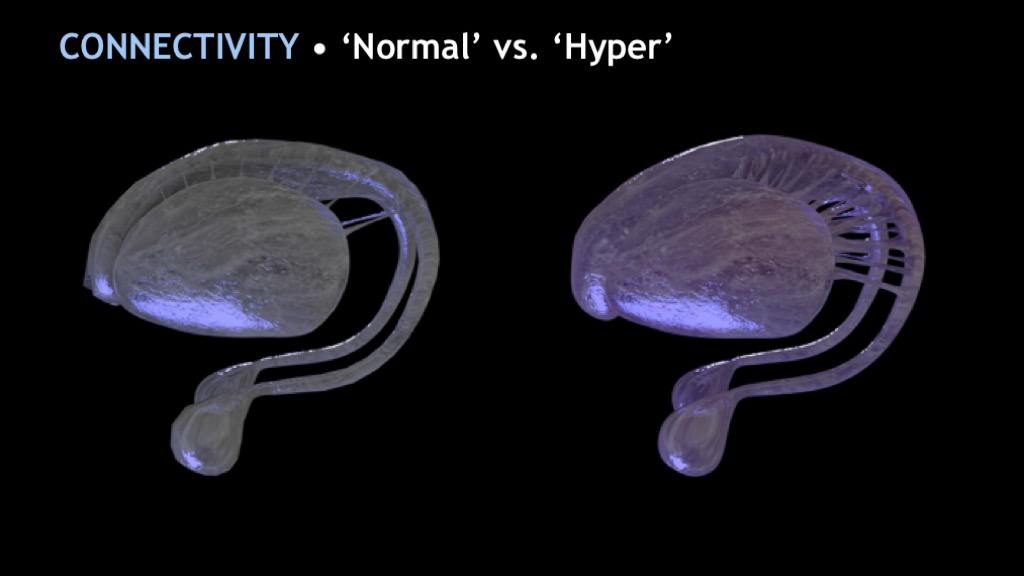 This past winter, a few blogs including Terra Obscura announced the highly intriguing findings of Garry Nolan (Rachford and Carlota Professor in the Dept. of Microbiology and Immunology at Stanford School of Medicine) and forensic neurologist Christopher “Kit” Green (Depts. of Diagnostic Radiology and Psychiatry and Behavioral Neurosciences at Wayne State School of Medicine and Detroit Medical Center) on a brain area called the caudate-putamen. In the course of working with a population of 135 high-performing military and intelligence personnel who had suffered injuries from anomalous encounters in the line of duty, the researchers noted an additional feature in a few patients’ MRIs. Twenty of the most high-functioning and “intuitive” of this group, as determined from medical and psychological records, displayed significantly enhanced connectivity between their caudate and putamen, compared to the general population.
The work of this sample of persons is secret, as are the circumstances of the injuries that brought them to the attention of the researchers in the first place; but the implication is that those who showed the enhanced connectivity are the kinds of people who have “Spidey sense,” who could instinctively guide you down the right path in enemy territory because they sense danger down the left. A sample of remote viewers for whom MRI scans were available all showed the same caudate-putamen biomarker.
The caudate-putamen, also known as the dorsal striatum, is thought to be a kind of “hub” that integrates information from across the brain and translates that information into motor actions. Nolan and Green’s sample show exceptionally high parallel and rapid processing of what in very recent years has emerged as functions of the dorsal striatum’s receipt of incoming sensory information, and subsequent integration in the prefrontal cortex.
In presentations of their finding, the researchers have called the dense, spoke-like connectivity in these high-performing individuals an “antenna”—there is indeed something suggestive of an antenna in its visual appearance—but they have not tested the notion of any electromagnetic receiving or transmission capability, and they recognize that its precise functional role in intuitive skill performance is a matter of speculation at this point. But they did not find this feature at all in brain scans from a retrospective sample of over 300 “ordinary” people—that is, patients who had no medical histories of high executive functioning, and who served as single-blind controls.
And interestingly, it appears to run in families. The researchers fortuitously had access to siblings, parents, and children of some subjects—3 or 4 family members in a few cases—and the MRI finding was present in those individuals also. Consequently, Nolan established a genetic pilot study that is now underway, to learn more about this feature and its heritability. It is still unknown whether and to what extent life experience or training may also influence it (i.e. the brain’s plasticity). When helpfully answering my questions by email, they also stressed that their finding about the caudate-putamen in this sample has not been peer-reviewed, nor yet published, nor subjected to double-blind verification.
“Antenna” is a sexy term, and it got the attention of many people who are interested in intuitive and psychic functioning. But if further research supports this brain feature and its relation to high performance, I have a hunch “Predictor” might turn out to be an even better term for what Nolan and Green have found.
The Jouissance System
The study of psychic phenomena has always adopted some model of information-transfer, rooted in telecommunications technologies of the day. The telegraph dominated the thinking of Frederic Myers with his theory of “telepathy” in the last two decades of the 19th Century. In the Rhines’ day, radio was an obvious metaphor for ESP. And later remote-viewing researchers naturally likened the practice to tuning in on a TV signal. Today, the metaphors of nonlocality and entanglement between psychics’ minds and the wider universe are hot. But if “psi” is really precognition, then nothing necessarily needs to be sensed or detected from outside the body or even outside the nervous system. It would be the nervous system’s connection to itself across time that matters.
In that view, a soldier with Spidey sense might not actually be receiving some kind of waves coming from the IED down the left path and thus leading her squad down the right path. Her brain might instead be post-selecting on the ambivalent future reward of having taken the right path and then heard the explosion and screams of some other less-fortunate squad that took the left. Intuition would be a premonition of ambivalent future reward. If that’s the case, then the neurotransmitter dopamine and the reward circuits that use it might have a lot to do with this disturbing-yet-rewarding “signal” from the individual’s future.
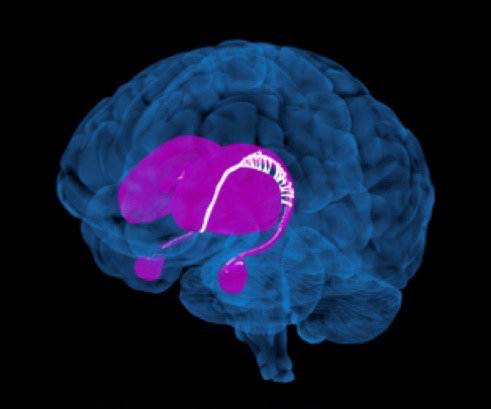 This is why I was (selfishly) a bit excited to hear about Nolan’s and Green’s discovery. In interviews such as his recent appearance on Café Obscura, Nolan has highlighted the caudate and putamen’s role in intuition, but one way of looking at intuition is generating actions from available information quickly, bypassing conscious, deliberate decision-making. When we talk about bypassing those more deliberate processes, we’re essentially talking about making our responses automatic. In a lot of neuroscience literature, the dorsal striatum is not only associated with intuition but also with habits and compulsions—actions we don’t necessarily want to engage in but do so anyway, feeling we have no choice. In other words, in the brain, intuition is closely tied to habit and to the most un-“freely willed” of our behaviors, such as compulsions and addictions.
Like other parts of the reward circuit, the cells of the dorsal striatum, including those spoke- or antenna-like connections identified by Nolan and Green, predominantly use dopamine for signaling. It is part of what I think of as the brain’s “jouissance system.” Jouissance is just a fancy French word for the drive that takes over in a compulsive disorder like a neurosis or an addiction—a reorientation of the salience of incentives away from some euphoric payoff or reward into various cues associated with it, which perpetuate the drive. Freud called it the “compulsion to repeat,” and for him it was the basis of neurotic behavior.*
If anomalous cognition or psi is “really” (or mainly) precognition, it makes sense that brain areas governing habit and compulsivity might figure prominently in its neurobiology. The reason is that computation across the fourth dimension depends on repetition: The brain’s ability to make some sense of information coming down the pike requires self-consistency over time. Just as a New Yorker will have an easier time understanding a time traveler from a 25th Century where they still speak recognizable English in New York versus a future where everyone had switched to Russian, the more we expect our reactions to stimuli in ten minutes or a year will be the same as now, the more decontextualized information coming from our future can make sense and be useful in guiding behavior. Compulsions and habits, which in many ways are just overlearned skills, create the necessary self-expectations that might serve as the cipher-key of information back-flowing from an individual’s future.
A “Predictor” circuit could in a sense be likened to an antenna, but in the fourth dimension. Just like some antennae appear as grids, parallel lines, or “repetitions” in space, a fourth-dimensional biological antenna would likely involve repetition of behaviors over time.
iPredictor™
Here is where we come back to the theme of “free will” and Ted Chiang’s story. Not unlike people in the grip of an addiction or a compulsion, intuitive and highly skilled people are those who readily make decisions without thinking. Their high performance, as well as their “psi,” is an outside-of-conscious-will phenomenon. And it may be the best model for thinking about the unconscious in relation to consciousness: The unconscious leads the way, but it may be in a necessary partnership with the 20-20 hindsight of conscious awareness. The squad leader’s psi/jouissance needs that confirmation in the form of the screams coming from the other path. The time-looping relation to future confirmation is crucial.
 There is a tendency to think of precognition as some kind of superpower enabling the individual to scan various options ahead and select the optimal one, like a kind of radar. But if in fact precognition is just what Freud called “the unconscious” in many or all its manifestations, then we need to rethink its role in our lives. it is not, in that case, some “super” faculty giving us the ability to spot dangers and avoid them—which could lead to the paradoxical situation of preventing a foreseen outcome. It is instead the faculty that prepares us, cushions us, for alarming news and close calls that do lie ahead in our un-freely-willed future.
If there is something like a radar, it would really (in this view) be our ordinary conscious thought processes that consider counterfactual situations and scenarios and make us take wise precautions and adjust our behavior based on past errors. The anxious brain lying awake at 3AM consciously worrying about disasters and dangers and agonizing over mistakes is the real radar that steers us clear from undesirable outcomes ahead. However, in a block universe, action verbs like “steer” need to be seen more statically, as parts of four-D time loop formations. “Steering toward success” needs to be rephrased as “discovering you are the person who was successful.” Overhauling our language to deal with a block universe is a massive subject, for another post (or book).
But the bottom line is: I will be the first in line at the Apple store when the Chiang-inspired iPredictor goes on sale in May, 2026. Far from creating a population of akinetic mutists, it will act as a material(ized) koan, fast-tracking users to Satori.
Postscript: Failure Is Not an Option
People who find the idea of precognition, retrocausation, and time loops interesting are often of an occultist bent, and I have been asked several times how the block universe that allows precognition can be reconciled with the active intention setting that a magician might utilize. And what about the idea that thoughts and intentions create our reality? I often think of my friend Mitch Horowitz’s brilliant writings on New Thought (such as his recent book The Miracle Club), and how determinism in a block universe seems on the surface so antithetical to the outlook he describes: that thoughts are causative.
 Sometimes when two ideas seem diametrically opposed, zooming in reveals a closer kinship. For one thing, I agree with Mitch’s basic assertion that thoughts are causative. Where I may differ is in the direction of their causation. If our unconscious behaviors are premonitory of what we think of as our will, if what we “precognize” with our bodies and our automatic (unconscious) actions is our future conscious thoughts, realizations, and “intentions,” then those thoughts are by definition retro-causing the past. Our conscious realizations and intentions for the future are actually writing (or “having written”) our past life scripts. They do this not just by reordering our memories in the present (Slavoj Žižek’s cautious, not-quite-retrocausal, not-quite-Gnostic position), but by actually directing our actions from the future and influencing our younger selves.
So in other words, I think our thoughts are efficacious, and specifically in our past—that is to say, in the past (or prehistory) of the thought. This kind of retrocausation may be operative on millisecond or second scales, such as in the presentiment research of Dean Radin or the “feeling the future” studies of Daryl Bem, but also over days, years, and decades. A macro model for this is dreams, of the sort I’ve discussed frequently on this blog. If a person’s day is even slightly affected by a dream (even just in the mere act of writing it down) and the dream consists of or contains precognitive material—which it’s even conceivable all dreams do—then information from the future has exerted a shaping force on the past … even if we misinterpret the dream. If this time-looping logic goes all the way down, even to the cellular level of thoughts in the brain, as I strongly suspect it will turn out to, then our thoughts are causative of our histories. We ongoingly shape ourselves into the past. Our past is an effect of our future.
Note that this is not the same thing as “changing the past”—the idea that we could somehow meddle in and alter our timelines—the Mandela effect and whatnot. How would we ever know our timeline had changed? We can however produce improved outcomes in our near future when we realize how we have contributed to shaping our past. We can sow seeds in the past for a better tomorrow. This is exactly the payoff of the “dream paleontology” I described a few posts back, and it will turn out to be the motto or philosophy of our timefaring descendents.
We need to remember: What we think we “know” of the past (or present) is at best a tapestry of suppositions, assumptions, and interpretations. Most modern conceptual frameworks for understanding the past make no room for a teleological influence and thus we think of the past as fixed and untouchable by any later influence … but that’s just a modern, post-Enlightenment failure of imagination, not a real limitation on reality. Increasingly, evidence shows our commonsense view of causality only going in a forward direction is simply wrong—in Time Loops I call it “folk causality.” We simply need to update our imaginations.
We have no proof yet, but my hunch is that the underlying principle in precognition will probably turn out to be retrocausal processes in quantum biology—perhaps quantum computation in molecular structures controlling brain plasticity (microtubules). One way we already know quantum processes manifest in biology is the phenomenon called quantum tunneling: the apparent fast-forwarding of unmeasured particles toward their destinations. (We know photosynthesis and enzymatic actions depend on it, for instance.) The retrocausal interpretation of quantum mechanics reframes this: It is the “measurement” (or just, terminal interaction) that retro-determines the particle’s path.
This quantum fast-forwarding toward what to our eyes appear like “intended” outcomes could be the X factor separating life from lifeless matter in organic molecules, the missing “vital” principle underlying life. It would force us to reincorporate “purpose and desire” into our understanding of living systems. And it would scale up in nervous systems, which tend (to some greater-than-chance degree) to post-select on survival and rewards in the organism’s future.
This allows us to “flip” the New Thought idea that success is built on mind. Mind is really built on success. Mind IS success. And since on a basic level that “success” is post-selecting the actions leading to it, there is no “other” world of “failure” (or “missing”) out there as an option for where a particle could go or what an organism could do. That Spidey-sense squad leader automatically took the right path without the IED, and there was no alternative or counterfactual reality where she took the left path instead. Failure is literally not an option in a retrocausal universe, at least on the most basic level of particles. The Mind scales up this “tunneling toward the optimum” principle and utilizes it to create the splendiferous 4-D formations that are our biographies.
ACKNOWLEDGMENTS: Many thanks to Kit Green and Garry Nolan for sharing their research and slides with me, and for answering my many questions. My interpretations of their finding are entirely my own. Thanks also to Michael Garfield of the Future Fossils podcast for alerting me to Chiang’s “What’s Expected of Us.”
NOTES
** A similar shift of orientation toward cues rather than payoffs also reflects the intrinsic reward that takes over in practioners of highly trained skills. For a race car driver, the pleasure is in the driving, not just in crossing the finish line—in fact, the latter is a bit of a disappointment, because it means the race is over. Presumably some of the intuitive high-performers in Nolan’s and Green’s sample are fueled by the same dopamine drive, a kind of jouissance from always being on the edge of peril or risk.

Edges of Forever: Time Travel and the Stories That Might Have Been
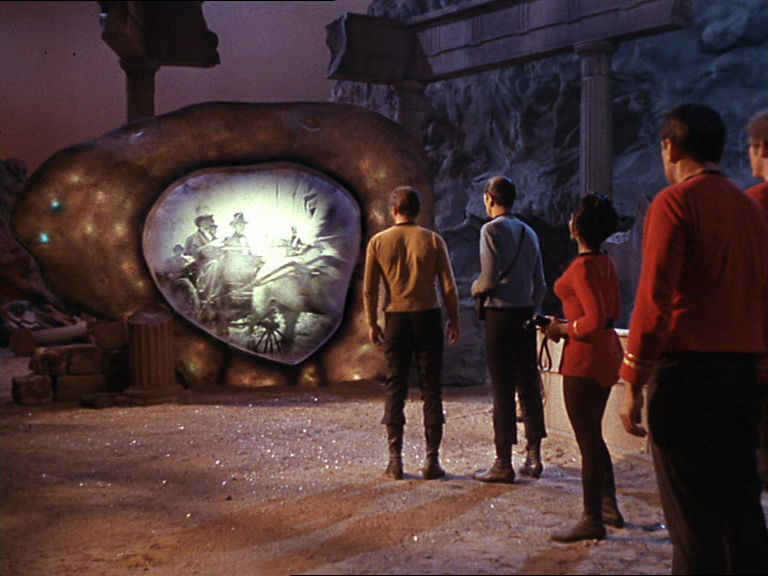
“We can’t imagine our lives without the unlived lives they contain.”—Adam Phillips, Missing Out
Ship’s Log: star-date 3139.0. Having tracked unusual spacetime ripples to their source, the Starship Enterprise now threatens to be ripped apart as it struggles to maintain its orbit over an uncharted, weirdly time-disturbing planet. There is chaos on the bridge. Mr. Sulu, injured by his exploding control panel, is brought back to life by an injection of an adrenaline-like wonder-drug called Cordrazine … but just then, another spacetime ripple causes Dr. McCoy to accidentally inject himself with a megadose of the stimulant. Raving mad, McCoy dashes from the bridge as the rest of the crew struggle to save the ship, and he beams himself down to the planet that is causing all the spacetime havoc.
 Pursuing the mad Doctor to the surface, Kirk, Spock and several crewmembers find they are in the ruins of an incredibly ancient and vast city; at its heart is an enormous loop pulsating with light. This object awakens to their presence and announces, in a deep echoing voice, that it is the Guardian of Forever, a sentient portal through time. It begins showing its visitors scenes from Earth’s history, and just as it displays a street scene from 1930s America, Dr. McCoy, who had been hiding behind a nearby rock, dashes through the portal.
The landing party suddenly finds that the Enterprise has disappeared from orbit overhead. Somehow Dr. McCoy, centuries in the past, changed history, leading to a present with no Enterprise to return to, and perhaps no Star Fleet … maybe even no Earth. So Kirk and Spock have to go through the portal themselves to try and make things right.
Thus begins “The City on the Edge of Forever,” perhaps the most famous and best-loved original series Star Trek episode. Even now, over half a century since it first aired, it remains a great hour of television, with some of the most moving, funny, and (yes) campy moments in the whole series. It is also one of the few Trek episodes to attain a kind of tragic gravitas. Joan Collins delivers a memorable performance as Kirk’s love interest Edith Keeler, the Depression-era peace activist whose sacrifice to the wheels of history is required to return the river of time to its former course.
Even though it is just a piece of network TV from a much more innocent era, “City” is arguably one of the most influential time travel narratives of all time. I’ll wager that more people have seen (and remember) this one episode of Gene Roddenberry’s NBC series than have ever read H. G. Wells’ The Time Machine, for instance. It also came to define the life of its famously cantankerous scriptwriter Harlan Ellison in ways that weirdly—really weirdly—mimicked the original treatment and teleplay he penned for it. This is no accident, as I believe it is yet another case of the literary-creative precognition that is so prevalent among imaginative writers. As we saw with Joan Lindsay and her novel Picnic at Hanging Rock, these cases always fractally swirl around “time gimmicks” of one sort or another. Ellison’s time machine (which only became the sentient stone-loop Guardian in the filmed episode) made the perfect “strange attractor” for a precognitive writer’s soul. And as in Lindsay’s case, it was the alterations made to Ellison’s story by other people that created this defining time warp in his life.
Anger Issues
Trek nerds know what went down, at least in its rough outlines, and Marc Cushman gives all the sordid details in the first volume of his essential tome, These Are the Voyages. Ellison, already a respected writer of SF stories and screenplays for series like The Outer Limits, was commissioned by Roddenberry in 1966 to write an episode for the first season of his new space series. The treatment Ellison delivered contained the brilliant premise we all know and love—Kirk travels into the past and falls in love with an idealistic peace activist whom he must then allow to die … but it was also totally unfilmable as written, at least to fit within a single hour of network TV. Also, it contained dark elements that were way out of character with what Roddenberry envisioned for his still-unaired utopian show.
 Ellison’s version opens with a drug deal. The ship’s navigator, hopelessly addicted to an alien narcotic called the Jewels of Sound, purchases some of the stuff from a shady officer named Beckwith. We fade to the bridge, where the navigator, now high as a kite, nearly destroys the ship and is relieved by an angry Mr. Spock. When the navigator, below decks, announces to Beckwith he’s going to go straight and turn the dealer in, Beckwith murders him. There follows a court martial that finds Beckwith guilty, and Kirk and Spock lead a landing party down to a desolate planet to execute Beckwith by firing squad. Their immediate punitive plans are interrupted when they spot an ancient city high in the distant mountains. Because Star Fleet protocols prohibit executing criminals on inhabited worlds, they need to investigate this city before executing Beckwith, a “creature not even worth calling a man.”
Once the landing party reaches the city, they find it long abandoned except for a group of tall, ancient, bearded immortals who protect a portal-like time machine. After Beckwith flees through the machine while it is showing scenes of the Depression, the landing party beams back up, only to find that the ship is no longer the Enterprise but a renegade pirate ship called the Condor. This is when Kirk and Spock decide to go back down and go through the portal to try and change history back, while the rest of the landing party fight off the pirates. Once in 1930s America (Chicago in Ellison’s version), Kirk and Spock are chased by a xenophobic mob, steal some clothes, and then get jobs while waiting for Beckwith to appear. All this happens before we ever meet Kirk’s love interest Edith Koestler (she was changed to Keeler in a later version) in Act Three.
It’s a two-hour movie, in other words, not a 50-minute Star Trek script. And did I mention it was dark? After Kirk and Spock repair history by preventing Beckwith from pushing Edith out of the way of a truck, they return to the future; there, the “wise” (in fact, sadistic) Guardians assure Spock and the grief-immobilized Kirk that history has been repaired, but as a favor they request that they leave Beckwith with them, so they can punish him appropriately. They beckon Beckwith toward a pillar of light, and he “finds himself materializing in the heart of a sun.”
An execution that goes on forever and ever, for the Guardians have altered their machines so that Beckwith is caught in a time-Mobius. An interlocked time-phase that puts him into the heart of a blazing inferno just long enough to die, then snaps him out to a moment before he died, then puts him back then takes him out, over and over and over and over…
Yeah. It’s a really angry story. Ellison was a famously angry man. (Writer Nat Segaloff titles his biography of Ellison A Lit Fuse.)
The script Ellison delivered after Roddenberry’s requested cuts and changes simplified things a little—for instance, the court martial and firing squad from the treatment were eliminated in favor of Beckwith just fleeing to the surface—but the changes were not sufficient. Thus, Roddenberry had his writing staff—Steven Carabatsos, Gene Coon, and Dorothy Fontana—perform a series of rewrites that greatly simplified Ellison’s story. Beckwith was eliminated and an accidentally drugged McCoy became our history-altering MacGuffin. The Guardians of the time portal were eliminated and the portal itself became sentient, saving further on cost. The scene where the landing party beams up to the Condor and Yeoman Rand fights to hold the pirates at bay, was cut. Scenes showing a fascist demagogue stirring up hate in the streets and an employer’s racist treatment of Spock (passing himself off as a “Chinee”) were also cut. They also eliminated other, moving but strictly extraneous scenes and characters, including one involving a legless veteran of the Battle of Verdun named Trooper—more on whom below.
Apart from just simplifying (and way lightening up) Ellison’s sprawling story, the rewrites clarified and strengthened the narrative in crucial ways. In Ellison’s original version, Spock merely convinces Kirk that Edith must die because of supposition on his part that her peace movement might alter history by delaying the U.S. entry into WWII. Fontana, the unsung script doctor and secret heart of much of Star Trek, added the contrivance of a radio tube mechanism whereby Spock is able to use his tricorder to actually view news headlines from the original and the altered timelines, thereby convincing Kirk (and the audience) that, as he repeatedly says, “Edith Keeler must die.” This simple, elegant plot device is crucial to understanding and being compelled by the story.
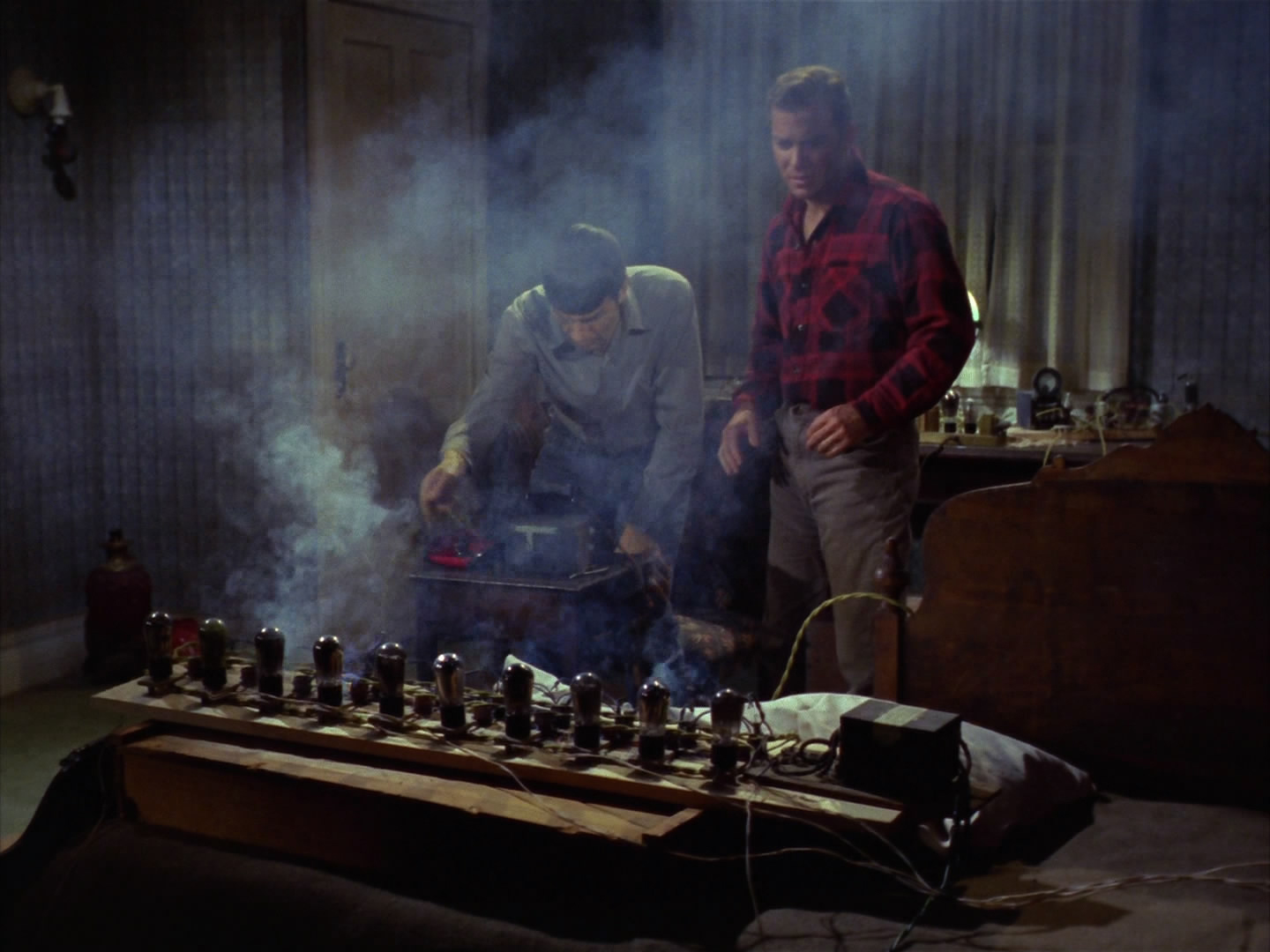 I’m hardly the first to say that, even though Ellison’s teleplay is beautifully written and also contains the most badass scene ever written for Yeoman Rand*, it’s not Star Trek. It is unnecessarily sprawling—way too sprawling for an hour-long show. Whatever we might think of moralistically bowdlerizing realities (even on future starships) like drug-dealing and addiction, or the dangers of fascism, it reads less like an installment of the essentially utopian future of Roddenberry’s series than like a stand-alone film script. The logical and compassionate Spock’s repeated epithets about Depression-era Earthers (“savages” and “barbarians”) do not compute. Nor does it seem realistic that Kirk would be willing to let his beloved Edith die simply because Spock persuades him she might change history a certain way, based on cryptic hints provided by the ancient Guardians of the portal. There needs to be something concrete, and the viewer needs to see on Spock’s amped-up tricorder those conflicting headlines (“SOCIAL WORKER KILLED” and “F.D.R. CONFERS WITH SLUM AREA ‘ANGEL’”) as well as scenes of Hitler’s rallies, to be really sold on the necessity of letting history resume its former shape through the sacrifice of Edith. The mad-scientist contrivance of radio tubes—made as Spock memorably says, from “stone knives and bearskins”—is just the ticket.
As Fontana later revealed, one transformation in the story was not due to rewriting but to a comical misreading. Ellison’s ancient city was, like its Guardians, like something out of Tolkien—an ethereal vision of spires in the high mountains. Ellison had even described it as full of “rune stones.” The director of the art department, however, who admitted reading it after a couple drinks, did not know what “runes” were and, when he consulted a dictionary, happened on the word “ruins” and decided that that must be what Ellison intended. So the city in the filmed episode became an ancient, ruined city—an anachronistic (but now iconic) mix of broken Doric columns and the distended bagel-shaped Guardian of Forever.
Ellison hated it.
Success Has Many Parents
It is always easy to laud the solitary genius writer and fault the producers when things go wrong in Hollywood, but it is harder to acknowledge that Hollywood’s successes often arise from the same process. As Leonard Nimoy diplomatically puts it in a statement about Ellison’s script, “Success has many fathers. Failure is an orphan.” Fathers and mothers. The rewrites by Carabatsos, Coon, Fontana, and ultimately Roddenberry himself took Ellison’s great core premise and made it even better by stripping it of what was inessential and amplifying the love story at its heart. They also, it must be said, made it affordable—they made it possible to make the episode. Besides being too long, Ellison’s script had called for large crowds, glimpses of a mastodon rampaging through the Pleistocene, a pirate ship in orbit, and many more locations and characters. The success of the episode, and indeed its very existence, really was the product of a collaborative effort … and even happy accidents like the drunk art director thinking “rune” meant “ruin.”
 Ellison was never able to see it that way … at least not consciously. He was already used to producers changing his scripts, and on other shows had opted to use the name “Cordwainer Bird” to disown the ones he felt were butchered. That name honored Paul Linebarger’s nom de plume Cordwainer Smith, while giving the “bird” to the producers who ruined his work. Fontana’s naming of the super-stimulant that drives McCoy mad, “Cordrazine,” was clearly a preemptive acknowledgment that Ellison would probably react badly to how she was changing his work. (Viewers should thus understand McCoy’s Cordrazine-crazed “Murderers! Assassins!” as Fontana’s affectionate parody of Ellison’s imagined reaction to her script-doctoring.)
Despite the extensive rewrites, Roddenberry begged Ellison not to use his nom de plume on this episode. The success—indeed, survival—of his bold new series depended on the high-caliber names he was bringing to the project. In fact, the producer had already elicited Ellison’s aid in a letter-writing campaign to “save Star Trek.” It has been argued that it was the success of “City” specifically that led to the renewal of the show for a second season. Thus, Ellison’s script, and his name, became inextricably entangled with Star Trek and its success.
While his initial experience was certainly frustrating, Ellison’s ire mainly grew over the subsequent decades when, at Star Trek conventions and in interviews, Roddenberry persisted in saying that the rewrites of “City” were necessary because Ellison’s original script was poor and that “he had Scotty dealing drugs”—both of which were demonstrably false, as anyone reading the draft can attest. Roddenberry’s lies over the years helped turn Ellison’s entanglement with Star Trek and with everyone’s favorite episode into a kind of festering wound: It became a dark sun, one that he couldn’t walk away from.
A fixture at Trek conventions and friend of many of its cast, Ellison’s grievance over Roddenberry’s unprofessional behavior and the original script of “City” that might have been—which he never stopped asserting was far superior to what was filmed—became part of the Trek myth. It was eventually published, along with Ellison’s incendiary rant and supporting essays by Nimoy, Fontana, and other Trek staff and cast, in 1995. Then in 2014 a comic series was made based on it, with gorgeous art by J. K. Woodward and covers by Juan Ortiz and Paul Shipper.
Thus, Ellison’s name came to be indelibly associated with the show. And arguably, at least for the wider public, it may be “City on the Edge of Forever” that Ellison is best known for. It is certainly what I knew him best for, even before I was aware of any of this saga, and I had even read a lot of his other fiction as a teen. All his fiction is outstanding, but “City” is fairly or unfairly regarded as one of his masterpieces.
Here’s the thing: I think this big existential/creative clusterfuck, this big unfolding train wreck having to do with authorship and counterfactuals—what-ifs having to do with what he perceived as the ruination of his script, the “show that might have been,” and his good name appearing on what was really a collective creative effort—are precisely what his original script of “City” is about. In that story, he was vividly precognizing the “counterfactual neurosis” he suffered after it was rewritten and aired on April 6, 1967.
Mattering in the Time Flow
James Gleick argues in his book Time Travel that the SF premise of traveling back in time and undoing past mistakes is a way of dealing with trauma and regret. (“Regret,” he writes, “is the time traveler’s energy bar.”) The psychoanalytic term for regret and the counterfactual fantasies that repair our regrets is “castration.” That term is not just (or mainly) about lost genitalia. It is about being and nonbeing, having and losing, and fundamentally indeterminate there/not-there impossibility around which our desires and wishes revolve. The inner life of the neurotic is, one way or another, a confusing landscape of superimposed counterfactuals, “what ifs” and “what if nots” hovering over everything.
 As I argue in Time Loops, life’s castrations—episodes in which we gain something despite a loss, or lose something despite a gain—are precisely what the precognitive (i.e., time traveling) unconscious focuses on.
Ellison’s script centers on a counterfactual situation involving the destruction (vs. rescue) of something pure and beautiful and innocent. Kirk, who has fallen in love with the do-gooder activist Edith, must override his urge to stop Beckwith from pushing her out of the way of an oncoming truck … thus restoring history and returning the Enterprise to that future sky, so our heroes can go home. In other words, the life of this innocent beautiful pure thing must be taken or mangled so that others may live and that history must resume the shape that it already has.
It is interesting, first of all, that key characters cut from Ellison’s story have a curious there/not there quality even in his script. First, it seems significant how much deal—bizarrely too much—Ellison’s story makes of the erasure/obliteration of the “evil” character Beckwith, who was replaced by the temporarily Cordrazine-addled McCoy in the filmed version. It’s like the script’s MacGuffin was written to disappear, first to be executed on the most desolate planet imaginable—it is described as being so lonely and hopeless in the dead of intergalactic space that the ship’s blinds are drawn to keep the crew from having to view it (seriously!)—and then at the end to be condemned to infinite deaths in the heart of a sun by the “wise” Guardians. They keep bringing him back only to destroy him again, and again, and again.
Careful readers of the original script will note an uncomfortable paradox about Beckwith and his punishment: Despite his depravity, it is Beckwith whose human impulse is to rescue Edith at the climactic moment of the story as Ellison told it: Impulsively, he rushes to save her as a truck barrels down on her. It’s not Kirk’s love for Edith that changes the past, in other words—an obvious premise for a lesser writer—but the angry, drug-dealing murderer. But with Kirk and Spock now on the scene to make things right, Beckwith is thwarted from redeeming himself.** His flickering there/not there quality is like the larger counterfactual premise in which he is embedded, as well as the counterfactual history of Ellison’s script itself.
Something similar is true of Trooper, the legless survivor of the battle of Verdun, who appears at the beginning of the final act of Ellison’s script. “He is a man destroyed,” Ellison writes. “The light has gone out in the eyes, the mouth speaks a silent sadness. Disillusioned. He was the drummer boy who went to war, and came back to find no one needed him.” A sympathetic Kirk offers a couple dollars to Trooper, who is selling apples on the street from his wheeled cart, to let him know if he sees an armed, unusually-dressed man—Beckwith—appear in the neighborhood. Later, when Kirk and Spock are out walking at night, the veteran lets them know that a man fitting that description is nearby. Beckwith ambushes them and fires his phaser, vaporizing Trooper, and then gets away. Spock is concerned about Trooper’s death, noting: “Any death in this era that alters the sum of intelligence … alters time permanently.” Saddened, Kirk adds, “If he mattered in the time-flow.”
Later, after the accident that kills Edith and Kirk and Spock bring Beckwith back to the future, the time guardians announce, “Time has resumed its shape.” The first thing Spock asks is “What of the death of the cripple?” “He was negligible,” the wise Guardians reassure Spock.
So here again: The veteran’s mutilated condition, then his literal phaser-vaporization within the story and the assurance that history remains unchanged despite his death, both prefigure his “castration” from the story itself as it was eventually filmed.*** He is created to be unnecessary, disposable. Interestingly, the creators of the five-part comic version of Harlan Ellison’s The City on the Edge of Forever depicted Trooper as Ellison—honoring the writer by depicting him as its most poignant character.
Did Ellison’s precognitive brain grasp his own “castration” already as he was writing the character of Trooper? It is almost as if, in writing this character, Ellison was channeling his future regret at capitulating to his nemesis Roddenberry over the issue of his real name appearing on the title card—not standing up to him, in other words. For the famously feisty Ellison, this uncharacteristic capitulation to a producer may have been the crux of his counterfactual neurosis, the regret that drove him repeatedly into the past to make things right.
“Let Me Help”
Another interesting “counterfactual” difference between “City” as it might have been in Ellison’s version and as it “really was” in the televised version happens to center on my favorite bit of dialogue in all Star Trek. As Edith and Kirk are out walking in the evening, on a date, she notes how otherworldly he seems and his difficulty talking about his past. First, here’s how it appears in Ellison’s script:
EDITH: Sometimes you seem, well, disoriented, Jim, like a man fresh from the country.
KIRK: Iowa?
EDITH: Further away than that.
KIRK: “When night proceeds to fall, all men become strangers…”
EDITH: It’s true. Who said it, I don’t recognize it.
KIRK: Wellman 9. An obscure poet. Someday people will call his work the most beautiful ever known in the galaxy.
EDITH: That’s a lot of territory.
It’s poetic and beautiful—indeed, like much of Ellison’s script. But now read the scene as it appeared in the filmed version:
EDITH: Whatever it is, let me help.
KIRK: Let me help. A hundred years or so from now, I believe, a famous novelist will write a classic using that theme. He’ll recommend those three words even over I love you.
EDITH: Centuries from now? Who is he? Where does he come? Where will he come from?
KIRK: Silly question. Want to hear a silly answer?
EDITH: Yes.
KIRK: A planet circling that far left star in Orion’s belt…
 I don’t know whether it was Coon or Fontana (or Roddenberry) who wrote this beautiful scene. But note how the final version not only manages to substantiate Kirk’s enigmatical nature in poetic terms (as Ellison did), but also makes the scene romantic (it slips “I love you” in there) as well as expressing what Spock will later say in starker terms: “She was right, but at the wrong time.” Kirk so much as tells Edith here that her own ethic of helping really is the way of the future—beyond mere love between two people. Kirk’s soliloquy becomes about Edith, in other words, instead of about himself: She is ahead of her time, just as much as he is out of his.
My point is by no means that Ellison is a lesser writer than Coon or Fontana; he came up with the story, and he came up with the scene. It is simply that, like all good script revisions, a good idea is often refined further to become great. Behind many great writers there is also a great editor.
One has to wonder how much of the darkness and conflict in Ellison’s story, such as the dripping-with-cruelty punishment of Beckwith, or even the line about all men becoming strangers, reflected his own future conflicted feelings the “impossible” situation his script for “City” had put him in as an artist, because of the way his original creation differed from what audiences saw. Although the core premise and situation of “City” is every bit Ellison’s genius, much of what was shown in the episode was someone else’s. Besides the scene about “Let me help,” those “not Ellison” parts include also its most famous and memorable lines like “stone knives and bearskins” and “Edith Keeler must die.” Yet there’s Ellison’s name, in bold yellow letters right in the title credits. Taking (or being given) credit for other people’s good work is just as uncomfortable for a serious artist as having one’s words mangled or changed for the worse.
Having Our Cake…
The psychoanalytic essayist Adam Phillips almost sounds as if he has Ellison specifically in mind when he writes in his book Missing Out that “what was not possible all too easily becomes the story of our lives. Indeed, our lived lives might become a protracted mourning for, or an endless tantrum about, the lives we were unable to live.”
Again, Ellison maintained to the bitter end that his script was far superior to what Star Trek audiences saw that April night in 1967 (and endlessly on reruns in the 1970s), and he always promoted his script as the “City on the Edge of Forever” that should have been. But the thing about counterfactuals, about worlds and lives that might or should have been, is their disingenuousness. They are predicated on changing some nagging detail that bugs us, but without facing all the many consequences that would inevitably arise from making such a change in the real world. They are about having our cake and eating it too.
When you read Ellison’s bilious rants about Roddenberry and his Star Trek experience, his tirades against the talentless hacks who make life a living hell for writers, his scorn for idiot actors and the “bimbo queen” Joan Collins who tarnished his pure character Edith with her steamy reputation, the phrase “protests too much, methinks” comes to mind. Indeed, protests too much against a reality that really favored him in many ways.
There is no doubt Roddenberry lied and behaved unprofessionally, and for that, Ellison was right to feel aggrieved. But where is the acknowledgment that Star Trek and “City” were important and even central features in his life? Where is the acknowledgment that sometimes producers make the right decisions with scripts and that simplifying his sprawling story made it filmable? A reality of writing for the TV and film industry is that scripts are rewritten—and yes, sometimes badly. But the success of “City” as it was filmed—it won a Hugo award and was listed by many fans, cast, and crew as their favorite Trek episode—attest that the rewrites and other creative decisions made by Roddenberry’s team did not hurt this particular episode one bit. Quite the opposite.
The situation here is very similar to that of Joan Lindsay’s Picnic at Hanging Rock: Had changes not been made to the original story, it either would not have been published or filmed, or it would have failed to gain a huge following. An unfilmed or poorly produced “City” would have failed to win the hearts and minds of audiences and thus would have failed to help sustain the ship of Star Trek into a second season … and then sustain ongoing interest of the fans. The same may be true had Ellison’s name not been attached to it. In either case, he would not have been associated—angrily or pleasantly—with the show and its enormous fan base and success over the next decades and for the rest of his life. (He was a regular feature at those Trek conventions.)
The disingenuous of Ellison’s later-life reflections on “City”—and I think, his deep-down awareness of their disingenuousness—are encoded, precognitively, right in the script’s basic “grandfather paradox” premise: that one person could change the past and that his shipmates could pursue him and undo or nullify his action. I mean, any ten-year-old can see, and does see on some level, that if the past has been altered to the extent that there’s no more Enterprise in orbit, there can’t be a Kirk and Spock and landing party standing there in front of the Guardian of Forever either. (This glaring problem was even more obvious in Ellison’s script, where the landing party beams back up to a different ship, now a pirate vessel manned by criminals; what are the odds that in the altered timeline an evil counterpart to the Enterprise just happened to be overhead?) Moreover, it is precisely while on a date with Kirk that the truck runs Edith over and that Beckwith (in Ellison’s version) or McCoy (in the final version) can be thwarted by our heroes from saving her.
The counter-history, in other words, depends on the “real” (or corrective/corrected) history at every turn. These problems stood out like sore thumbs in Ellison’s original script and would have made it that much harder to suspend disbelief. The rewrites hid them more effectively, but they are still there in the basic premise.
Our thoughts about how reality might be different unfold within this reality as it is. It is this easily forgotten fact that can serve as the “cipher key” of precognitive art, symptoms, and dreams.
Soldier
It is often time gimmicks of one sort or another that are the dead tip-off that some sort of real time loop by way of precognition may be occurring in an artwork as much as in a dream. It is interesting that while Ellison wrote a wide range of stories, and not only science fiction, he may be best known for three TV scripts about time travel: one that became an ongoing source of frustration into his future (“City”), another that resulted in a plagiarism suit, and a third that got associated with another filmmaker’s later work by association. All three involve future conflicts displaced or transposed into the past.
 In 1964, Ellison adapted one of his short stories (“Soldier from Tomorrow”) for the series The Outer Limits. This episode, “Soldier,” starred Michael Ansara (whom Trek fans will recognized as the Klingon Commander Kang from “Day of the Dove”) as a future warrior named Qarlo Clobrigny who accidentally slips back through time to 20th Century LA, followed by an unnamed enemy soldier intent on finding and killing him. The opening scene of this episode (a post-apocalyptic battlefield with rayguns cutting through the night sky), and its basic premise (future warriors pursuing each other into the past), are virtually identical to James Cameron’s Terminator two decades later. When someone alerted Ellison to this similarity even before the film was released, he managed to get a look at the film in an early screening and sued the production company and distributor. Part of the evidence supporting Ellison’s claim of plagiarism was that Cameron had admitted in an interview with Starlog magazine that his story was inspired by some old Outer Limits episodes. A settlement was reached that included a credit to “the works of Harlan Ellison” in the home video version.
Cameron didn’t agree with the settlement, but it is obvious, watching “Soldier,” that his film did borrow from it (perhaps unconsciously). Could it also be the case that “Soldier” was precognitively inspired by Terminator—or rather, by Ellison’s uncomfortable encounter with that film—two decades hence? I find it odd that, here again, a story involving time travel, centering on a clash between two mighty foes chasing each other into the past, also resulted later in hard feelings between Ellison and a bigshot director that pertained directly to questions of originality and authorship.
Time travel stories are stories about origins. The linguist who studies Qarlo and takes him into his home determines that he has no family—no parents (he was, he reveals, raised in a “creche hatchery”). The unparented, the unborn, the truly original, with which we are led to sympathize, is pursued into the past by an enemy. Is this not a little like how Ellison might have seen Cameron’s apparent plundering of his 20-year-old “Soldier”?****
Even more uncannily, just as Trooper is depicted as legless in Ellison’s original “City” script, the pursuing unnamed future warrior in “Soldier” is trapped for most of the episode between times, struggling with his legs still in the future while his upper body is in the past. He literally struggles, legless, to free himself from his limbo throughout the episode.
People who are vaguely aware of Ellison’s legal wrangling around Terminator sometimes confuse or conflate “Soldier” with another, even better (and stranger) Outer Limits episode Ellison also penned in 1964, called “Demon with a Glass Hand.” This episode is about a mystery man named Trent, played memorably by Robert Culp, who is pursued to 20th Century Los Angeles from the far future by alien Kaibans, bent on exterminating the last survivor of the human race. Trent is fitted with a glass hand, a computer whose memory is contained in missing fingers that he must obtain from the Kaibans who are pursuing him. In the end, having finally recovered all his fingers, the computer reveals that he himself is an android whose torso contains the memory of the entire human race on a copper wire—he must wait 2000 years for their memory to be reconstituted.
 The possible confusion with the Terminator story here is the role of the hand—recall that Terminator 2 is premised upon the attempt to back-engineer technology recovered from the arm of the original robot assassin left behind in the past. But what a viewer of “Demon” today will be stunned by is the familiarity of the setting: The action takes place in the Bradbury Building in Los Angeles, which is where the climax of Blade Runner also takes place. Watching “Demon” now is like a weird B&W déjà vu, “revisiting” this gorgeous Victorian building with its wrought iron railings and its elevators. Like in Blade Runner, some of the action takes place in its attic and on its roof. And like Blade Runner’s climactic scenes with a fixation on hands that are mangled or maimed (Deckard’s broken fingers, Roy Batty’s self-impalement), “Demon” also centers on images of Trent’s glass hand that is disturbingly incomplete, missing some of its digits.
Here again, is sci-fi causality simply proceeding in the usual, billiard-ball direction, with a more modern filmmaker (Ridley Scott in this case) paying homage to a brilliant predecessor? Or is there a degree of bidirectional causality going on too? Did Ellison’s time travel scripts fractally reflect his later mixed feelings over the role of those scripts in his life, which by then appeared as forgotten ghosts haunting big science fiction blockbusters?
There is no way to answer these kinds of questions definitively, and we cannot ask Ellison about it because he passed away in June of last year. But in my experience with dreams and writing, time travel is a conveniently gimmicky way for the precognitive unconscious to package an idea or a feeling that comes from one’s future. I suspect Ellison, at least in these famous time-travel stories, was drawing on his future conflicts with other artists as well as with his future self, as the source and wellspring of his creativity.
2+2=4
A psychoanalyst professor of mine used to relate a piece of professional lore that applies to a conflicted person like Ellison, or to anyone insofar as we are conflicted: A normal person says “two plus two equals four.” A psychotic person says “two plus two equals five.” But a neurotic person says “two plus two equals four … and I hate it.” The moment of cure in psychoanalysis is equivalent to becoming able to say that two plus two equals four without screwing one’s face into a grimace—an acceptance of reality as it is, without nursing the kinds of counterfactual fantasies that consume so much of our inner energy.
 The Zen experience of “suchness” or tathata, is identical to this almost euphoric satisfaction of things being just as they are. In other words, nothing is different, but suddenly I don’t need to worry so much about it. I don’t need to mentally rummage in the past to correct things that can’t be fixed anyway. And I don’t need to stress out that my actions now might lead to a future that will compare unfavorably to one in my imagination.
The Guardian of Forever in the famous, filmed version of “The City on the Edge of Forever” has its own way of pronouncing the psychoanalytic cure, or tathata, and one that is even more poetic: Upon Kirk, Spock, and McCoy’s return to the future, it announces: “All is as it was before.”
All is as it was before. It is a deeply reassuring statement to the rest of the landing party, who barely noticed Kirk and Spock were gone (from their vantage point, they had only been away a minute or two) and now find the Enterprise hailing them from orbit. It is not totally reassuring to Kirk, smarting (to put it mildly) from the pain of losing Edith Keeler. But restoring time to its normal shape is often painful, even while it is freeing—regaining one’s “legs,” so to speak, or one’s ship. You are free to move on.
It enables you to say, as Kirk does at the end of “City”: “Let’s get the hell out of here.”
Personal Postscript
I’ve been putting off writing about “City” for a long time. It is such a powerful myth in my own life that I am almost superstitious about it. It initially aired exactly one month after my birth, and it is indelibly etched in my brain from a childhood steeped in Star Trek reruns. Over the years I have had significant, powerful dreams that centered on motifs and objects from this episode. These dreams were not about that episode—why would evolution equip us with a brain that obsessed over old television shows?—rather, like all dreams, they were using its elements and themes as symbols to represent concerns in my life then and even, I think, thoughts from my future. Those thoughts including some of the ideas about time, time loops, and counterfactuals that have been obsessing me in the past year or so.
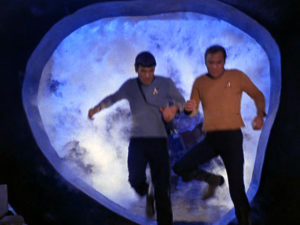 Another, equivalent way of looking at it is that these present thoughts—even this blog post—shaped me in my past, even decades ago, via those dreams.
For example, Spock’s radio-tube contraption as a kind of “counterfactual detector” has been a recurring theme in my dreams over the years. It is often conflated or mashed up with an old tube amp I purchased at a music store on Pearl Street in Boulder, Colorado, in my freshman year of college and very regretfully swapped for a less cumbersome solid-state one a couple years later. (Both amps are now long gone from my life.) This “amp that might have been” (always threatening to overheat, as Spock’s does) has reappeared in dreams over the years in connection with counterfactual situations, sometimes with a “time gimmick” involved. In one dream, for example, I used the device to play a heavily distorted version of the Doctor Who theme song. That too was years before I knew I’d be devoting a significant chunk of my life to the study of time and our mental travel through it.
In another powerful dream from 1995, I made an initiatory journey through a stone loop in a wild landscape toward a plaster mastodon (ancient bones in a cast), prefiguring by more than two decades my parapsychological interest in time loops and the autobiographical project of dream paleontology … and possibly even prefiguring my recent reading of Ellison’s teleplay, which includes a mastodon appearing in his time portal.
The lesson of time travel is that the past cannot be changed from what already is, but that it can be (and always was) created by us in the present. As we move through life, especially as we become increasingly conscious of our four-dimensional nature (our “long body”), we can ongoingly unearth evidence of how our experiences and thoughts now contributed to who we were and what we did then. This mindblowing perspective on our biographies will increase as we become more culturally comfortable with retrocausation. With that comfort will come the setting aside of security blankets like “many worlds” and multiverses that let us have the cake of our exquisite regrets (like foolishly getting rid of that totally sweet tube amp) and eat them too.
NOTES
* I’m obviously somewhat biased in favor of “City” as it was filmed, but one regret about the version that might have been is that Ellison had written such a good scene for Yeoman Rand, fighting to keep the pirates at bay aboard the renegade ship Condor. Grace Lee Whitney, who played Rand, had already been let go from the series by the time this episode shot, however. In a counterfactual history where Whitney was still with the series, her role would probably have been reduced to the one Nichelle Nichols’ Uhura had to play in the filmed version, delivering it’s most cringeworthy line: “Captain, I’m frightened.” The gender backwardness of the series must be acknowledged.
Also, the circumstances around Whitney’s dismissal cast even poorer light on Roddenberry, and may even have added an unspoken dimension to Ellison’s anger at Roddenberry over the ensuing decades. What really happened has been the subject of much controversy, but the general picture that emerges was the kind of thing that has become all too familiar in our Me Too era: Whitney claims she was raped by one of the producers—some figure, from hints in her memoir, that it was Roddenberry himself. Almost immediately after this happened, Roddenberry allegedly capitulated to pressure from the studio to cut her character due to the perception that she made Kirk seem less available. Whitney was devastated, but claimed that she ultimately forgave Roddenberry. Whitney returned to the franchise for roles in several of the films.
According to his biographer Nat Segaloff, Ellison and Whitney had been dating in the years before he wrote his episode for Star Trek. Ellison later contended that the “studio pressure” to dispense with the character of Yeoman Rand was really pressure from Majel Barrett (Nurse Chapel), who was at that point having an affair with Roddenberry and was jealous of Whitney.
Yes, Star Trek was really a soap opera. Did I mention Marc Cushman’s These Are the Voyages is essential reading?
** In Ellison’s version, Kirk himself is too conflicted to stop Beckwith, so Spock is the one who has to intercede.
*** The filmed version contained instead a scene of an anonymous homeless man who witnesses McCoy’s emergence in the past and who manages to get his phaser. He accidentally destroys himself with it—and here again, the heartless presumption of the story is that “he doesn’t matter” in the sum of intelligence of the universe.
**** Viewers of “Soldier” today will also be stunned at how much parts of it resemble the movie Arrival—indeed, almost as if the filmmakers were unconsciously borrowing from Ellison’s old Outer Limits episode, just as Cameron had done when he made Terminator. As in Arrival, the story begins with the recruitment of a linguist by a government agency to help translate the words of the captured Qarlo, with the plot centering on the linguist’s gaining the mysterious man’s trust.
SOURCES
Marc Cushman, These Are the Voyages, Vol. 1. San Diego, CA: Jacobs Brown (2013).
Harlan Ellison, The City on the Edge of Forever. New York: Open Road (1995).
Harlan Ellison, Scott Tipton & David Tipton, J. K. Woodward, Harlan Ellison’s The City on the Edge of Forever: The Original Teleplay (5 issues). San Diego, CA: IDWPublishing (2014).
James Gleick, Time Travel: A History. New York: Pantheon (2016).
Adam Phillips, Missing Out: In Praise of the Unlived Life. New York: Picador (2012).
Nat Segaloff, A Lit Fuse. Framingham, MA: NESFA Press (2017).
Wormholes, Freud, and Jacob the Dreamer
In the 1980s, when the possibility of wormholes began to capture physicists’ imaginations, there was the inevitable concern about what such objects might mean for causality in an Einsteinian, time-elastic universe. Wormholes through space meant, inevitably, wormholes through time. And so, naturally, people thought of the grandfather paradox, that strange fantasy of killing one’s patriarchs that is the big stumblingstone for rational people when trying to countenance the idea of time travel. Killing one’s grandfather or (Oedipally) one’s father, though, boils down to a fantasy of self-negation; so, when physicists model this problem, it is more convenient to cut out the patriarchal middlemen and ask about the neurotic possibility of self-inhibition or (more extremely) suicide in time-traveling objects.
In the early 1980s, a Russian physicist named Igor Novikov worked out that physical law would actually prevent any such self-inhibition, that in fact a principle of self-consistency would govern a wormhole-riddled universe. Even if an object could enter a wormhole at some time point B and emerge earlier, at some time point A, it could never actually interfere with its own entry into the wormhole at that later time point B. Two Caltech students of black hole and wormhole expert Kip Thorne checked and found that Novikov was right: First, a time-traveling billiard ball cannot take the place of its younger self—a kind of “exclusion principle” would prevent that (more on which in a future post). Instead, what happens is the time-traveling object encounters its earlier self and interferes in such a way that its later entry into the wormhole is actually facilitated.
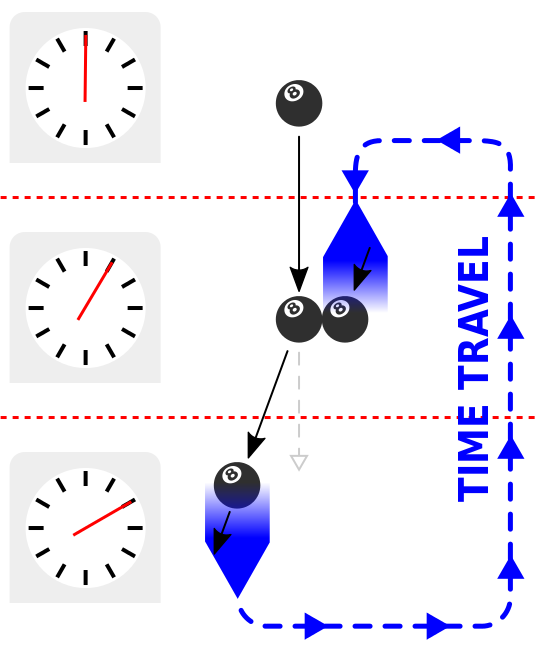 All possible paths of a billiard ball entering a wormhole later (bottom, in graphic at right) would in fact, upon exiting the wormhole earlier (top), nudge itself into the mouth of the wormhole later, thus completing the causal tautology, or what physicists call the closed-timelike curve. These days, quantum physicists use the idiom of “post-selection”—a kind of informational-causal Darwinism which ensures that the only information that survives its journey into the past is information that does not foreclose its origins in the future.
My book Time Loops touches lightly on the physics of time-traveling billiard balls and quantum informational reflux into the past, but it delves mainly into the psychodynamic principles governing time-traveling information in our tesseract brains. It is no coincidence, I think, that the associative laws of the unconscious work so nicely to prevent paradox in beings who are subject much more than we know to premonitions and who are constantly guided by a kind of presentimental orientation toward future rewards. The unconscious, I suggest, is just ordinary conscious thought displaced in time. Paradox is prevented by the very nature of the rules that allow information to reflux into the past, specifically the limitations on making that refluxing information meaningful as opposed to noise.
Dreams offer the best example for what I’m talking about. A typical precognitive dream is an oblique and indirect associative halo around some future experience or train of thought; its exact relationship to that experience or train of thought only becomes clear in hindsight. There are apparent exceptions: more obvious premonitions that may even be almost “video-quality” in their transmission backward of some future scene (I believe this is exactly what sleep-paralysis episodes and “out of body experiences” may in fact be*); but even in those cases, the “metadata” of the transmission is always lacking: the when, where, and how, as well as the meaning, or how the event fits into the ordinary course of life. One way or another, the information that arrives from the future in dreams and altered states is garbled or incomplete and thus cannot be used to foreclose the inciting experience.
Could the laws preventing billiard balls from interfering with themselves in wormholes offer us a new way of thinking about the processes of distortion in dreams?
Irma’s Injection
The mechanisms that control the back-flow of information in the tesseract brain are probably not as picturesque as spacetime-bending wormholes—I suggest they probably will turn out to have something to do with quantum computation controlling brain plasticity (the constantly updated strengths of neural connections). But whatever the ultimate explanation, the principles are similar: Our future conscious thoughts interfere with us in the present and deflect us just the right way so we end up having those future thoughts at just the right time, creating time loops in our lives.
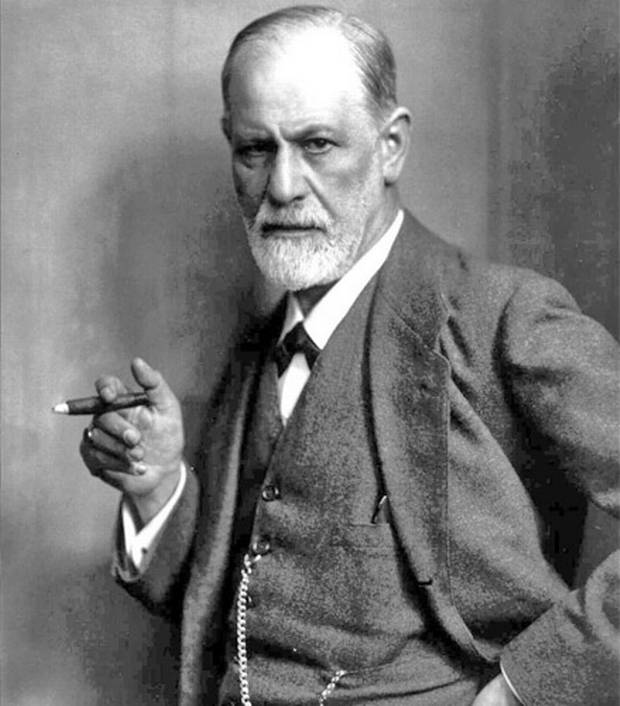 The best example of this happens, not coincidentally, to be one of the most famous and influential dreams in history: Freud’s “specimen dream” about “Irma’s Injection” in Chapter II of The Interpretation of Dreams. I discuss this dream at length in my book, but the short version is this: In 1895, Freud dreamed he was examining a patient and childhood friend of his, Anna Hammerschlag, whom he gave the name “Irma” to protect her anonymity. In real life, Anna’s problems were purely psychological (“hysteria”), but when Freud’s dream-self looked inside her mouth, he saw a white patch and scabs on her cheek and palate and a feature that should only have been visible in the nose. It was hard to get her to open her mouth—she acted like a woman shy because of wearing dentures. He summons a trio of physician friends to have a look—they poke and prod and pompously mansplain, like stereotypical Victorian doctors—and lastly Freud’s dream-self concludes that what caused Irma’s oral malady was an injection administered thoughtlessly, with a dirty syringe, by one of those friends, his family pediatrician, whom he gave the pseudonym “Otto.”
After free-associating on this dream’s various elements, Freud concluded that the “latent dream thought” embedded in this tableau was a wish that he be innocent of any failures or malpractice in his treatment of Anna (malpractice was going around in his medical circle at the time) and that Otto instead be the one at fault for the fact that, in real life, his friend Anna had not improved despite his psychoanalytic treatment. It was this dream that led Freud to the famous, controversial conclusion that all dreams are the disguised fulfillment of repressed wishes.
In 1982, a Brazilian psychoanalyst and cancer surgeon named Jose Schavelzon noticed something amazing: The precise symptoms displayed in dream Irma’s mouth matched the progression of oral cancer that Freud himself suffered nearly 3 decades later: a white patch, followed by scabs in the aftermath of increasingly invasive surgeries and radiation treatments; surgeons had to remove part of his jaw and palate, which exposed his nasal cavity to view inside his mouth—it would have exposed precisely the feature he thought he could see in “Irma’s” mouth. It became hard for Freud to open his mouth once a denture-like prosthetic was fitted, and he could only barely talk for the last decade and half of his life. The “Irma dream” seems, in other words, like a premonitory dream about the grave illness that severely impeded Freud’s quality of life in his old age.
The premonitory nature of this dream has been discussed by other writers such as Robert Moss and Larry Dossey, but I think we should go farther: This dream needs to be re-read as representing/dramatizing a set of conscious thoughts (and wishes) Freud would have had in 1923, following his cancer surgeries, rather than “unconscious” wishes belonging to the year 1865 when he had the dream.
When bad things happen to good people, even good people may find themselves wishing the bad thing had happened to someone else. We have no proof, obviously, but Freud’s thoughts in 1923 and later may well have included a vague wish that someone else and not him might suffer the awful cancer and brutal surgeries he was enduring. In any case, we can be quite confident that his thoughts at this point in his life would certainly have included a self-reproach for not following the urging of his best friend Wilhelm Fliess (another in that physician trio), who in 1895 had been trying get him to quit smoking his cigars for the sake of his health. In fact, Freud had just relapsed from a short period of abstinence just before having the dream and was specifically worried what his friend would say—this may have even sparked the temporal “short circuit” with his later situation. That situation was caused, one will note, by something symbolically very like a “dirty syringe.” Freud’s dream-self reproaches his patient “Irma” with the very words he might have consciously directed at himself: “You know, it’s really only your own fault.”
Most importantly, I argue, Freud could not have been blind, in 1923, to the similarity between what was happening in his own body then and the symptoms Irma had displayed in the dream 28 years earlier that wound up putting him on the scientific map. Thus, his thoughts would have returned to that dream and included a wish that he had been correct that dreams (especially that one fateful dream) are really “just” wish-fulfillments and not premonitions of future events. That dreams could predict the future was a common folkloric belief that, throughout his career, he took every opportunity to disclaim and debunk, but how could this coincidence not have unsettled that outward certainty? Wishing he was right about dreams being just wishes would effectively wish away his cancer as well as put himself above any professional reproach for having misled the world about the meaning of our dreams.
It is precisely the kind of situation Freud found himself in in following 1923—surviving, but at a cost—that precognitive experiences typically focus on. Dreams seem to navigate us through perilous shoals in life, ironic and unsettling ordeals (usually much more minor ones) where we come out the other end changed and, typically, humbled.
Psychic 8-Ball
How do wormholes fit in to all this? Remember that time-traveling billiard ball, deflecting the path of its earlier self so that it nudges itself into the wormhole, completing the loop. Freud noted that dreams commonly saddle others with our own unwanted predicaments and “give” thoughts we don’t want to acknowledge having to other people in our lives. This fact has been noted again and again in other dream theories, but Freud’s theory explicitly framed it in terms of “defense mechanisms” such as projection and displacement. The unacceptable thought struggling to be expressed is deformed and sent off course by a kind of “psychic” (in the older sense of the term) force field, a kind of deflection.
 By the laws of self-consistency and post-selection, Freud’s dreaming brain saw fit to deflect his symptoms onto someone close enough to him to be highly salient. (In Time Loops, I discuss various reasons why his friend Anna Hammerschlag fit the bill), but in such a way that its premonitory nature would not and could not have occurred to him … until it was too late. One of Freud’s biographers noted that various other maladies of dream Irma and discussed by the physician trio were actually Freud’s own illnesses at the time he had his dream—rheumatism, intestinal issues, etc.—so their inclusion in a bundle with his later cancer makes perfect sense.
In short: Freud’s most famous dream was like a billiard ball sent back to his younger self by his 68-year-old brain. The big 8-ball in his life that deflected him onto being the great pioneer of the new method called psychoanalysis was itself a wish from his future self that he’d done a few things different when he was younger, including being less adamant that dreams were only disguised fulfilments of repressed wishes. It was a corner he could not back himself out of. This is why I say that it was “not coincidental” that his most famous and significant dream happened to center on the most grave circumstance of his later life: It had to be a particularly powerful and significant shot to deflect him in just the right direction, that many years before.
There are many other looping dimensions to this dream—it’s a veritable temporal-biographic clusterfuck, and you’ll need to read Chapter 9 of my book for all the amazing details. And it couldn’t really have been clearer than it was. Freud could not have had a crystal-clear (or video-quality) premonition of his own cancer that terrified him into quitting smoking, because then he wouldn’t have gotten cancer, and thus wouldn’t have had the dream. His dream, and in some sense his whole career—indeed his “immortality”—depended on that outcome, and the specific ways in which he misinterpreted it from his younger vantage point.
A principle could be formulated here: Our blindness to our precognitive nature is what leads us to having the experiences our dreams precognize. There are still many open questions: Is it the message itself that is distorted in its backward temporal passage, or is it our conscious interpretation of those pieces of mail from our future self that distorts their message? In other words, is the dream itself a misinterpretation of a clear retrograde signal or is the signal itself distorted in its backward passage, or both?
Jacob’s Bum Hip
In artistic and critical contexts, the defense mechanisms that protect the ego by deforming our thoughts and actions are sometimes called tropes, “turnings,” or what Harold Bloom calls swerves. These are good terms: Instead of having a dangerous realization, our thoughts deviate onto a safer path, and we only feel a troubling anxiety, like our hair standing on end from a nearby electric field. It is not an accident that Freud’s famous time-traveling archetype Oedipus walked with a limp—in fact, it’s the etymological meaning of his name (“swollen foot”). Like a shopping cart with one stuck wheel, the dreaming self swerves in its avoidance of thoughts that will cause trouble (thoughts like Freud’s famous “wanting to sleep with your mother”). On its own, the mind wants to go in circles of rationalization and denial rather than press forward into uncharted and dangerous territory. This is the repetitive, “orbiting” behavior of the neurotic symptom.
It so happens that one of the most famous Biblical dreamers, Jacob, also swerved, because of a dream. I’m not referring to his famous dream of angels ascending and descending a ladder to heaven. The more decisive episode in this trickster-shaman’s life is his all-night wrestling match on his return trip from Canaan, with a shadowy, silent figure on the banks of the river Jabbok.
The same night he arose and … crossed the ford of the Jabbok. … And a man wrestled with him until the breaking of the day. When the man saw that he did not prevail against Jacob, he touched his hip socket, and Jacob’s hip was put out of joint as he wrestled with him. Then he said, “Let me go, for the day has broken.” But Jacob said, “I will not let you go unless you bless me.” And he said to him, “What is your name?” And he said, “Jacob.” Then he said, “Your name shall no longer be called Jacob, but Israel, for you have striven with God and with men, and have prevailed.”
 Rule #1 of myth interpretation is that any ordeal that “lasts all night” and ends with the sunrise is referring to a dream. Jacob encountered and struggled with what he thought was God in his dream. Was it God or was it his own future self? Could the former not be our misrecognition of the latter? Philip K. Dick suggested this, and so did precognitive-dream pioneer J. W. Dunne, for whom our dreaming higher consciousness was equivalent to the God of the mystics. Whoever Jacob wrestled with, it left him with a limp.
Again, it may be that we misrecognize our own future experiences and thoughts and wishes in our dreams, and thus take oblique and even mildly self-destructive paths in our lives, precisely to the extent that we cannot recognize ourselves in them and still remain self-consistent. Moreover, our swerves to avoid self-recognition, the defense mechanisms that distort our reasoning (the debased modern word, infected with an arrogant scientism, is “bias”) may be the more extreme the more our fate is spectacular. The patriarch Jacob’s fate was highly significant—he assumed the name “Israel” after this dream, after all—and his displacement by his backward-traveling-billiard-ball future self felt like no less than a struggle with the Creator. Freud’s fate was spectacular too—I would argue, deservedly so, despite many missteps and mistakes along his path—and his defensive swerving was also spectacular and multidimensional, as I show in my book. But we all have it in us to be pioneers in exploring and laying claim to our own country. We all have it in us to be Jacobs.
How do you claim ownership of your life? Go back to your dreams, the ones you have never forgotten and may even have written down, yet naturally imagine could not have any relevance to little you, right now, today. I have found not only in my study of famous writers’ dreams but also in my own humble dream life that the “biggest” dreams, the ones that might even have inspired us in a decisive course of action or study, often reach across years of our lives; they were big precisely because they have to do with the ways we return to them or reflect on them much later. Your initially unrecognized reflection may seem especially huge and symbolically complex in an old dream, like looking at yourself in a parabolic mirror.
Look at your old dreams again with new, Freudian eyes, but leave aside Freud’s defensive admonition that dreams never show us our future. He was right about their characteristic swerves, but he was wrong in denying their time-defying character.
The Question
The reality of precognition in our lives (a constant reality, I argue, to which occasionally noticed precognitive dreams gives just a taste) offers a totally new way of looking at the basic question Freud posed most clearly for our time: Why do we know ourselves so poorly? What accounts for the vastness of our un-conscious? If we are getting glimpses of our future, shouldn’t we know ourselves better?
 Maybe the whole question of self-knowing is wrong, or wrongly posed. Freud operated within the classical assumption of the mind as a mirror of the world. It goes by many names—representationalism, for one—but the basic assumption was that ideally the mind should reflect reality, including the pre-existing reality of who we ourselves are. To explain our foibles and irrationality, Freud appealed to our baser instincts and desires that were incompatible with our socialized egos. In our repression of facts we don’t want to face about ourselves, we distort that mirror … and it ends up distorting everything else along with it.
But as Richard Rorty argued in his now-classic Philosophy and the Mirror of Nature (in a perhaps unconscious transmission of the sixth Zen patriarch Hui-Neng, whose two-word version was “What mirror?”), maybe that mirror itself is the problem. Modeling knowing on the eye and what it apprehends led to many unproductive assumptions about the mind, including the idea that there is some knowable essence that we get wrong, or misrepresent, and thus that there is a truth lying behind these distorted appearances. Rorty, a pragmatist-deconstructionist, sees this all as a kind of smokescreen distracting us from grasping thinking as something we do, with other people (an extension of communicating). One of the things we do, I would add, is discover ourselves, discover who we are, at every moment. And as I argued in my last post (and in Time Loops), what if that discovering is simultaneously our own making, in our past?
What if there’s no “truth” about ourselves, precisely because we always arrive at a truth that is its own making? What if our entire substance is swerves (or loops)?
What Freud called the unconscious is really that portion of our consciousness (or our cognition) that happens in our future, and that inflects our actions and bends our interpretations in the present (including future memories, future discoveries about the moment we are living through right now). At every moment, we are Jacob on the shore of the Jabbok, wrestling with a presence that is unrecognized and unknown—our own future self. In Interstellar, “Coop’s” future self tries to warn his younger self against going on a mission that involves traveling through a wormhole, but obviously that won’t work. What happens instead is that his messages are understood from the wrong point of view, the point of view of his ignorant younger self. He is the billiard ball that deflects a younger version of himself into the wormhole, quite literally.
This is our predicament: We are always ignorant of the future that is inflecting us. The only times we aren’t is when that future is unavoidable.
When we see our behavior at every moment as a compromise our outcome of efficient causes “pushing” from our past and refluxing thoughts from our future deflecting or swerving us, we see ourselves in a different light, and even may get a new, philosophical distance on age-old, unproductive hangups like whether or not we possess free will. In the Glass Block Universe, our field of “freedom” is not our future; it is our self-creation in and of our own past, the simultaneous discovery and creation of who we always were.
NOTES
* Episodes of sleep paralysis, I have come to suspect strongly (as a lifetime sufferer), are lucid dreams in which you vividly and realistically precognize being awake in bed a few minutes later. You may see your surroundings just as they are in real life, as though your eyes are open, but in fact, those experienced with sleep paralysis may note that in fact their eyes are not open even though they seem to see their room, etc.—hence the incorrect belief that you are awake and paralyzed, rather than still sleeping but lucidly precognizing a future awake situation. You feel frustrated and terrified at your inability to move, and the confused sleeping brain may interpret this as a malevolent possession or inhibition (e.g., being sat on by an “old hag” in some folkloric contexts). My hunch is that the intense terror arises from the semi-lucid brain’s maddening inability to control the body from a temporal vantage point in the visual stimulus’s past.